
Florida CDL Practice Test
$69.00
- Buy to unlock unlimited access to all Quiz questions.
- After purchase you can print a PDF of the whole quiz at any point. The PDF will contain the questions and the correct answers.
About this Exam
This study guide and preparation article is designed for all aspiring commercial drivers in the state of Florida. To operate commercial vehicles like large trucks, passenger buses, or tankers, a Florida Commercial Driver's License (CDL) is legally required.
The process of obtaining your CDL is a multi-stage path, starting with crucial knowledge tests, and this guide frames your successful journey around diligent study and effective practice methods. Whether you aim for an intrastate career or interstate transport (requiring you to be at least 21), understanding the exam components and practicing thoroughly is the key to success.
Our goal is to equip you with the essential information to approach the Florida CDL General Knowledge and endorsement tests with confidence. Consistent and focused effort, including the regular use of valid Florida CDL practice tests, is your most effective tool for passing these initial written exams and moving towards the required commercial learner's permit and eventual skills assessment.
Ready to test your knowledge?
Buy Now to Access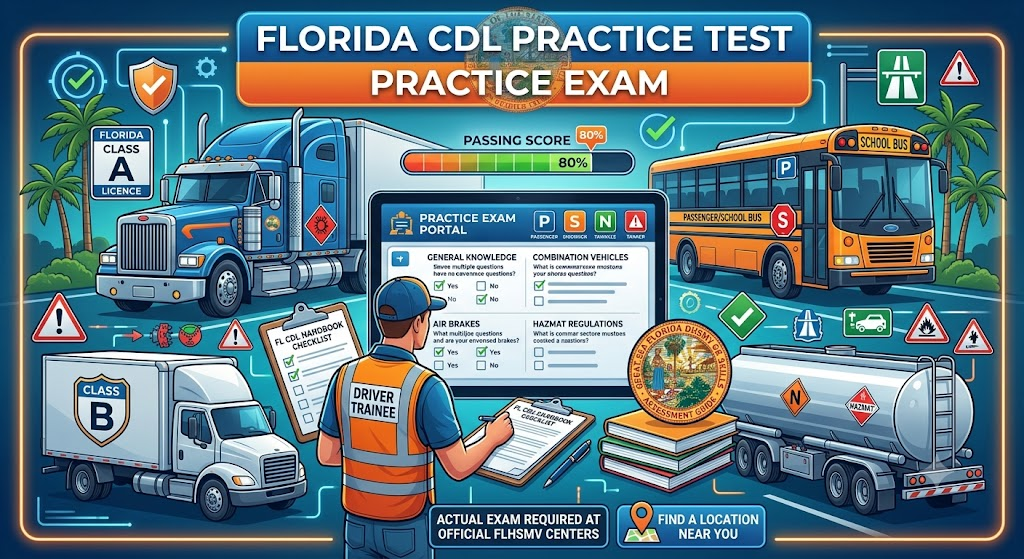
Additional Information
What the Course Entails and Exam Details
Your comprehensive preparation for the Florida CDL doesn't involve a single "course" but a structured process of self-study and potentially organized training. The primary written requirement is the General Knowledge test, which is mandatory for all CDL applicants. This test covers fundamental safety and operational rules for all large vehicles.
Beyond the General Knowledge exam, you will likely need to take one or more endorsement knowledge tests, depending on the specific type of vehicle you intend to operate and the cargo you will be hauling. These specialized endorsements include:
Air Brakes: Necessary for operating vehicles with air brake systems.
Combination Vehicles: Required for Class A licenses and specific tractor-trailers.
Hazardous Materials (Hazmat): Requires passing a knowledge test, a background check, and paying additional fees to transport placarded quantities of hazardous materials.
Passenger Endorsement: Required to operate vehicles designed to transport 16 or more people, including the driver.
Tanker Endorsement: Required for operating vehicles designed to transport liquid or gaseous materials in bulk tanks.
School Bus Endorsement: Necessary to drive a school bus, requiring both knowledge and a skills test.
Doubles/Triples Endorsement: Required to operate combination vehicles with multiple trailers.
The overall knowledge assessment tests your understanding of traffic laws, vehicle equipment, safe driving practices, cargo handling, and emergency procedures specific to Florida and general commercial operations.
What to Expect in the Final Exam
The Knowledge portion of the Florida CDL exam is not just one test but a combination of several, all administered in a multiple-choice format at a Florida Highway Safety and Motor Vehicles (FLHSMV) location. Here is what you can expect:
General Knowledge Test: Typically consists of 50 comprehensive multiple-choice questions. The exam usually has a 1-hour time limit. To pass, you must achieve a minimum score of 80%, which translates to correctly answering at least 40 of the 50 questions.
Endorsement Tests: Each endorsement has its own knowledge test with a distinct set of questions, generally in the range of 20-30 multiple-choice questions per endorsement. They also have time limits and require a similar 80% passing score. You only need to pass the endorsements required for your intended CDL class and operation.
You will need to pass the General Knowledge test first to receive your Commercial Learner's Permit (CLP). You may also take and pass endorsement knowledge tests at that time or later. Once you have held your CLP for at least 14 days and completed the entry-level driver training (if required), you will need to successfully pass the detailed CDL skills test, which includes a vehicle inspection, basic control skills, and an on-road driving evaluation.
How to Study and Exam Centers
Preparation is the cornerstone of your commercial driving ambition. The main source of information is the official Florida Commercial Driver License Manual, which can be found online or at FLHSMV offices. Study this handbook thoroughly, section by section.
In addition to your manual, actively and repeatedly using relevant Florida CDL practice tests is a highly recommended and proven strategy. These practice tests help you:
Become familiar with the question formats and terminology.
Identify areas where your knowledge is lacking.
Reinforce critical information and memory retention.
Manage test-day pressure.
Create a consistent study schedule, use flashcards, and practice with these test-style questions frequently. Focus extra time on challenging topics like Air Brakes or Hazmat regulations.
Exam Centers and Process: All CDL knowledge assessments must be taken in person at an authorized FLHSMV location. Not every FLHSMV office provides commercial licensing services, so it is crucial to use the official Florida website (GoRenew.com or the main FLHSMV site) or call (850) 617-2000 to find a designated center near you. Appointments are highly recommended and often required for testing. When scheduling or visiting, you will also need to present proof of identity, social security number, Florida residency, and a current medical certification (DOT health card).
Job Opportunities from the Course
Successfully obtaining your Florida CDL opens doors to a wide and dynamic array of career paths within the essential transportation industry. Depending on your license class and endorsements, your potential job titles could include:
Over-the-Road (OTR) Truck Driver (Class A)
Regional Truck Driver
Local Delivery Driver (Class B or C)
Dump Truck Operator
Passenger Bus Driver (City, Charter)
School Bus Driver
Tanker Driver
Hazardous Materials (Hazmat) Driver
Heavy Equipment Transporter
Construction Vehicle Operator
The demand for qualified commercial drivers in Florida and across the nation remains high, offering stable employment, various specialization options, and opportunities for growth and good earning potential.
Frequently Asked Questions
Reviews
5.0
Based on 0 reviews
Leave a Review
No reviews yet. Be the first to review!