
Firefighter Certification Practice Test & Exam Prep
$69.00
- Buy to unlock unlimited access to all Quiz questions.
- After purchase you can print a PDF of the whole quiz at any point. The PDF will contain the questions and the correct answers.
About this Exam
The journey to becoming a certified firefighter is both challenging and rewarding. It requires a distinct blend of physical ability, quick thinking, and a robust understanding of fire science and rescue techniques. This certification is the professional standard for entry into this critical career. It demonstrates your readiness to handle the demanding and often hazardous tasks of the job. For aspiring firefighters and dedicated students preparing for this pivotal step, leveraging comprehensive study guides, practice tests, and exam preparation materials like the Firefighter Certification Practice Test & Exam Prep is absolutely essential. This complete guide provides an essential overview of what to expect and how to excel, ensuring you approach test day with clarity and confidence. The first step toward your rewarding future in fire service begins here.
Ready to test your knowledge?
Buy Now to Access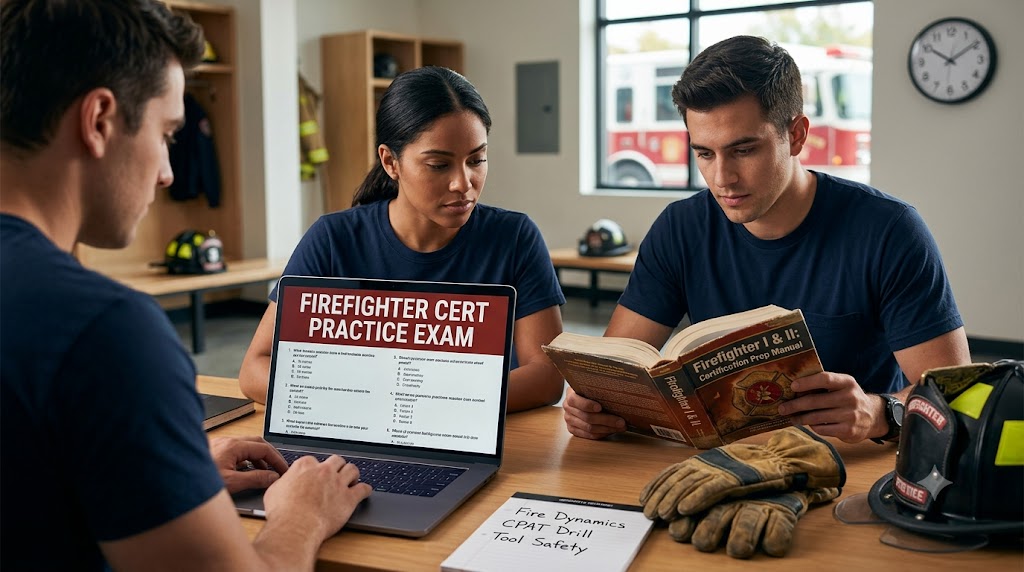
Additional Information
What to Expect in the Final Exam
The final exam process for firefighter certification is
notoriously rigorous and multi-faceted, reflecting the real-world demands of
the profession. You should anticipate a testing environment that values
knowledge, skill, timing, and composure. While specific details will depend on
your local and state standards, here is what you can generally expect:
The Written Examination:
- Format:
Typically a series of standardized multiple-choice questions, ranging
anywhere from 100 to over 200 items. These questions are designed to test
your knowledge across the entire curriculum outline.
- Duration:
Candidates will generally have a specific time limit, often around 2 to 3
hours, to complete the written portion.
- Passing
Score: Most jurisdictions require a minimum passing score, often in
the range of 70% to 80% on the written exam, though this can vary.
- Topics:
Questions will cover the foundational theory outlined in Section 2,
including fire behavior, safety, equipment, communications, building
construction, medical basics, and relevant laws/standards.
The Practical/Physical Examination:
- Format:
This section is distinctly separate and is a critical part of the overall
assessment. It usually includes a Candidate Physical Ability Test
(CPAT) or a equivalent timed physical agility assessment that
simulates common firefighting tasks (e.g., stair climb with hose,
equipment carry, ladder raise and extension, search, forced entry, rescue
drag, and hose advance). Some programs may also have distinct Skill
Stations where candidates are evaluated on specific, practical skills
like tying knots, donned gear properly, or operating an SCBA, requiring a
very high standard of proficiency (often 100% success on all tasks within
specific time frames).
- Scoring:
Physical ability tests are typically pass/fail, and skill stations require
successful completion within specific constraints and steps.
- Time
Constraints: The physical ability test has strict, pre-determined time
limits for individual tasks and the overall sequence. Skill stations also
have defined time frames.
- Rules
& Conditions: Safety protocols are strictly enforced. All parts of
the exam must be completed within the rules. Failure to successfully
complete a single component of the practical exam may result in overall
failure, depending on the program's rules. Candidates will be required to
wear specific attire and personal protective equipment for physical and
skill tests. Identification is mandatory for both portions of the test. No
electronic devices, cell phones, or study materials are typically allowed.
How to Study and
Exam Centers
Preparation is the cornerstone of success for your
firefighter certification exam. Developing a strategic study plan and knowing
where to take your tests is essential.
Actionable Study Strategies:
Master the Textbooks: The fundamental knowledge is
laid out in designated textbooks (e.g., IFSTA Essentials of Fire Fighting
or Jones & Bartlett Fundamentals of Fire Fighter Skills). Read these
cover-to-cover and dedicate significant time to understanding key concepts,
definitions, procedures, and safety rules.
Take Comprehensive Practice Tests: Utilize
high-quality practice exams and question banks, such as the Firefighter
Certification Practice Test & Exam Prep, to simulate the actual written
exam. These resources help you identify knowledge gaps, practice time
management, and become familiar with the types of questions and formatting
used. Focus on understanding why a correct answer is right and why the
other options are wrong.
Create Flashcards & Study Guides: Condense
critical information into flashcards for key terms, definitions, equipment,
safety protocols, and medical procedures. Develop your own detailed study
guides, highlighting the most important concepts from your textbook and
classes.
Practice Physical Training: Do not underestimate the
intensity of the physical ability test (CPAT/Agility Test). Create a specific
workout regimen that mimics the tasks involved, focusing on strength,
endurance, agility, and cardiovascular conditioning. Safely practice specific
tasks like climbing stairs with added weight or dragging an object. Many
academies offer practice sessions or orientation days for these physical tests.
Form a Study Group: Collaborate with fellow
candidates to discuss challenging topics, quiz each other, and practice
practical skills together. Explaining concepts to others is an excellent way to
reinforce your own
understanding.Review Practical Skills Constantly:
Utilize any opportunity during training or on your own time to physically
practice essential skills until they become second nature. Donning personal
protective equipment (PPE) and self-contained breathing apparatus (SCBA),
deploying hoses, carrying ladders, and tying knots should be practiced
regularly and correctly.
Exam Centers and Location:
Firefighter certification exams, both written and
practical/physical, are typically administered and coordinated through specific
bodies.
- State
Fire Academies / Regional Training Centers: These are common locations
for both written testing and physical/practical assessments.
- Local
Fire Departments / Training Facilities: Large departments may run
their own certification processes or act as testing sites for a regional
area.
- State
Fire Marshal's Offices: This office often oversees and schedules the
certification process for the entire state, directing candidates to
various authorized testing locations.
- Authorized
Community Colleges or Educational Institutions: Some academic
institutions with fire science programs are authorized testing sites.
- Online
Proctoring / Specialized Test Centers (for written only): In some
cases, the written component might be administered through a designated
third-party testing service like Pearson VUE at their professional testing
centers or through approved online proctoring platforms. However, the
practical and physical parts are almost always completed in person at a
fire service training facility.
To find your specific exam center and register for the test,
you must contact your authorized training instructor, local fire academy, or
your State Fire Marshal's office directly, as procedures and locations vary. Be
sure to understand registration deadlines and any fees associated with the
examination.
Job Opportunities
from the Course
Earning your firefighter certification unlocks a rewarding
career path with diverse potential roles. This credential is the professional
foundation for entry-level firefighting positions and is highly valued by fire
service employers. A clear and informative list of common job titles and career
paths this certification enables includes:
- Career
Firefighter (Municipal/County): Joining a career fire department,
responding to structural and other fire emergencies, medical calls, and
rescue operations in urban or suburban areas.
- Volunteer
Firefighter: Serving your local community as a trained and certified
responder in a volunteer department. (Certification is often required or
highly desirable even for volunteer roles).
- Industrial
Firefighter: Working in private sector industrial settings such as
refineries, factories, power plants, or airports to prevent and respond to
fires and hazardous incidents.
- Wildland
Firefighter (with appropriate specialized wildland certs often required in
addition): Combatting vegetation fires in forests, grasslands, and
rural areas (certification details and physical requirements can differ).
- Airport
Firefighter (with specific aircraft rescue and firefighting - ARFF
training often added): Specializing in aircraft rescue, fire
suppression, and first aid at commercial and regional airports.
- Rescue
Technician (with advanced certifications often needed): Pursuing
specialized training in areas such as hazardous materials (Hazmat),
technical rescue (trench, structural collapse, high-angle), or swiftwater
rescue.
- Fire
Inspector / Fire Prevention Specialist (often with additional
certification and experience): Investigating fire origins, conducting
fire code inspections of buildings, and educating the public on fire
safety.
- Fire
Investigator (often requires significant experience and specialized,
advanced certifications): Analyzing fire scenes to determine the cause
and origin of fires, collecting evidence, and documenting findings.
- Fire
Service Leadership Roles (long-term career path, requiring extensive
experience and education): Progressing through ranks to become a
Lieutenant, Captain, Battalion Chief, Assistant Chief, or Fire Chief,
managing personnel, training programs, and entire fire department
operations.
Your firefighter certification is a critical prerequisite
for almost all of these rewarding career paths.
Prepare diligently, embrace the challenges, and step
confidently into your future in the fire service.
Frequently Asked Questions
Reviews
5.0
Based on 0 reviews
Leave a Review
No reviews yet. Be the first to review!