
Fire Rescue Practice Test & Exam Prep | South Africa
$69.00
- Buy to unlock unlimited access to all Quiz questions.
- After purchase you can print a PDF of the whole quiz at any point. The PDF will contain the questions and the correct answers.
About this Exam
Embarking on a career in fire and rescue in South Africa begins with obtaining the necessary certifications and passing crucial entry exams.
These assessments are designed for dedicated individuals who aspire to join municipal fire services, private emergency organizations, or specialize within the field.
Successfully navigating this process validates your knowledge, skills, and physical readiness to protect lives and property across diverse communities.
It is a demanding but incredibly rewarding path for those committed to public service and safety.
Ready to test your knowledge?
Buy Now to Access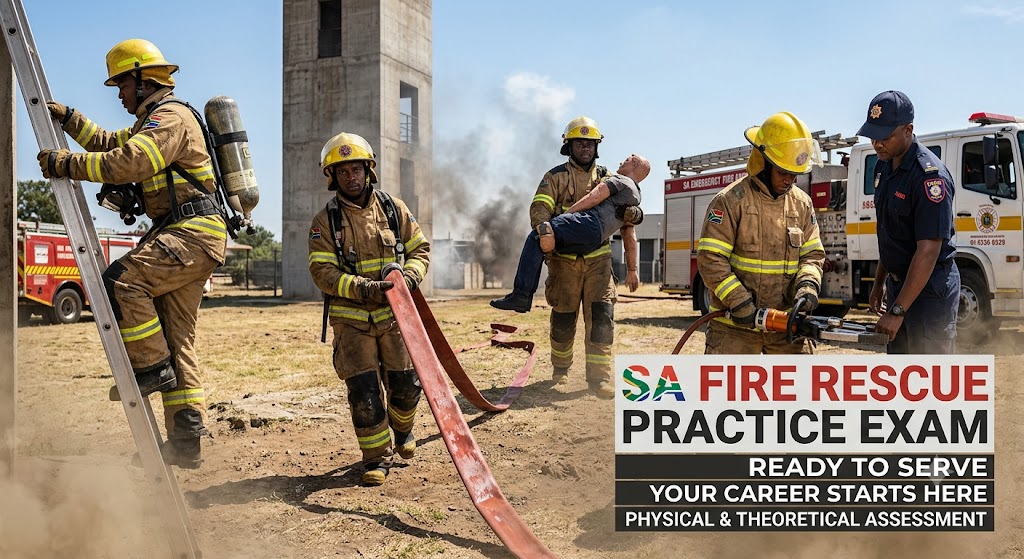
Additional Information
What the Course Entails and Exam Details
Fire rescue training programs in South Africa cover a vast
and critical range of topics, often adhering to international standards like
the NFPA (National Fire Protection Association) while incorporating specific
local protocols and legislation.
Prospective firefighters and rescue personnel can expect
comprehensive instruction in:
- Fire
Suppression Principles & Techniques: Understanding fire dynamics,
extinguishing agents, and various firefighting strategies for different
types of fires (structural, wildland, industrial, etc.).
- Equipment
Handling & Maintenance: Mastering the use and care of essential
tools, hoses, pumps, breathing apparatus (SCBA), and other specialized
gear.
- Rescue
Operations: Learning safe and effective methods for various rescue
scenarios, including vehicle extrication, high-angle rescue, confined
space rescue, and water rescue.
- Hazardous
Materials (Hazmat) Awareness & Operations: Developing the ability
to identify, assess, and safely manage incidents involving dangerous
substances.
- First
Aid & Basic Life Support (BLS): Acquiring vital medical skills to
provide initial care to victims before advanced medical help arrives,
often a requirement.
- Safety
Procedures & Risk Assessment: Prioritizing personal and team
safety in high-stress environments and learning to evaluate potential
dangers.
- Relevant
South African Legislation & Operational Protocols: Familiarizing
yourself with the legal framework and standardized procedures governing
emergency services within the country.
The exact curriculum can vary based on the specific
certification (e.g., Firefighter I, Firefighter II, various rescue specialties)
and the training provider, but these core areas form the foundation of most
accredited programs.
The exams then rigorously test competency across these
essential disciplines through both written and practical components.
What to Expect in
the Final Exam
The final assessment for fire rescue certifications in South
Africa is typically a multi-faceted process, demanding both mental acuity and
physical prowess.
You can expect:
- Written
Examination: This component tests your theoretical knowledge through a
series of multiple-choice questions, which may be subdivided into sections
assessing:
- Firefighting
theory and principles.
- Equipment
knowledge.
- Safety
protocols.
- Hazardous
materials information.
- Medical
knowledge (if applicable).
- Reading
comprehension, mechanical reasoning, and numerical reasoning (especially
for entry-level municipal exams).
Be prepared for scenarios requiring critical thinking and
application of learned concepts, not just rote memorization.
Some exams may also include short answer or essay sections
requiring detailed recall and explanation.
Expect substantial time limits (e.g., 2-3 hours) for the
written part.
- Practical
Assessment: This is a crucial and often the most demanding part of the
process.
It is a hands-on evaluation of your physical fitness,
strength, endurance, and technical skills.
Specific tasks can include:
- Rigorous
physical fitness tests (e.g., timed runs, beep tests, push-ups, sit-ups).
- Ladder
climbs and handling.
- Hose
dragging and rolling.
- Equipment
carrying over distances.
- Search
and rescue simulations in challenging environments.
- Proper
use of SCBA (Self-Contained Breathing Apparatus).
- Timed
skill demonstrations for specific rescue techniques.
The practical assessment is frequently conducted on a
pass/fail basis for key physical requirements, meaning failure to meet standard
scores in any section could result in overall failure, regardless of written
performance.
Strict adherence to safety and correct technique is
paramount during all practical tasks.
- Interview/Oral
Assessment: Depending on the context (especially for municipal job
applications), there might also be an oral interview to evaluate
communication skills, problem-solving, situational judgment, and
suitablity for the demanding nature of the role.
Passing scores vary significantly but are generally
demanding, with written exams often requiring 60-70% or more for qualification,
and practical assessments having strict, sometimes absolute, performance
standards that must be met.
Ensure you understand the specific passing criteria for your
particular exam and certification level.
Remember, this is not just a test; it's a verification that
you can safely and effectively perform critical duties.
How to Study and
Exam Centers
Effective preparation is key to success.
Combine consistent effort across multiple areas:
- Consistent
Physical Training: This is paramount.
Dedicate significant time to building overall fitness,
strength (especially core and upper body), endurance, and cardiovascular
health.
Train specifically for the types of tasks you will face
(e.g., running, stair climbing, carrying heavy loads).
Start early and be disciplined.
- Theoretical
Study: Thoroughly review all course materials, textbooks, and any
relevant guides.
Use accredited practice tests and quizzes repeatedly to
familiarize yourself with the question format, identify weak areas, and build
confidence.
Focus on understanding the why behind protocols and
procedures, not just the what.
- Hands-on
Skill Practice: If possible, gain hands-on experience through
accredited training providers, volunteer opportunities, or supervised
practice sessions.
Repetition builds muscle memory and confidence for the
practical assessment.
Seek feedback from instructors to refine your technique.
- Practice
for All Written Sections: Don't neglect non-firefighting sections
(e.g., mechanical reasoning, math, reading comp).
Dedicate time to practicing these skills using general test
prep resources if necessary.
- Time
Management & Test Strategies: Practice completing theoretical
questions within time constraints.
Learn to eliminate incorrect options and make educated
guesses when unsure.
For the practical exam, learn to pace yourself and maintain
focus under pressure.
- Maintain
Well-being: Get sufficient sleep, eat well, and manage stress in the
lead-up to the exam.
A healthy mind and body will perform best.
Exam Centers:
Fire rescue exams in South Africa are typically administered
at authorized training institutions.
These include:
- Municipal
Fire Services Training Academies: Each major municipality (e.g., City
of Johannesburg, Cape Town, eThekwini, Buffalo City) operates its own
accredited training center where entry exams for their fire services are
held, as well as various certification courses.
- SAESI
(South African Emergency Services Institute) Accredited Training
Providers: Numerous private and public institutions across the country
are accredited by SAESI to provide fire and rescue training and administer
associated exams.
Search the SAESI website or contact local emergency services
for a list of accredited providers in your province.
- Specific
Private Training Companies: Some specialized private entities offer
comprehensive firefighting and rescue courses that culminate in accredited
exams (e.g., EMCARE, Rescu-Life Africa, Kishugu Training).
To take an exam, you generally need to be enrolled in an
accredited course or apply through a specific municipal recruitment process.
Registration details, schedules, and specific locations will
be provided by the relevant training academy or municipality.
Ensure you are aware of all prerequisites (age, education,
driver's licence, etc.) well in advance.
Some private courses might offer exams directly, while
municipal applications involve multi-stage processes including screening,
testing, and training.
Job Opportunities
from the Course
Successfully achieving fire rescue certifications and
passing the necessary exams opens doors to dynamic and vital career paths
within South Africa.
Your qualifications could lead to roles such as:
- Firefighter
(at various levels, e.g., Learner, Junior, Senior) in municipal fire
services across towns and cities.
- Fire
Officer (Station Officer, Divisional Officer, etc.) within fire
services after gaining experience and further qualifications.
- Fire
Safety Officer: Specializing in fire prevention, inspections, code
enforcement, and public education.
- Hazmat
Technician: Dealing specifically with hazardous materials incidents.
- Technical
Rescue Specialist: Performing complex rescues (high-angle, confined
space, vehicle, etc.).
- Wildland
Firefighter: Protecting natural resources and communities from veld
and forest fires.
- Fire
Investigator: Determining the cause and origin of fires.
- Training
Instructor: Sharing knowledge and training future generations of fire
and rescue personnel.
- Emergency
Services Manager: Leading and coordinating emergency response efforts
in various sectors.
- Opportunities
may also exist within industrial fire teams, airports, private emergency
response companies, and conservation organizations.
Your dedication and continuous learning can pave the way for
advancement, specialization, and leadership within this essential field.
Preparing for and conquering the fire rescue exams in South
Africa is a demanding journey that requires significant dedication, physical
stamina, and theoretical knowledge.
By understanding the process, studying effectively, training
rigorously, and knowing where to go, you significantly increase your chances of
success and set yourself on a course for a meaningful career dedicated to
protecting others.
Frequently Asked Questions
Reviews
5.0
Based on 0 reviews
Leave a Review
No reviews yet. Be the first to review!