
FCLE U.S. Constitution and Bill of Rights Practice Test 2026
$69.00
- Buy to unlock unlimited access to all Quiz questions.
- After purchase you can print a PDF of the whole quiz at any point. The PDF will contain the questions and the correct answers.
About this Exam
The Florida Civic Literacy Examination (FCLE) is a computerized, high-stakes assessment mandated for students in Florida’s public postsecondary institutions, including both the Florida College System (FCS) and the State University System (SUS). First implemented to ensure graduates possess a foundational understanding of the principles that govern American society, this exam is a graduation requirement for all degree-seeking undergraduate students.
The test is designed for any student—regardless of major—who must fulfill the state's civic literacy competency requirement. It assesses an individual’s understanding of American democracy, the U.S. Constitution and Bill of Rights, foundational documents of the United States, and landmark Supreme Court cases and legislation that have shaped the nation’s legal and social landscape.
Ready to test your knowledge?
Buy Now to Access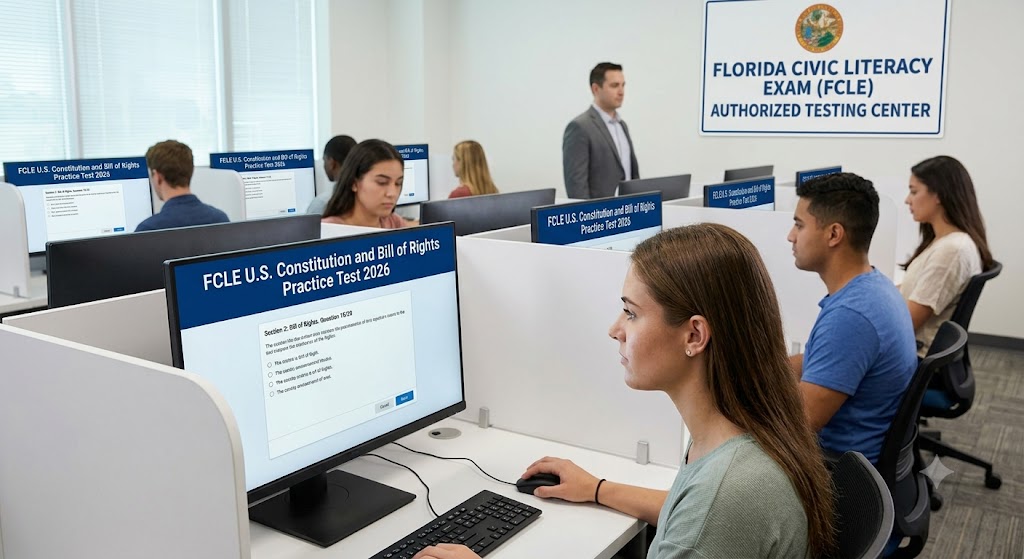
Additional Information
What the Course Entails and Exam Details
While the FCLE itself is a standardized assessment and not a "course," its content is directly tied to a specified body of knowledge. Many students prepare for the exam by taking the required civic literacy course, such as POS 2041 (American Government) or AMH 2020 (Introductory Survey Since 1877). The core competency area focused on in this guide—the U.S. Constitution and the Bill of Rights—is one of four key domains covered by the exam.
The FCLE consists of 80 multiple-choice questions, which are divided evenly across the four main domains (20 questions per domain). To demonstrate competency in the U.S. Constitution and Bill of Rights, you must understand the structure, function, and powers of the branches of government, the process of amendment, and the specific rights guaranteed to citizens, as well as their practical application.
The primary content areas of the FCLE are:
American Democracy (Basic principles and practices)
United States Constitution (Structure, application, and amendments)
Founding Documents (Declaration of Independence, Federalist Papers, etc.)
Landmark Impact on Law and Society (Supreme Court cases, legislation, and executive actions)
What to Expect in the Final Exam
The FCLE is a computerized, proctored test. You will not receive a numeric score; instead, your result will be reported as either "Pass" or "Fail."
Key exam specifications include:
Format: 80 computerized, multiple-choice questions.
Passing Score: A minimum of 60% is required to pass, which corresponds to correctly answering at least 48 out of the 80 questions.
Time Limit: There is no official time limit for the computerized platform itself, allowing you to work at your own pace. Most students complete the exam in approximately 60 to 90 minutes.
Retake Policy: If you do not pass, you are permitted to retake the exam. There is a required waiting period between attempts, typically seven (7) to fourteen (14) days, depending on the testing center's specific rules. There is generally no limit on the total number of attempts.
Identification: Proper government-issued photo identification (or an institutional ID) that matches your registration name is mandatory for entry. Prohibited items, including smart devices and sometimes scratch paper, are strictly forbidden in the testing center.
How to Study and Exam Centers
Preparation is the key to success on the FCLE. Start your study process early and utilize a variety of resources.
Actionable Study Strategies:
Review the Florida Department of Education (FDOE) Supplemental Guide: This official guide outlines all test competencies and is an essential roadmap for your studies.
Take Practice Tests: Actively engage with multiple-choice questions specific to the FCLE format. This guide’s focus on the U.S. Constitution and Bill of Rights is an excellent starting point.
Study Foundation Documents Directly: Read and summarize key parts of the U.S. Constitution (including all 27 Amendments), the Declaration of Independence, and select Federalist Papers.
Master Landmark Cases: Create flashcards for required Supreme Court cases, detailing the facts, the constitutional issue, and the Court’s decision and rationale.
Utilize University Resources: Many FCS and SUS institutions provide workshops, study guides, YouTube review videos, and tutoring services specifically for the FCLE.
Testing Centers and Registration: The FCLE is administered in a secure, proctored environment. You generally take the exam at the testing center of the Florida college or university where you are enrolled.
Registration: You must register in advance through your institution’s testing center portal. Note that registration is often non-refundable and may carry a reschedule fee.
Location: The test is usually taken in person on campus. However, some institutions may offer remote proctoring options (such as through Cambium), though these may carry additional proctoring fees.
Fees: Many institutions offer the initial FCLE attempt to their students at no cost, or for a minimal administrative fee. Retakes or testing as a non-student often incur a proctoring fee (e.g., $10-$35).
Job Opportunities from the Course
While the FCLE is primarily a graduation requirement and not a professional certification, the knowledge it validates—a strong grasp of American civic life and constitutional law—is invaluable in many career fields. Meeting this requirement is an essential hurdle for any student aiming for a degree from a Florida public postsecondary institution, opening the door to virtually any professional path that requires a college education.
Demonstrated civic literacy is particularly relevant and desirable for career paths including:
Public Administration and Government: For roles within local, state, or federal government agencies.
Law and Paralegal Services: Fundamental for those pursuing careers as attorneys, paralegals, or legal assistants.
Education: A requirement for many teaching certifications, particularly in social studies, history, and civics.
Law Enforcement and Criminal Justice: Essential for police officers, federal agents, and probation officers who must understand constitutional rights.
Non-Profit and Advocacy: Key for individuals working in community organizing, public policy, or civil rights advocacy.
Journalism and Communications: Critical for reporters covering political news, legal affairs, or government proceedings.
Frequently Asked Questions
Reviews
5.0
Based on 0 reviews
Leave a Review
No reviews yet. Be the first to review!