
FCLE Principles of Democracy Practice Test 2026
$69.00
- Buy to unlock unlimited access to all Quiz questions.
- After purchase you can print a PDF of the whole quiz at any point. The PDF will contain the questions and the correct answers.
About this Exam
The Florida Civic Literacy Exam (FCLE) is a computerized assessment designed to measure a student’s civic literacy knowledge.
This exam is a mandatory graduation requirement for all degree-seeking students first entering a Florida public postsecondary institution (college or university).
It is intended for students who need to demonstrate proficiency in American civics, ensuring they understand the foundational principles that shape our nation's history, government, and legal system.
Passing this test is a crucial step toward completing your degree and entering the workforce as an informed, engaged citizen.
Ready to test your knowledge?
Buy Now to Access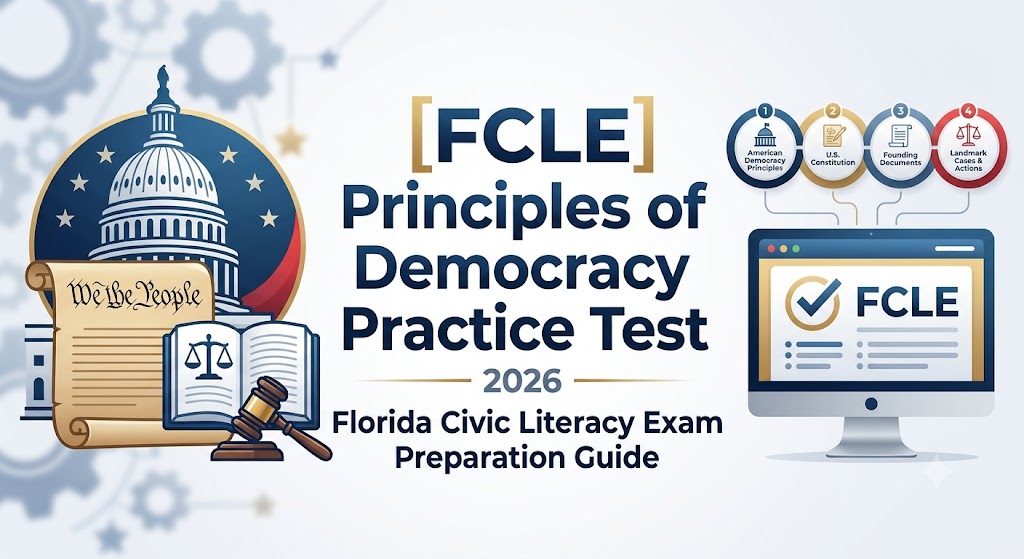
Additional Information
What the Course Entails and Exam Details
The FCLE does not correspond to a single, specific course, but rather measures knowledge across four core civic literacy competencies that are expected of every graduate.
The exam content is drawn from the following domains:
First, it covers the Understanding of the basic principles and practices of American democracy and how they are applied in our republican form of government.
Second, it tests your Understanding of the United States Constitution and its application to modern legal and societal issues.
Third, you must possess Knowledge of the founding documents and how they have shaped the nature and functions of our institutions of self-government.
Finally, it assesses your Understanding of landmark Supreme Court cases, landmark legislation, and landmark executive actions and their impact on law and society.
What to Expect in the Final Exam
The final FCLE is a computerized, closed-book examination administered in a controlled testing environment.
It consists entirely of 80 multiple-choice questions, distributed evenly across the four competency areas.
You will have a strict time limit of two hours (120 minutes) to complete the entire assessment.
A passing score is typically required to be 60 percent or higher, which means you must answer at least 48 of the 80 questions correctly to satisfy the civic literacy requirement for graduation.
There are no penalties for guessing, so it is in your best interest to answer every question.
How to Study and Exam Centers
Effective study for the FCLE requires active review of the primary sources and practice with the official formatting.
Your first step should be to utilize the official "FCLE Supplemental Guide and Sample Items" and the "Quick Review Guide" provided directly by the Florida Department of Education (FLDOE) on their website.
You should actively read the full text of primary founding documents, including the U.S. Constitution, the Declaration of Independence, and select Federalist Papers (such as No. 10 and No. 51).
Additionally, make flashcards for the landmark Supreme Court cases (e.g., Marbury v. Madison, Plessy v. Ferguson, Brown v. Board of Education) and significant legislation, focusing on their core holdings and long-term societal impact.
Candidates do not take the exam at a generalized center like Pearson VUE; instead, scheduling is handled directly through your specific Florida college or university’s testing center portal.
You must take the exam at your institution’s authorized physical testing center or a designated remote proctoring service if offered by your school. Be sure to check your institutional deadlines for completing this requirement well in advance of your graduation date.
Job Opportunities from the Course
Passing the FCLE is not a certification for a specific job, but rather an academic milestone that unlocks graduation.
A diploma from a Florida postsecondary institution, verified by this civic competency, is essential for pursuing professional roles.
However, the robust knowledge base required to pass the FCLE is highly valued and provides a competitive advantage in several fields:
Local, State, and Federal Government: Positions within legislative offices, administrative agencies, and civic planning departments.
Legal Professions: Essential foundational knowledge for legal assistants, paralegals, and court clerks.
Education: A prerequisite foundation for secondary social studies and history teachers.
Civic Engagement and Nonprofit Management: Roles focused on community outreach, policy advocacy, and public relations for advocacy groups.
Law Enforcement: Understanding the constitutional limits and responsibilities of public officers.
Journalism and Communications: Reporting on political, legal, and governmental affairs.
Frequently Asked Questions
Reviews
5.0
Based on 0 reviews
Leave a Review
No reviews yet. Be the first to review!