
FCLE Practice Test 2022 OLD
$69.00
- Buy to unlock unlimited access to all Quiz questions.
- After purchase you can print a PDF of the whole quiz at any point. The PDF will contain the questions and the correct answers.
About this Exam
The FCLE Practice Test 2022 OLD is a specific practice resource designed to help students prepare for the Florida Civic Literacy Exam. This exam is a postsecondary requirement for all students in the Florida College System (FCS) and the State University System (SUS), aimed at demonstrating proficiency in fundamental civic literacy principles. Established by Florida law, the civic literacy requirement ensures that students possess a functional understanding of U.S. history, government, and constitutional principles. Using this older version of the practice test allows students to review historical core content, though it is crucial to understand that the current FCLE may have updated question pools and focus areas based on modern educational standards. This guide focuses on preparing with the content from this 2022-era practice exam.
Ready to test your knowledge?
Buy Now to Access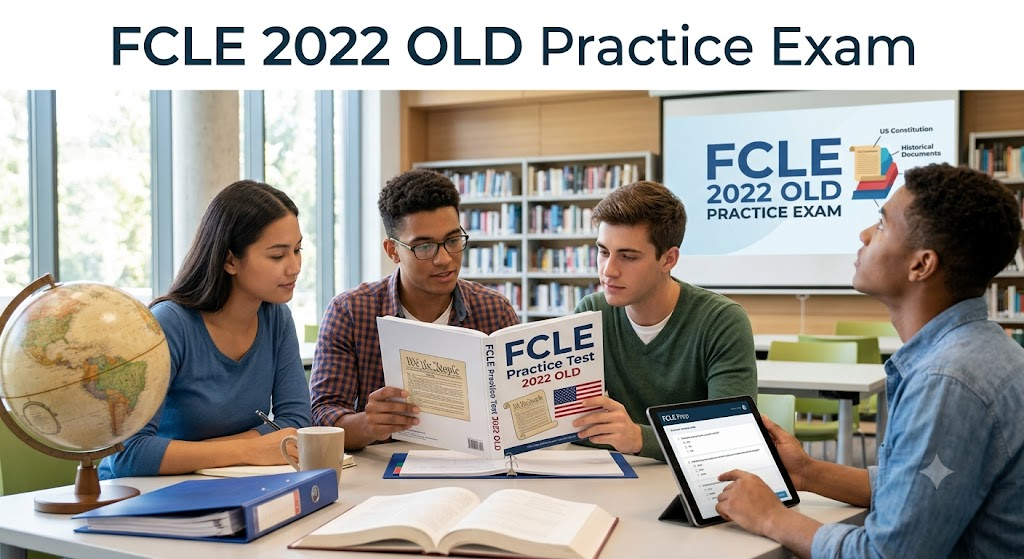
Additional Information
What the Course Entails and Exam Details
While not a single "course," preparing for the FCLE involves demonstrating knowledge across a spectrum of essential civic topics. The FCLE Practice Test 2022 OLD covers content aligned with four main competency areas:
Understanding of the U.S. Constitution: The structure of the government, the Bill of Rights, and the division of powers among the legislative, executive, and judicial branches.
Understanding of Historical Documents: Analysis of foundational texts such as the Declaration of Independence, the Federalist Papers, and landmark Supreme Court cases.
Impact of Constitutional Governments: Evaluating how the U.S. Constitution has shaped the government and protects individual rights over time.
Role of Citizens in a Democracy: The rights, responsibilities, and importance of active citizenship in the American system.
Historically, this specific exam version may have consisted of approximately 80 multiple-choice questions, and it was administered via a digital testing platform.
What to Expect in the Final Exam
When taking the full, proctored version of the Florida Civic Literacy Exam based on this structure, students can expect a specific format:
Format: The exam typically consists of multiple-choice questions. These questions range from direct recall of historical facts and document excerpts to applying constitutional principles to scenarios or interpreting source materials.
Passing Score: Students generally must achieve a passing score, which was commonly set at 60% for this requirement around that time, to demonstrate civic literacy competency. (Note: Check current state and institutional policies, as passing requirements can change).
Time Limit: There is typically a strict time limit for the exam, often around two hours, which requires effective time management to complete all questions.
Specific Rules: The FCLE is a formal, proctored assessment. This means it is often administered under controlled conditions. Prohibitions usually include the use of cell phones, unauthorized notes or materials, and any communication with others during the test session. Standard academic integrity guidelines apply.
How to Study and Exam Centers
Effectively preparing using the FCLE Practice Test 2022 OLD requires a strategic approach:
How to Study:
Utilize Primary Sources: Dive into the documents themselves. Read the full text of the U.S. Constitution, key amendments, and historical documents like the Gettysburg Address. Don't just rely on summaries; understand the context and language.
Take the Practice Test with Purpose: Treat this 2022-era practice test like the real exam. Time yourself. Afterward, review every incorrect answer. Understand why your chosen answer was wrong and why the correct answer was right, reinforcing your understanding of the principle involved.
Review Key Case Law: Be familiar with pivotal Supreme Court decisions that shaped American constitutional law, such as Marbury v. Madison, Brown v. Board of Education, and Gideon v. Wainwright. Understand their core legal findings and impact.
Understand the Timeline: Have a strong mental map of key events in U.S. history and the development of the U.S. government.
Exam Centers:
Students typically took the Florida Civic Literacy Exam through their educational institutions:
College and University Testing Centers: Check with your current Florida college or university to find information on taking the active version of the exam. Each institution coordinates testing dates, locations, and registration procedures.
Authorized Online Portals: While testing was institutional, some colleges may have utilized specific proctoring services or online testing platforms (e.g., Pearson VUE might have been used in some capacity, though primarily for institutional delivery of the exam).
Wait: This specific version of the practice test (2022 OLD) is for reference and preparation. Students must verify the current requirements, testing procedures, and platforms with their active educational institution in Florida.
Job Opportunities from the Course
Demonstrating civic literacy competence by passing the FCLE is not a professional certification in itself. Rather, it is a key educational milestone and graduation requirement for postsecondary students in Florida. Completing this requirement alongside a college degree opens doors to countless career paths where strong analytical skills, an understanding of government function, and historical context are valuable. Career opportunities for graduates who have completed the civic literacy requirement include roles such as:
Public Administrator
Policy Analyst
Legal Professional (e.g., Lawyer, Paralegal, Judge)
Legislative Aide or Staffer
Community Relations Specialist
Human Resources Specialist
Political Consultant or Campaign Manager
Historian or Archivist
Archivist or Museum Curator
Educator (e.g., U.S. History, Government, Social Studies Teacher)
Communications or PR Specialist
Intelligence Analyst
State or Federal Government Employee in various departments
Nonprofit Organization Leader
Demonstrating the requisite level of civic literacy shows a commitment to understanding the foundational principles of American democracy, a trait valued in positions of public service, leadership, and analytical professions.
Frequently Asked Questions
Reviews
5.0
Based on 0 reviews
Leave a Review
No reviews yet. Be the first to review!