
FCLE Founding Documents Practice Test 2026
$69.00
- Buy to unlock unlimited access to all Quiz questions.
- After purchase you can print a PDF of the whole quiz at any point. The PDF will contain the questions and the correct answers.
About this Exam
Master the Florida Civic Literacy Exam (FCLE) with our comprehensive Founding Documents Practice Test, specifically updated for 2026. This practice exam is an essential tool designed for Florida postsecondary students—and many high school students—who must demonstrate civic literacy competency as a graduation requirement. Our test focuses intensely on the seminal documents that established the United States government and defined American citizenship. By utilizing this practice resource, you will gain the knowledge, familiarity, and confidence necessary to pass the official FCLE on your first attempt, clearing a critical hurdle toward your degree or diploma.
Ready to test your knowledge?
Buy Now to Access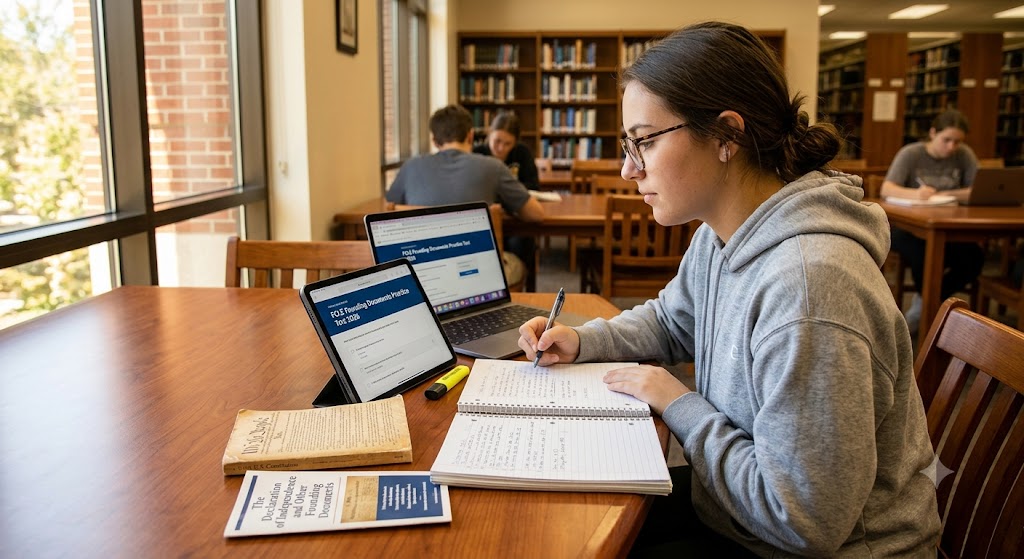
Additional Information
What the Course Entails and Exam Details
This practice resource focuses heavily on the "Founding Documents" competency domain of the official FCLE. It is designed to mirror the actual exam’s curriculum, ensuring comprehensive coverage of critical historical texts and principles. You will encounter detailed questions regarding the structure, content, and application of:
The Declaration of Independence
The United States Constitution (including the Bill of Rights and all subsequent Amendments)
The Federalist Papers (specifically focusing on foundational arguments like Federalist No. 10 and No. 51)
Beyond just memorizing texts, this practice test evaluates your ability to analyze landmark Supreme Court cases that have interpreted these founding documents throughout American history. The questions will challenge your understanding of core concepts such as checks and balances, separation of powers, federalism, individual rights, and the rule of law.
What to Expect in the Final Exam
The official Florida Civic Literacy Exam is a computer-based, multiple-choice test consisting of approximately 80 questions. Here is what you need to prepare for in the final examination setting:
Format: 100% Multiple Choice questions, designed to test both knowledge and analytical application.
Time Limit: Students typically have 160 minutes (over two and a half hours) to complete the test.
Passing Score: A passing score is required. This is often a scale score, but generally equates to achieving approximately 60% correct, although specific required percentages can fluctuate slightly depending on the test administration.
Permitted Items: This is a closed-book exam. No outside materials, dictionaries, or electronic devices (beyond the testing computer) are permitted during the testing session.
How to Study and Exam Centers
Preparation is key to succeeding on the FCLE. Achieve your best score by following these proven study strategies:
Read the Source Material: There is no substitute for closely reading the original documents. Study the U.S. Constitution and the Declaration of Independence repeatedly.
Focus on Interpretation: Don't just learn what the document says; understand how the Supreme Court has interpreted its meaning in landmark cases (e.g., Marbury v. Madison, McCulloch v. Maryland, Brown v. Board of Education).
Take Multiple Practice Tests: Use our practice exam to simulate the testing environment, identify your weak areas, and become comfortable with the wording of multiple-choice civic literacy questions.
Create Flashcards: Utilize flashcards for key terms (e.g., Habeas Corpus, Judicial Review), significant Amendments, and summaries of essential Supreme Court rulings.
Where to Take the Exam: The FCLE is primarily administered at Florida state colleges and universities. Students currently enrolled in these institutions can typically register for and take the exam at their campus’s designated testing center free of charge. High school students may take the exam at their respective schools during designated testing windows. Some institutions may also offer remote proctoring options using services like Honorlock, depending on individual school policy.
Job Opportunities from the Course
While the FCLE itself is a graduation requirement rather than a professional certification, the deep understanding of American government and civic responsibility it proves is highly valuable in numerous career paths. Demonstrating civic literacy is a foundation for roles in public service, law, and advocacy, including:
Legislative Assistant
Political Campaign Manager
Paralegal / Legal Assistant
Public Administration Specialist
Community Outreach Coordinator
Non-Profit Program Manager
Civics or Social Studies Educator
Government Relations Specialist
Frequently Asked Questions
Reviews
5.0
Based on 0 reviews
Leave a Review
No reviews yet. Be the first to review!