
European Baccalaureate Practice Test & Exam Prep
$69.00
- Buy to unlock unlimited access to all Quiz questions.
- After purchase you can print a PDF of the whole quiz at any point. The PDF will contain the questions and the correct answers.
About this Exam
The European Baccalaureate (EB) is a prestigious bilingual qualification awarded to students who have completed the two-year European Baccalaureate cycle (years S6 and S7) at one of the recognized European Schools. It is a comprehensive and rigorous program designed for students from a diverse range of linguistic and cultural backgrounds within the European Union. The EB is not just an academic credential; it fosters broad knowledge, critical thinking skills, and multilingual proficiency, preparing students for university studies across Europe and worldwide. This practice exam is specifically created to help students in the final years of the program feel confident and well-prepared for this challenging academic milestone.
Ready to test your knowledge?
Buy Now to Access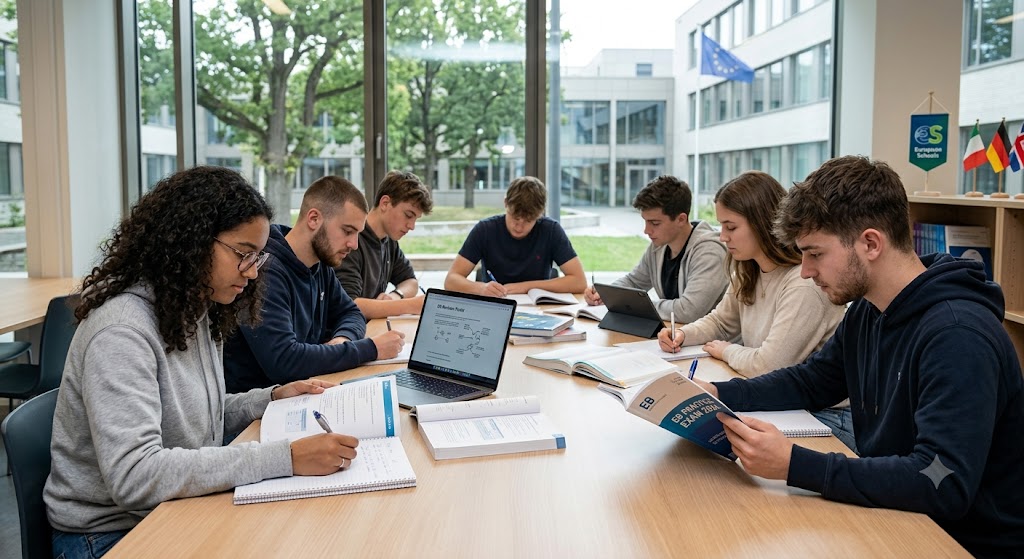
Additional Information
What the Course Entails and Exam Details
The European Baccalaureate syllabus covers a wide spectrum of subjects over two years, focusing on a balance of languages, humanities, sciences, mathematics, and optional courses. Students typically select a "mother tongue" language, a first foreign language, mathematics, and a range of other subjects based on their interests and university goals. The continuous assessment plays a crucial role; the final EB score is composed of 50% coursework marks from S7 and 50% from the official exams taken at the end of S7. The exam details involve two major components: five written exams (covering key subjects and languages) and three oral exams (testing communication and knowledge in various topics). The syllabus requires in-depth understanding and the ability to apply complex concepts rather than simple memorization.
What to Expect in the Final Exam
The final European Baccalaureate exams are a rigorous test of endurance, knowledge, and application. Written exams contribute 35% to the final EB mark, while oral exams contribute 15%. Written exams are comprehensive, lasting between 3 to 4 hours per subject depending on the course. They encompass essay questions, problem-solving tasks, and analytical exercises that require clear expression and structured argumentation. The three oral exams (testing languages and chosen optional subjects) are interactive sessions, typically lasting around 20-30 minutes each, including preparation time. During the oral exams, students must demonstrate not just factual knowledge, but the ability to articulate thoughts fluently and respond critically to questions from examiners. A minimum overall score of 60 out of 100 is typically required to pass the European Baccalaureate, with individual subject scores also being significant for university admissions.
How to Study and Exam Centers
Preparation is key to succeeding in the European Baccalaureate. Here are some actionable study strategies:
Master the Syllabi: Thoroughly review the official syllabi for all your subjects to understand the precise learning outcomes expected.
Practice with Past Papers: Regularly complete past European Baccalaureate written and oral exam papers to get familiar with the question types, time constraints, and required level of detail.
Refine Language Skills: For oral exams, practice speaking and listening regularly in your chosen languages. Practice structuring arguments and presenting ideas clearly.
Develop Time Management: Work on managing your time effectively during practice exams to ensure you can complete all sections within the allotted time.
Collaborate and Discuss: Engage in study groups to discuss complex topics and receive feedback from peers and teachers.
Utilize Authorized Resources: Leverage resources and revision guides provided by the European Schools and recognized educational publishers.
Exam Centers: The European Baccalaureate exams are strictly administered within the established European Schools networks across Europe and a very limited number of accredited schools authorized by the Board of Governors of the European Schools. You must take the exams at your designated, official school location; they are not available through common third-party testing centers like Pearson VUE or online portals.
Job Opportunities from the Course
The European Baccalaureate is a highly respected qualification that serves as a primary key to university education across Europe and the globe. While it doesn't directly qualify you for specific entry-level jobs without further study, the broad skills and multilingual abilities it unlocks lead to diverse and rewarding career paths after higher education. Here is a list of potential career avenues that the foundation of the European Baccalaureate supports:
European Union Civil Servant (after university and specialized training)
International Relations Specialist or Diplomat
International Business Manager or Consultant
Multilingual Translator or Interpreter
Scientific Researcher (in fields like Biology, Chemistry, Physics, or Engineering)
Data Analyst or Economist
Journalist or Foreign Correspondent
Human Rights Lawyer or International Legal Expert
Global Marketing Executive
Software Engineer or IT Specialist (within international contexts)
Frequently Asked Questions
Reviews
5.0
Based on 0 reviews
Leave a Review
No reviews yet. Be the first to review!