
Equations and Inequalities Test Question Answers 2026
$69.00
- Buy to unlock unlimited access to all Quiz questions.
- After purchase you can print a PDF of the whole quiz at any point. The PDF will contain the questions and the correct answers.
About this Exam
Welcome to your comprehensive guide for mastering the Equations and Inequalities Test Question Answers 2026. This critical assessment is designed for students and lifelong learners aiming to validate their foundational algebra skills. Whether you are preparing for a high school exit exam, a college placement test, or a professional certification prerequisite, this exam rigorously evaluates your ability to manipulate mathematical statements and solve for unknown variables. Success on this test demonstrates not only computational fluency but also the analytical thinking required for advanced mathematics and STEM careers.
Ready to test your knowledge?
Buy Now to Access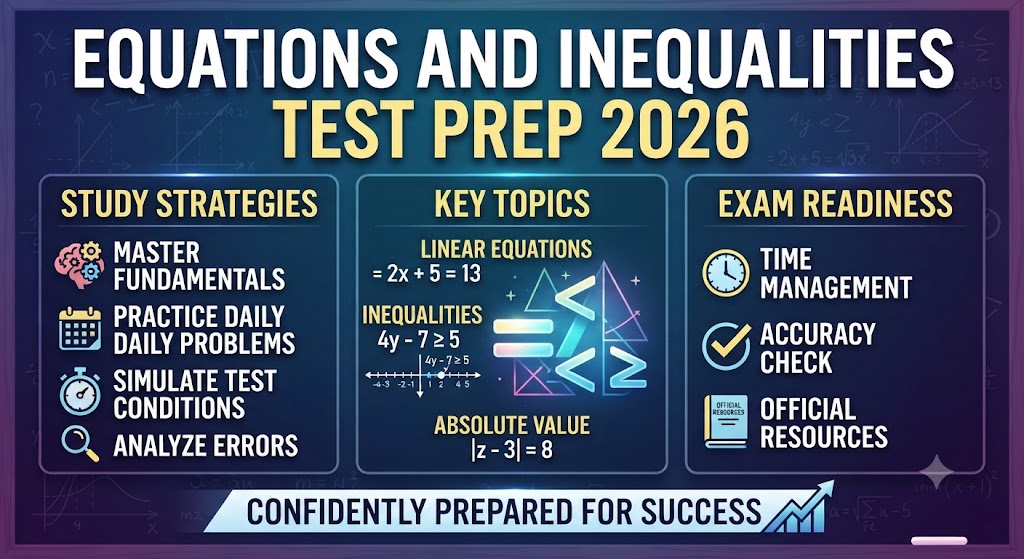
Additional Information
What the Course Entails and Exam Details
The curriculum leading to this exam covers a broad spectrum
of algebraic concepts essential for problem-solving. You will not only need to
recall definitions but also apply complex reasoning.
The core topics and skills covered include:
- Foundational
Operations: Simplifying algebraic expressions using the order of
operations (PEMDAS/BODMAS) and the distributive property.
- Solving
Linear Equations: Mastery of one-step, two-step, and multi-step linear
equations, including those with variables on both sides.
- Working
with Formulas: Rearranging literal equations and formulas to isolate a
specific variable.
- Equations
with Special Solutions: Identifying and understanding identities
(infinitely many solutions) and contradictions (no solution).
- Linear
Inequalities: Solving and graphing inequalities on a number line,
including compound inequalities (AND/OR statements).
- Absolute
Value: Solving absolute value equations and inequalities and analyzing
their unique solution sets.
- Modeling
with Equations: Translating real-world word problems into algebraic
equations and inequalities to find solutions.
What to Expect in the Final Exam
The Equations and Inequalities Test 2026 is a standardized
assessment structured to evaluate both speed and accuracy. While specific
formats may vary by institution, the general structure remains consistent with
rigorous academic testing standards.
- Exam
Format: The test is primarily composed of multiple-choice questions
designed to test conceptual understanding and common misconceptions.
However, expect a significant portion of the exam to be
"grid-in" or free-response, requiring you to show your work or
provide the exact numerical answer.
- Time
Limit: This is a timed assessment. Typically, students are given
between 60 to 90 minutes to complete the exam, averaging approximately 2–3
minutes per question. Time management is crucial.
- Passing
Score: The passing threshold is usually set at 70% or higher,
reflecting a required mastery of the subject matter.
- Testing
Rules: A scientific calculator is often permitted for specific
sections of the exam, but its use on foundational arithmetic sections may
be prohibited. You must be familiar with the specific calculator policy of
your testing authority. A formula sheet is rarely provided; therefore, you
must memorize key properties and rules.
How to Study and Exam Centers
Achieving a top score on this exam requires dedicated
practice and strategic preparation. Passive reading of textbooks is
insufficient; you must actively engage with problems.
- Actionable
Study Strategies:
- Master
the Fundamentals: Ensure you have a rock-solid understanding of
integer rules, fractions, and the properties of equality before tackling
complex equations.
- Practice
Daily: Consistent, short study sessions are more effective than
infrequent cramming. Work through at least 10–15 problems daily, focusing
on different question types.
- Use
Official Resources: Utilize the "Equations and Inequalities Test
Question Answers 2026" official study guide and practice banks
provided by your school or testing board. These resources are the most
representative of the actual exam difficulty.
- Simulate
Test Conditions: Take full-length practice tests under timed
conditions, without any external aids or distractions. This builds
stamina and identifies areas where you are slowest.
- Analyze
Errors: Do not just check if your answer is correct. If you get a
question wrong, thoroughly understand why you made the mistake.
Was it a calculation error, a misunderstanding of the inequality sign, or
a misread question?
- Where
and How to Take the Exam:
- For
Students: If this is a course requirement, the exam will be
administered directly by your school, either in a classroom setting or a
dedicated proctored testing center on campus.
- For
Certification/Placement: If you are taking this independently, the
exam will likely be administered through secure online testing portals
(requiring lockdown browsers and webcams) or at authorized professional
testing centers like Pearson VUE or Prometric. Always register through
the official exam website to receive your confirmation and specific
instructions.
- Job Opportunities from the Course
Proficiency in solving equations and inequalities is not
just an academic requirement; it is a gateway skill for numerous high-demand
careers. Excelling on this test proves you possess the logical reasoning and
quantitative literacy necessary for success in technical fields.
This certification validates skills directly applicable to
the following job titles and career paths:
- Data
Analyst: Utilizing algebra to model datasets, identify trends, and
make data-driven business decisions.
- Financial
Analyst: Applying quantitative skills to manage budgets, forecast
economic trends, and analyze investment risks.
- Software
Developer/Programmer: Using logical operators and variable
manipulation inherent in coding and algorithm design.
- Engineering
Technician: Solving technical equations to design, test, and maintain
infrastructure, machinery, and systems.
- Actuary:
Assessing risk and uncertainty using advanced mathematics and statistical
equations.
- Science
Researcher: Modeling real-world phenomena, such as population growth
or chemical reactions, using algebraic expressions.
- Logistics
Manager: Optimizing supply chains and transportation routes using
quantitative analysis and linear programming.
Frequently Asked Questions
Reviews
5.0
Based on 0 reviews
Leave a Review
No reviews yet. Be the first to review!