
EOC US History Assessments Practice Test #2
$69.00
- Buy to unlock unlimited access to all Quiz questions.
- After purchase you can print a PDF of the whole quiz at any point. The PDF will contain the questions and the correct answers.
About this Exam
The End-of-Course (EOC) US History assessment is a critical examination designed to measure students’ understanding and mastery of essential United States History knowledge and skills.
Typically taken by high school students after completing a comprehensive United States History course, this test is a requirement in many states for graduation or high school course credit. The EOC US History Assessments Practice Test #2 is specifically created as a valuable study tool, offering students a realistic opportunity to practice answering questions similar to those they will encounter on the official final exam. This practice test helps familiarize students with the exam’s format, types of questions, and content, boosting their confidence and preparation for the actual test day.
Ready to test your knowledge?
Buy Now to Access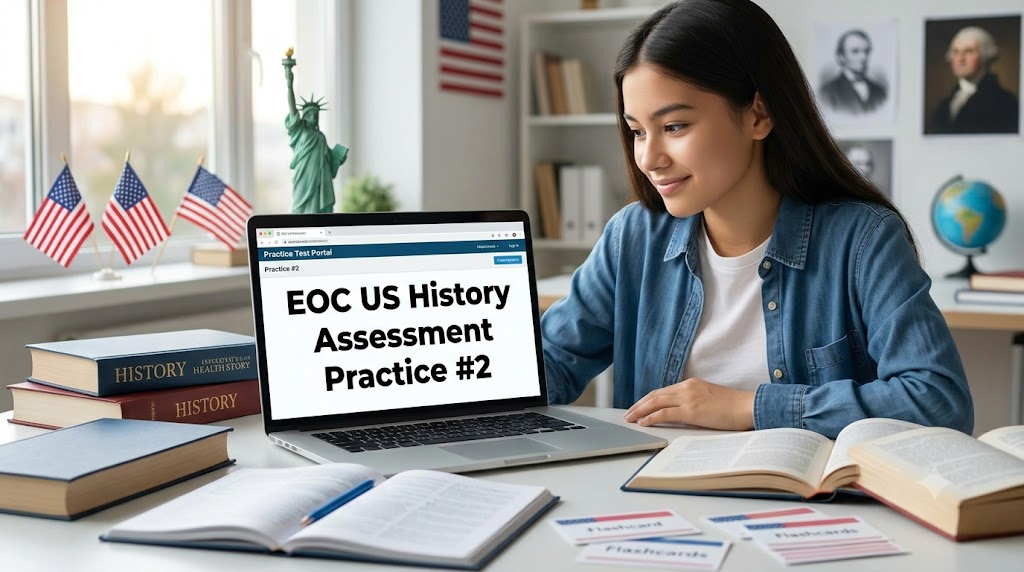
Additional Information
What the Course Entails and Exam Details
A high school US History course, and by extension the EOC assessment, covers a broad range of key periods, themes, and events in American history, from the late 19th century through the modern era.
Students are expected to demonstrate knowledge in areas such as the Gilded Age, the Progressive Era, World War I, the roaring Twenties, the Great Depression, the New Deal, World War II, the Cold War, the Civil Rights Movement, and contemporary events. The curriculum emphasizes critical historical analysis, the interpretation of primary and secondary sources, and the development of arguments based on historical evidence. The exam questions are derived from state learning standards, assessing students' ability to connect historical concepts, analyze complex issues, and understand the evolution of American society, government, and global influence.
What to Expect in the Final Exam
The official EOC US History final exam typically consists of multiple-choice questions, which evaluate knowledge and application across all major historical eras.
Some versions may include other types of questions, such as short-answer or technology-enhanced items, but multiple-choice remains the standard format. Students are given a set time limit, often ranging from 90 to 120 minutes, to complete the exam. Passing scores are determined by individual states and may be a specific numerical score or proficiency level. Results often impact a student's final course grade and graduation status. The actual testing experience is structured and proctored, mirroring standard statewide testing environments.
How to Study and Exam Centers
Effectively preparing for the EOC US History assessment involves a combination of content review and practice. Students should begin by thoroughly reviewing their class notes, textbook, and any study guides provided by their teachers.
Creating flashcards for key terms, dates, important figures, and historical events can be very helpful for memorization. Practicing with sample questions, including those in this Practice Test #2, allows students to familiarize themselves with the exam’s question style and time constraints. Analyzing both primary and secondary sources, such as speeches, photographs, and political cartoons, is crucial for developing historical thinking skills. Taking timed practice tests can help students build stamina and manage their time effectively.
Regarding exam centers, the actual EOC assessments are administered within individual schools, typically in a classroom or designated testing lab during regular school hours. The scheduling and specific logistics are managed by school administration and guidance counselors, who will provide students with their testing times and locations. In some rare cases for alternative schooling or make-up exams, students may take the assessment at a district testing center or via approved online platforms, as determined by their state's department of education.
Job Opportunities from the Course
While a high school US History course does not directly lead to specific job certifications, success on the EOC assessment is a crucial milestone toward graduation. It demonstrates core knowledge in social studies and critical thinking, which are foundational for success in many career fields and further education.
Here is a list of career paths where strong knowledge of US History is beneficial or often required for advanced studies:
High School History Teacher
Social Studies Educator
Archivist
Museum Curator
Librarian
Political Analyst
Historian
Researcher
Journalist (Specializing in politics or history)
Writer or Author
Legal Assistant or Paralegal (leading to legal careers)
Public Policy Administrator
Government Official (Various levels)
Diplomat
These roles typically require further education, such as a bachelor’s degree, often in history, political science, journalism, education, or law, but a strong performance on high school assessments like the US History EOC lays the groundwork for these career trajectories.
Frequently Asked Questions
Reviews
5.0
Based on 0 reviews
Leave a Review
No reviews yet. Be the first to review!