
EOC Science Practice Test 2026 Official Study Guide
$69.00
- Buy to unlock unlimited access to all Quiz questions.
- After purchase you can print a PDF of the whole quiz at any point. The PDF will contain the questions and the correct answers.
About this Exam
Welcome to your comprehensive study resource for the 2026 End-of-Course (EOC) Science exam. This guide is specifically designed for high school students completing their required science courses—such as Biology, Chemistry, or Physical Science—and preparing for this critical state assessment.
Achieving proficiency on the EOC exam is a significant milestone, often serving as a graduation requirement or contributing significantly to your final course grade. This article and the accompanying practice materials are tailored to help you review key concepts, understand the test format, and build the confidence needed to succeed.
Ready to test your knowledge?
Buy Now to Access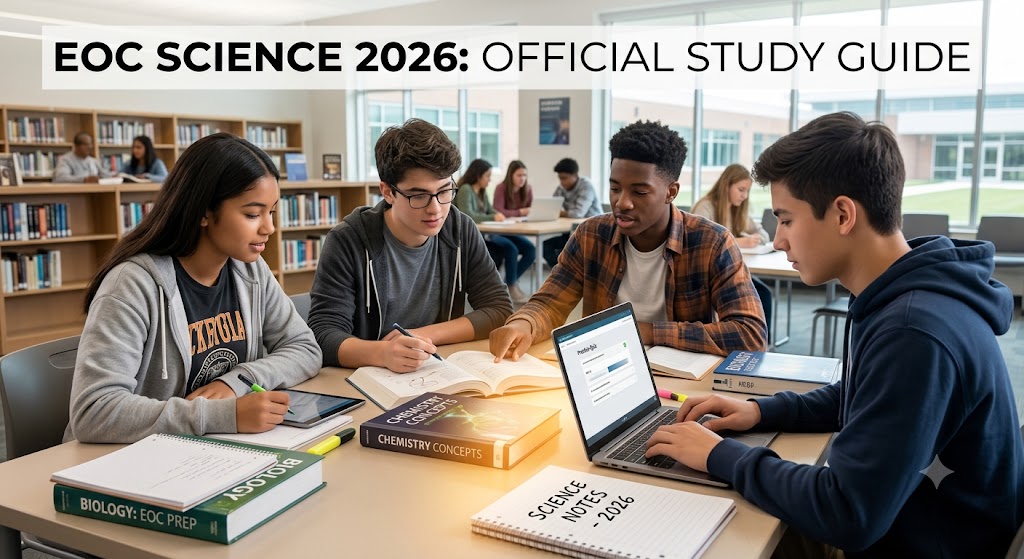
Additional Information
What the Course Entails and Exam Details
The content covered in the EOC Science exam reflects the foundational principles taught in your specific science course. While exact standards vary slightly by state, you can expect the exam to rigorously assess your understanding of core scientific domains.
The curriculum typically includes, but is not limited to, the following areas:
Scientific Inquiry and Methodology: Understanding how scientists ask questions, design experiments, analyze data, and draw conclusions.
Cell Biology and Genetics: The structure and function of cells, DNA replication, protein synthesis, and patterns of inheritance.
Evolution and Diversity: The mechanisms of natural selection, evidence for evolution, and the classification of organisms.
Ecology and Interdependence: The flow of energy through ecosystems, biogeochemical cycles, population dynamics, and human impact on the environment.
Physical Science Concepts: For physical science and chemistry EOCs, topics will cover atomic structure, chemical bonding, chemical reactions, forces, motion, and energy transformations.
What to Expect in the Final Exam
The EOC Science exam is a standardized test, typically administered on a computer. It is designed to evaluate not only your factual knowledge but also your ability to apply scientific concepts and analyze information.
Here is what you should expect regarding the exam format:
Format: The test consists predominantly of multiple-choice questions. Depending on your state, it may also include technology-enhanced items, such as drag-and-drop questions, hot spots, or questions requiring you to analyze graphs and data sets.
Time Limit: You will be given a specific time limit to complete the exam, usually ranging from 60 to 90 minutes per section.
Scoring: Your score is based on the number of questions answered correctly. A passing score is determined by your state's department of education.
Resources: Depending on the specific science subject, you may be permitted to use a scientific calculator, and reference sheets (such as a periodic table for chemistry) will often be provided within the testing interface.
How to Study and Exam Centers
Effective preparation is essential for performing your best on the EOC Science exam. Since this is an official state assessment, you do not need to register at external testing centers like Pearson VUE.
The exam is administered directly at your school, typically during the regular school day. Your teachers and school guidance counselors will provide you with the exact testing schedule and location details.
Here are actionable study strategies to incorporate into your preparation:
Review Your Coursework: Go back through your class notes, textbooks, and graded assignments from the entire school year. Focus on the main headers and key vocabulary.
Utilize Official Practice Tests: Take advantage of released practice exams and sample questions provided by your state’s department of education. These are the single best resource for understanding the question style and rigor.
Create Flashcards: Use digital or physical flashcards for definitions, formulas, chemical symbols, or key biological processes.
Focus on Your Weaknesses: Identify the topics you found most challenging during the course and allocate extra study time to review those specific areas.
Form Study Groups: Collaborating with classmates can help clarify difficult concepts and expose you to different perspectives on the material.
Job Opportunities from the Course
While the EOC Science exam itself is not a professional certification, achieving a strong score demonstrates proficiency in foundational scientific principles. This strong academic foundation is the essential first step toward a vast array of educational paths and future career opportunities in STEM (Science, Technology, Engineering, and Math) fields.
Strong performance in high school science opens doors to further education and careers such as:
Healthcare Professional (Nurse, Doctor, Pharmacist)
Biological Researcher or Biotechnologist
Environmental Scientist or Conservationist
Chemical Engineer or Chemist
Laboratory Technician
Science Educator
Forensic Scientist
Frequently Asked Questions
Reviews
5.0
Based on 0 reviews
Leave a Review
No reviews yet. Be the first to review!