
EOC Science Practice Test 1 – 30 Questions and Answers
$69.00
- Buy to unlock unlimited access to all Quiz questions.
- After purchase you can print a PDF of the whole quiz at any point. The PDF will contain the questions and the correct answers.
About this Exam
The Florida End-of-Course (EOC) Biology assessment is a critical, high-stakes exam designed to measure student mastery of the Florida standards in Biology. This test is mandatory for public high school students completing a Biology 1 course (or an equivalent) in the state of Florida.
The exam serves multiple purposes: it constitutes 30% of the student's final course grade, and achieving a passing score is often a requirement for earning a standard high school diploma. This practice test is designed specifically for Florida high school students who are preparing for this significant academic milestone, providing a realistic simulation of the types of questions they will encounter on the official assessment.
Ready to test your knowledge?
Buy Now to Access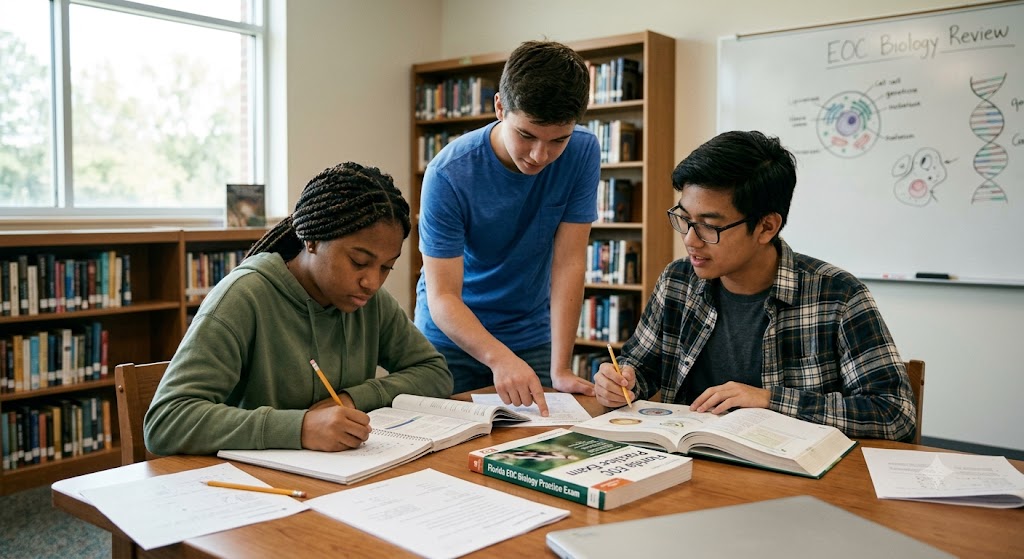
Additional Information
What the Course Entails and Exam Details
The Biology 1 course covers the fundamental principles of life science. Students preparing for the EOC must demonstrate proficiency in several core reporting categories, which are the primary focus of both the course and the final exam:
Molecular and Cellular Biology (Approx. 35%): This section includes topics like cell structure and function, cell reproduction (mitosis/meiosis), the role of DNA and RNA, genetics (Mendelian and molecular), and the chemical basis of life (macromolecules, enzymes).
Organisms, Populations, and Ecosystems (Approx. 40%): This category focuses on ecological principles, including energy flow in ecosystems, biogeochemical cycles, population dynamics, community interactions, natural selection, and human impact on the environment. It also covers the classification and diversity of living organisms.
The Nature of Science (Approx. 25%): This foundational category tests students' understanding of scientific inquiry, including formulating and testing hypotheses, designing experiments, analyzing data, and interpreting graphs. Students must also be able to distinguish between scientific theories and laws.
The practice test consists of 30 multiple-choice questions that reflect the weightings and complexity of these reporting categories.
What to Expect in the Final Exam
When taking the official Florida EOC Biology exam, students should expect a computerized testing format administered at their school. The official exam usually consists of 60-66 multiple-choice questions and is timed at 160 minutes, which is divided into two 80-minute sessions.
A passing score on the EOC is typically a Level 3 or higher on a scale of 1-5. Students who achieve Level 3 or above are considered proficient. While a Level 3 is passing, achieving higher levels (4 or 5) demonstrates a stronger mastery of the content, which can be beneficial for students planning to pursue further education in scientific fields.
A fundamental rule for the EOC is that it is a computer-based test, and students will have access to an online calculator and a scientific reference sheet (containing formulas and the periodic table) within the testing platform. No outside calculators are permitted.
How to Study and Exam Centers
Effective preparation is key to success on the EOC. Here are actionable study strategies:
Start with the Standards: Download the official "Biology 1 End-of-Course Assessment Test Item Specifications" from the Florida Department of Education website. This document outlines exactly what will be tested.
Utilize This Practice Test: Take this 30-question practice test under timed conditions to simulate the exam environment. Review all answers, understanding why the correct answer is correct and why the distractors are wrong.
Review Your Course Material: Go back to your class notes, textbooks, and labs. Focus heavily on the vocabulary terms associated with each reporting category.
Practice with Released Items: The FLDOE sometimes releases previous test questions or creates sample question sheets. Working through these provides excellent practice.
Form Study Groups: Collaborating with classmates can help you review complex concepts and test each other's knowledge.
Regarding Exam Centers: The Florida EOC assessments are administered by authorized Florida public schools for their enrolled students. Students do not need to register at external centers like Pearson VUE; their schools handle all scheduling and administration during the designated state testing windows (usually offered in Spring, Summer, and Fall). For home education or private school students, arrangements must typically be made through the local public school district’s assessment office.
Job Opportunities from the Course
Successfully mastering Biology is the first step on a pathway toward many rewarding and essential career paths. While the high school course itself is a foundational step, proficiency in biology unlocks opportunities in numerous fields that require further education (such as technical certificates, associate’s degrees, bachelor's degrees, or doctoral degrees).
Common career paths stemming from a strong foundation in Biology include:
Nurse (LPN, RN)
Medical Laboratory Technician
Physician
Veterinarian
Pharmacy Technician or Pharmacist
Biomedical Engineer
Environmental Scientist or Conservation Biologist
Marine Biologist
Forensic Science Technician
High School Biology Teacher or College Professor
Frequently Asked Questions
Reviews
5.0
Based on 0 reviews
Leave a Review
No reviews yet. Be the first to review!