
EOC Algebra Practice Test #4
$69.00
- Buy to unlock unlimited access to all Quiz questions.
- After purchase you can print a PDF of the whole quiz at any point. The PDF will contain the questions and the correct answers.
About this Exam
The EOC Algebra 1 End-of-Course (EOC) exam is a comprehensive assessment designed to measure a student’s understanding and mastery of fundamental algebraic concepts. This exam is a critical milestone for high school students, often serving as a graduation requirement or a significant factor in final course grades.
This EOC Algebra Practice Test #4 is specifically structured to mirror the official exam's rigor, content distribution, and question formats. It is an invaluable resource for any student completing an Algebra 1 course, offering a realistic preview of the final test and a powerful diagnostic tool to identify areas needing improvement.
Ready to test your knowledge?
Buy Now to Access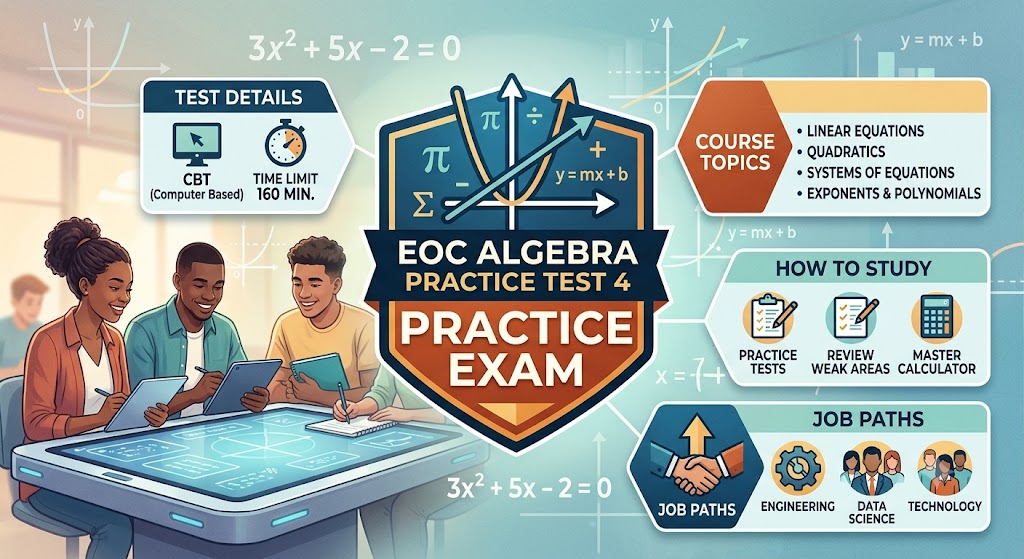
Additional Information
What the Course Entails and Exam Details
The underlying Algebra 1 course and consequently, this EOC assessment, cover a broad spectrum of core algebraic domains. Understanding these areas is essential for success on the final exam.
Number and Quantity: This involves working with rational and irrational numbers, simplifying expressions using properties of exponents, and performing operations with polynomials.
Algebra: This is the core of the exam, focusing on creating, solving, and graphing linear equations and inequalities. It also includes systems of equations, absolute value equations, and understanding the concept of a function. Students must be proficient in factoring quadratic expressions and solving quadratic equations using various methods.
Functions: This section assesses the ability to understand function notation, identify domain and range, analyze key features of graphs (intercepts, extrema, symmetry), and interpret different function types (linear, quadratic, exponential).
Statistics and Probability: This includes interpreting data presented in various formats (dot plots, histograms, box plots), calculating measures of center and spread, and understanding bivariate data analysis, such as scatter plots and lines of best fit.
The exam itself typically consists of multiple-choice and enhanced multiple-choice questions. It is administered by state or local education agencies, and the specific pass score is determined by the governing body. While time limits and specific rules (like calculator usage policies) can vary, the total testing time is often substantial, sometimes divided into multiple sessions to ensure comprehensive assessment.
What to Expect in the Final Exam
When sitting for the actual EOC Algebra 1 exam, students should be prepared for a rigorous and timed environment. Here is a breakdown of what to expect:
Format: The primary format is multiple-choice, but students may also encounter drag-and-drop, hot-spot, or grid-in question types designed to assess deeper understanding.
Rigor: The questions are designed to challenge conceptual understanding, computational fluency, and application skills. Students will need to apply algebraic concepts to real-world scenarios.
Time Limit: Expect a strict time limit, requiring efficient time management. It is crucial to practice pacing during your preparation.
Score Requirements: Passing scores are determined by individual state boards of education. Achieving a passing score is often necessary to fulfill graduation requirements.
Calculator Policy: Calculator policies are state-specific. Some sections might be non-calculator, while others permit specific models of scientific or graphing calculators. It is critical to familiarize yourself with your state's specific policy.
How to Study and Exam Centers
Preparation is paramount for success on the EOC Algebra 1 exam. Here are actionable study strategies and details on where the exam is administered:
Take Multiple Practice Tests: Consistently using resources like the EOC Algebra Practice Test #4 is one of the most effective strategies. It simulates the test-taking experience and helps you identify knowledge gaps.
Focus on High-Weight Areas: Analyze which topics appear most frequently on practice tests and ensure you have a strong command of those foundational concepts, particularly linear and quadratic functions.
Show Your Work: When practicing, always write out your steps. This helps you trace errors and ensures you understand the underlying process, rather than just guessing.
Create Cheat Sheets (for Study Only): Summarize key formulas, definitions, and procedures for each topic. The act of writing them down reinforces memory, even if you can't use the sheet during the exam.
Form Study Groups: Collaborating with classmates can offer new perspectives on problem-solving and provide motivation.
Exam Centers and Administration
The official EOC Algebra 1 exam is typically not administered through independent platforms like Pearson VUE. Instead, it is managed directly by state or district education departments and administered within your school.
Physical Testing Centers: The exam is almost always taken at your home high school or a designated school within your district. It will be conducted in a secure classroom or computer lab environment.
Online Portals: Many states now use dedicated online testing platforms for state assessments. You will access the exam using a secure browser provided by the school on school computers. The administration details, including dates and times, will be communicated by your school’s guidance counselors or administrators.
Job Opportunities from the Course
A strong foundation in Algebra 1, validated by success on the EOC exam, is not just about graduation; it is the cornerstone of numerous technical and rewarding career paths. Mastery of algebraic concepts is a prerequisite for subsequent mathematics and STEM-related fields.
Engineering Technician: Requires strong algebra skills to read technical drawings, interpret data, and assist in product development.
Draftsman/CAD Technician: Uses algebraic principles for geometric modeling and creating precise technical plans.
Lab Technician (Biological, Chemical): Involves using formulas, performing dilutions, and analyzing quantitative experimental results.
Quality Control Inspector: Applies algebraic concepts to interpret statistical data, perform measurements, and ensure product quality standards.
Bookkeeping and Accounting Clerk: Requires numerical proficiency and an understanding of algebraic relationships to manage financial records.
Computer Support Specialist: Problem-solving and logical thinking skills developed in algebra are fundamental for diagnosing and resolving technical issues.
Frequently Asked Questions
Reviews
5.0
Based on 0 reviews
Leave a Review
No reviews yet. Be the first to review!