
EOC Algebra 1 Practice Test #3 Review Exam
$69.00
- Buy to unlock unlimited access to all Quiz questions.
- After purchase you can print a PDF of the whole quiz at any point. The PDF will contain the questions and the correct answers.
About this Exam
The EOC Algebra 1 Practice Exam 3 is a vital preparatory tool designed specifically for high school students nearing the completion of their Algebra 1 coursework. This review exam is not just about testing current knowledge; it’s a crucial milestone to help gauge readiness for the actual state-mandated End-of-Course assessment in Algebra 1, which can often impact final grades and graduation requirements. Who is it for? Primarily students currently enrolled in Algebra 1, looking to solidify their understanding, identify weak areas, and build the confidence needed to succeed in their official EOC exam. This comprehensive guide and practice session are your keys to unlocking success.
Ready to test your knowledge?
Buy Now to Access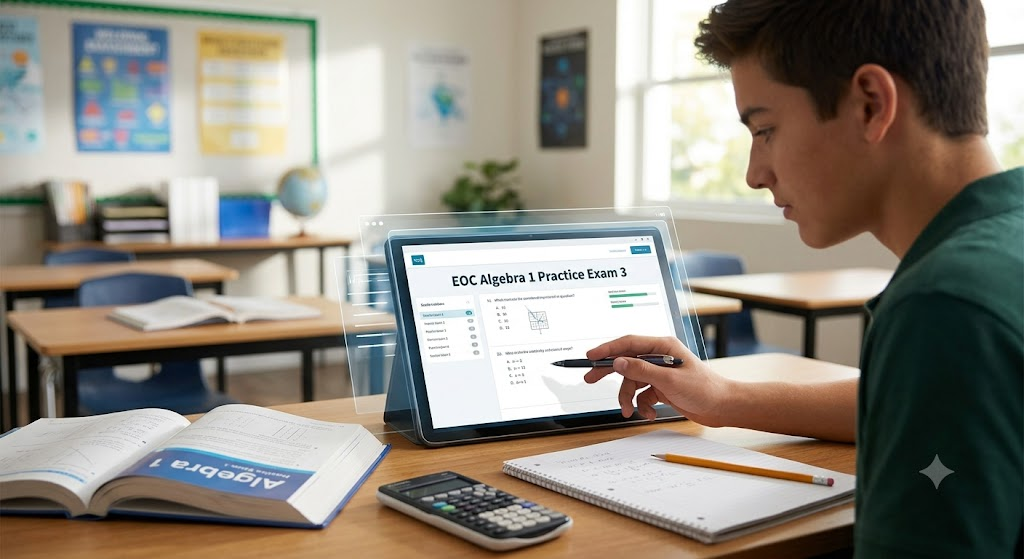
Additional Information
What the Course Entails and Exam Details
This practice and review course is comprehensive, designed to mirror the actual state-level Algebra 1 EOC as closely as possible. It ensures that students have a strong foundation in all core algebra concepts. The content covers a range of essential topics, including:
Understanding and manipulating expressions, equations, and inequalities (both linear and quadratic).
Mastery of functions and their various representations: linear, quadratic, and exponential functions, including interpreting their graphs, slopes, key features, and relationship types.
Polynomial operations, such as multiplying monomials, and techniques for factoring polynomials, which are fundamental algebraic skills.
Solving and applying systems of linear equations and inequalities, including solving complex word problems.
Working with exponents and radical expressions, as well as an introduction to basic data analysis and probability concepts within an algebraic context. The level of detail and problem complexity ensures that you are truly prepared for the rigors of the final EOC.
What to Expect in the Final Exam
For this EOC Algebra 1 Practice Exam 3, and reflecting the structure of the real End-of-Course assessment, you can expect a comprehensive testing format that challenges multiple levels of understanding. Here is what you will typically find:
Format: The primary style is often computer-based testing, with a substantial portion consisting of multiple-choice questions designed to assess conceptual knowledge and problem-solving skills quickly and efficiently. You might also encounter some extended-response or grid-in questions that require showing your work. The practice test itself often includes a fixed number of multiple-choice questions (often around 25-30 based on typical practice test structures). The actual EOC typically consists of two distinct sessions, with the number of questions being greater, possibly 60 or more, often spread over two testing periods.
Passing Score: For this specific practice exam, the "passing" score is generally indicative of proficiency and is often set by schools or districts to help identify students who are ready and those who need more review. Achieving a good score shows substantial algebraic competence. The actual state EOC often has a specific scale score or level requirement to fulfill graduation and credit conditions, often meaning achieving a 'level 3' or higher out of 5 levels on common state scoring models.
Time Limits: To simulate the real EOC pressure and structure, the practice exam will usually have a clear time limit. Expect a session of around 90 minutes for the practice. For the actual state EOC, there are typically two separate sessions, each with its own time limit, sometimes allowing extra time for completion but generally operating within a set timeframe.
Rules & Procedures: Standard academic integrity is paramount. You are expected to complete the work independently. For calculator use, the actual state EOC usually has one session that permits an online or approved handheld scientific or graphing calculator, and another session which does not allow any calculator. Practice exams often specify which session or questions are calculator-permitted. You will typically be provided with an approved formula or reference sheet for the actual EOC, which you should also use in your practice. Physical test security, identification, and other procedural rules strictly govern the actual state-level assessment.
How to Study and Exam Centers
Actionable study strategies are key to maximizing your success on both the practice and the actual EOC Algebra 1 exam. Here’s a blueprint for your preparation:
Take Multiple Practice Tests: The very exam this guide reviews is a crucial step! Regularly completing practice tests, including this one and previous versions, is hands-down one of the most effective ways to understand the question types, practice time management, and identify specific areas where you need more review.
Review Core Concepts: Don’t just memorize – understand! Go back to your notes and textbook. Pay close attention to factoring, solving and graphing systems of equations, interpreting slope and intercepts, and working with both linear and quadratic functions. If you struggle with a topic, dedicate extra time to working through examples and asking for help.
Simulate Exam Conditions: Timing is everything. For some practice sessions, set a timer and try to complete the test within the allocated time to build speed and accuracy under pressure. This will make the real exam feel less daunting.
Identify Weaknesses: After taking a practice test or section quiz, carefully review which questions you missed and why. Is it a conceptual misunderstanding or a simple calculation error? Knowing your weak points allows you to focus your study time most effectively. Utilize educational resources like textbooks, reputable online tutorials, and school-provided study materials to reinforce challenging concepts.
Exam Centers and Where to Take the Exam: The final state-level EOC Algebra 1 exam is typically administered within authorized high schools or designated district testing locations. In some cases, and often for distance learning students or special situations, you might access your exam via specific state or district-authorized online testing portals. It is essential to communicate directly with your school, counselor, or testing coordinator to confirm the specific location, date, and procedures for your official EOC. They will provide all necessary log-in information, room assignments, and specific instructions.This particular practice test review and practice exam are usually provided through your school or coursework materials, likely completed in a classroom setting or on a specific school-authorized educational platform. While some certifications are taken at broad centers like Pearson VUE, high school EOCs are school-integrated.
Job Opportunities from the Course
Succeeding in Algebra 1, marked by a strong performance on the EOC Algebra 1 Practice Exam 3 and the subsequent final assessment, provides foundational skills that are highly valued and universally applicable. These skills—strong numerical reasoning, problem-solving abilities, analytical thinking, and a structured approach to quantitative information—open doors to diverse job opportunities and career paths across numerous fields. Here are some examples of careers that directly benefit from or require a solid background in mathematics and algebra, starting with a strong performance at the high school level:
Data Analyst: Entry-level positions and beyond require analyzing data, which demands the algebraic skill to process information, build models, and visualize trends.
Software Developer / Programmer: Coding logic is deeply rooted in mathematical concepts and algebra, so a strong mathematical foundation is essential.
Financial Analyst: Professionals in finance use algebraic models and data to evaluate investment performance, assess risk, and forecast economic outcomes.
Engineer (e.g., Civil, Mechanical, Software, etc.): All engineering disciplines heavily rely on advanced mathematics, and a thorough grasp of algebraic principles is the fundamental building block.
Statistician / Actuary: These roles require expert-level mathematics and statistical analysis, beginning with strong algebra, to collect and interpret data and manage risk.
Business Analyst: Strong logical reasoning and analytical skills, honed by algebra, are key to identifying business needs and developing solutions.
Research Assistant (STEM Fields): Entry-level positions in scientific research involve data collection and basic analysis, requiring a foundational mathematical comfort level.
High School Math Teacher: For those with a passion for mathematics, teaching the subject is a rewarding path, ensuring new generations learn these critical skills.
Logistics Coordinator: This role uses algebra to optimize operations, calculate efficient routes, and manage inventory data.
Cryptographer: Security experts use complex mathematics, grounded in basic and abstract algebra, to create and analyze encryption codes. A strong score on the Algebra 1 EOC is not just a high school requirement; it’s a strong indicator of readiness for higher learning in quantitative and analytical fields, unlocking many of these career trajectories.
Remember to space each sentence properly for readability and easy copying!
Frequently Asked Questions
Reviews
5.0
Based on 0 reviews
Leave a Review
No reviews yet. Be the first to review!