
EOC Algebra 1 Practice Test #2
$69.00
- Buy to unlock unlimited access to all Quiz questions.
- After purchase you can print a PDF of the whole quiz at any point. The PDF will contain the questions and the correct answers.
About this Exam
The EOC (End-of-Course) Algebra 1 assessment is a critical milestone for high school students, typically taken upon completion of their first foundational algebra course. This exam evaluates a student's understanding of essential algebraic concepts and skills, which are fundamental for success in higher-level mathematics and various STEM careers.
Designed to measure proficiency against state-specific academic standards, the Algebra 1 EOC is often a graduation requirement or a significant factor in a student's final course grade. It targets students who have completed a full year of Algebra 1 instruction.
Ready to test your knowledge?
Buy Now to Access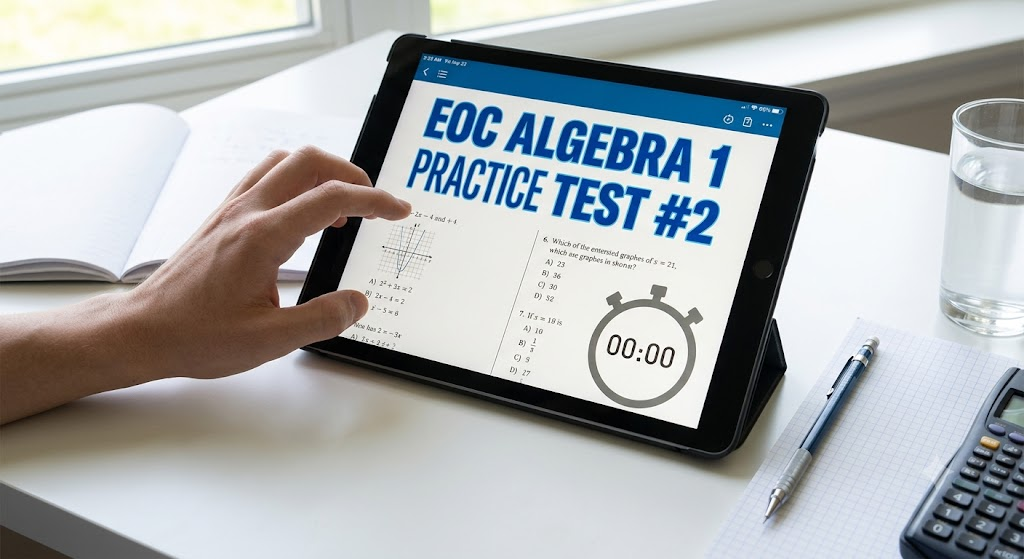
Additional Information
What the Course Entails and Exam Details
This comprehensive course, and consequently the EOC exam, covers five main reporting categories:
Number and Quantity: Understanding real numbers, quantities, and complex numbers.
Algebra: Seeing structure in expressions, performing arithmetic operations with polynomials and rational expressions, creating equations, and reasoning with equations and inequalities.
Functions: Interpreting functions, building functions, and understanding linear, quadratic, and exponential models.
Statistics and Probability: Interpreting categorical and quantitative data, making inferences, and justifying conclusions.
What to Expect in the Final Exam
While specific formats vary slightly by state, students can generally expect the following for the final EOC Algebra 1 exam:
Format: The primary format is computer-based testing (CBT). It features a mix of multiple-choice questions, multiple-select items, and technology-enhanced items where students interact with graphs or input digital responses. Some states include a brief constructed-response section.
Time Limit: Exams are typically divided into two sessions, often administered over two days. Total testing time generally ranges from 120 to 180 minutes.
Passing Score: Passing scores and achievement levels are determined by each state’s department of education. Scores are often reported on a scale (e.g., Level 1 to Level 5), with a specific level designated as meeting the graduation requirement.
Rules: Students are usually permitted a reference sheet containing common formulas and a specific calculator (scientific or graphing, depending on the session and state policy) during designated portions of the test.
How to Study and Exam Centers
Preparation is key to success on the Algebra 1 EOC. Here are actionable strategies:
Take Practice Tests: Consistent practice with resources like this "EOC Algebra 1 Practice Test #2" is essential for familiarizing yourself with the question types and formatting.
Review the Standards: Obtain a copy of your state's specific Algebra 1 academic standards to understand exactly which topics will be emphasized.
Use a Formula Sheet: Practice solving problems using the official reference sheet provided during the actual exam to improve speed and accuracy.
Focus on Weak Areas: Use practice test results to identify and prioritize your review of challenging topics.
Form Study Groups: Collaborating with peers can help clarify difficult concepts through mutual explanation.
Exam Centers
The final EOC Algebra 1 exam is typically administered in a secure, proctored environment directly at the student’s high school or an authorized physical testing center designated by the school district. It is not available through open, public online portals like Pearson VUE for initial administration.
Job Opportunities from the Course
While the EOC Algebra 1 assessment is not a professional certification, a strong performance validates the critical math reasoning skills required for academic advancement. This competency is a foundational prerequisite for high-demand, high-wage career pathways, including:
Engineering Technicians
Data Analysts (Entry-Level)
Drafting and Design Professionals (CAD)
Information Technology Specialist
Healthcare Technicians
Skilled Trades (Electricians, Machinists, HVAC)
Military Technical Roles
Frequently Asked Questions
Reviews
5.0
Based on 0 reviews
Leave a Review
No reviews yet. Be the first to review!