
Entrance Practice Test & Exam Prep | Pakistan
$69.00
- Buy to unlock unlimited access to all Quiz questions.
- After purchase you can print a PDF of the whole quiz at any point. The PDF will contain the questions and the correct answers.
About this Exam
The [Entrance Practice Test & Exam Prep | Pakistan] is a comprehensive preparation resource tailored specifically for students in Pakistan who are striving to gain admission into top-tier universities, medical colleges, and engineering institutes. This program is designed to cover the foundational and advanced topics required for various competitive entrance tests across the country, providing a vital bridge between intermediate education and professional degree programs.
Whether you are aiming for medical (MCAT/MDCAT), engineering (ECAT), or general undergraduate admission (NTS NAT, HAT), this course offers the structured guidance needed to excel. It is created for high school graduates and intermediate students (FSc/ICS/ICOM/FA) who are ready to take the next crucial step in their educational journey and require targeted practice to secure their desired placement.
Ready to test your knowledge?
Buy Now to Access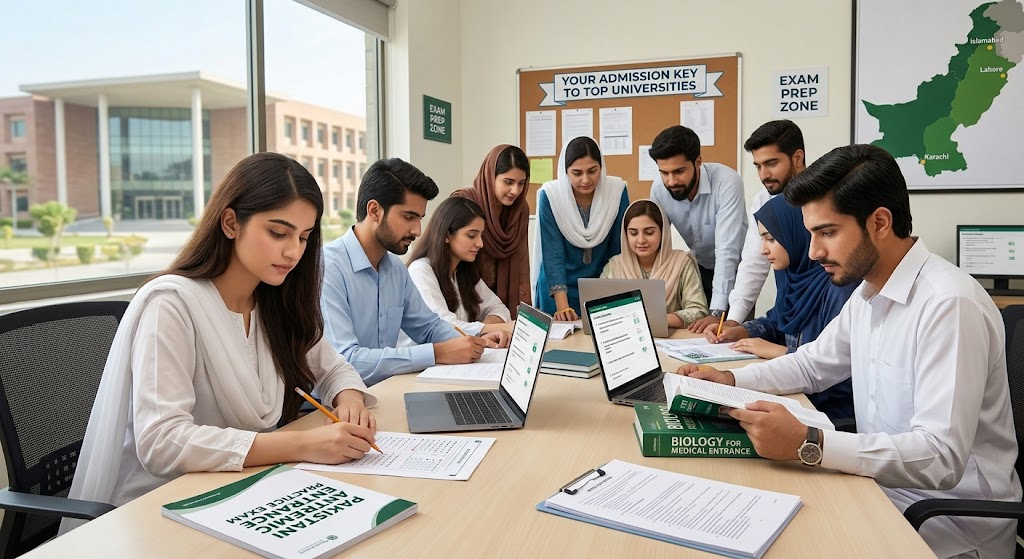
Additional Information
What the Course Entails and Exam Details
This preparation course provides an exhaustive review of the core subjects standard across Pakistani entrance examinations. The syllabus is meticulously aligned with the provincial and national test requirements, focusing on the essential conceptual knowledge and problem-solving skills tested by major examining bodies. The core curriculum covers a wide spectrum of academic disciplines:
Biology: Cell Biology, Genetics, Evolution, Physiology, Ecology, and Biotechnology, ensuring deep understanding for medical aspirants.
Physics: Mechanics, Electromagnetism, Optics, Heat & Thermodynamics, Waves, and Modern Physics, crucial for engineering and science programs.
Chemistry: Physical, Organic, Inorganic, and Analytical Chemistry, covering essential reactions, structures, and calculations.
Mathematics: Algebra, Calculus, Trigonometry, Matrices & Determinants, Analytical Geometry, and Statistics, vital for ECAT and other science tests.
English Language: Grammar, Vocabulary, Reading Comprehension, Sentence Correction, and Analytical Writing, ensuring standard linguistic competence.
Logical Reasoning and Analytical Ability: Critical Thinking, Pattern Recognition, and Data Interpretation skills needed to tackle non-academic sections.
The course is delivered through a blend of instructional methods, including video lectures, interactive workshops, and a massive repository of practice questions modeled on recent past papers.
What to Expect in the Final Exam
While the exact format can vary depending on the specific test (e.g., MDCAT vs. ECAT vs. NAT), most Pakistani academic entrance exams share common characteristics. The final exam is typically a high-stakes, standardized assessment conducted in a strictly controlled environment. Students should expect the following:
Format: The predominant format is Multiple Choice Questions (MCQs). However, some exams might include a subjective or analytical writing component.
Scoring: Standardized exams often use a system of weighted scoring. Negative marking for incorrect answers is common in many major competitive tests, making accuracy just as important as speed.
Time Limit: Exams are rigidly timed, typically ranging from 2 to 3 hours for the entire paper, demanding efficient time management.
Passing Score: The required score to clear the test and gain admission is dynamic. It depends on the university, the program, and the overall competitiveness of the applicant pool for that academic year. Generally, securing a high percentile rank is essential.
Rules: Standard examination protocols apply: no electronic devices, strict adherence to the seating plan, and mandatory presentation of original identification and the admit card.
How to Study and Exam Centers
Effective preparation for Pakistani entrance tests requires a combination of disciplined study and practical strategy. To maximize your score, adopt the following actionable approaches:
Master the Syllabus: Download the official syllabus for your specific target exam and create a comprehensive study plan that allocates time to each topic based on its weight.
Utilize Past Papers: This is the single most effective strategy. Solve at least 5–10 years of past papers to understand question patterns, difficulty levels, and time constraints.
Take Mock Tests: Replicate exam conditions by taking full-length, timed mock tests. This helps build stamina, identify weak areas, and refine your time management.
Focus on Concepts: Do not just memorize formulas or facts. Modern entrance exams test conceptual clarity and the ability to apply knowledge to new problems.
Seek Guidance: Enroll in reputable preparation classes or seek mentorship from seniors or experts who understand the nuances of the Pakistani testing landscape.
Exam Centers: The exams are typically conducted in major cities across Pakistan. For example, national tests like the MCAT/MDCAT are held simultaneously at specific physical locations in cities like Karachi, Lahore, Islamabad, Peshawar, and Quetta. Online portals managed by testing agencies (like the National Testing Service, NTS, or provincial authorities) are used for registration and, in some cases, for conducting computer-based tests at authorized physical test centers, school computer labs, or dedicated Pearson VUE centers for certain international standardized components.
Job Opportunities from the Course
A strong performance in a Pakistani entrance test is not a professional qualification itself but rather the master key that unlocks access to the country’s most sought-after and lucrative career paths. By preparing effectively, students can gain admission to specialized degree programs that lead directly to prestigious job opportunities. Here is a list of the specific career paths and job titles unlocked by the professional degrees accessible through these tests:
Medical Path: Leading to careers as a Doctor (MBBS), Dentist (BDS), Specialist Physician, Surgeon, or Medical Researcher.
Engineering Path: Opening doors to roles such as Civil Engineer, Software Engineer, Electrical Engineer, Mechanical Engineer, Chemical Engineer, and Aerospace Engineer.
Information Technology (IT) Path: Enabling careers as a Data Scientist, Cloud Computing Specialist, Cybersecurity Analyst, AI/ML Engineer, and IT Project Manager.
General Undergraduate Path: Leading to professions like Business Analyst, Economist, Corporate Lawyer (via LLB), Accountant (via CA/ACCA pathways unlocked by academic success), and roles within the Central Superior Services (CSS) of Pakistan, which requires a minimum bachelor's degree.
Applied Sciences Path: Unlocking opportunities in Biotechnology, Environmental Science, and Pharmaceutical Research.
Frequently Asked Questions
Reviews
5.0
Based on 0 reviews
Leave a Review
No reviews yet. Be the first to review!