
Engineering Entrance Practice Test & Exam Prep | India
$69.00
- Buy to unlock unlimited access to all Quiz questions.
- After purchase you can print a PDF of the whole quiz at any point. The PDF will contain the questions and the correct answers.
About this Exam
Engineering entrance exams in India are highly competitive assessments designed for students who have completed their higher secondary education (Class 12) with Physics, Chemistry, and Mathematics. These exams are the gateway to securing admission into prestigious undergraduate engineering programs (B.E./B.Tech) at top-tier institutions across the country, including the Indian Institutes of Technology (IITs), National Institutes of Technology (NITs), and other premier engineering colleges. They evaluate a student's conceptual understanding, problem-solving abilities, and readiness for rigorous engineering studies.
Ready to test your knowledge?
Buy Now to Access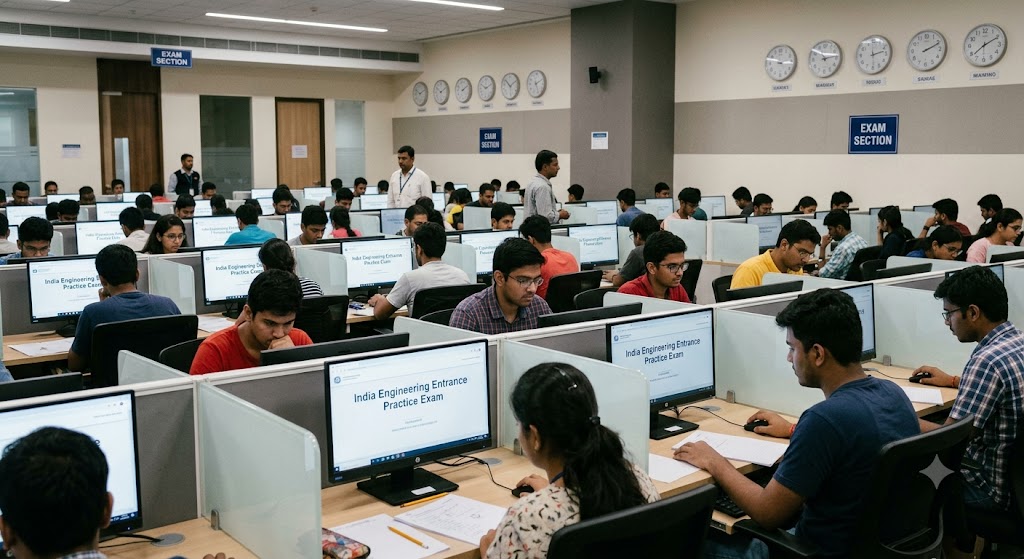
Additional Information
What the Course Entails and Exam Details
The syllabus for these entrance exams primarily focuses on the core concepts covered in Class 11 and Class 12 Physics, Chemistry, and Mathematics, largely based on the NCERT curriculum. The course of study involves deep diving into theoretical principles and their practical applications.
Key subject areas include:
Physics: Mechanics, Electrodynamics, Optics, Thermodynamics, and Modern Physics.
Chemistry: Physical Chemistry, Organic Chemistry, and Inorganic Chemistry.
Mathematics: Calculus, Algebra, Coordinate Geometry, Trigonometry, and Vectors/3D Geometry.
The exact exam structure and conducting body vary depending on the specific test (e.g., JEE Main, JEE Advanced, BITSAT, WBJEE, COMEDK, etc.).
What to Expect in the Final Exam
Most engineering entrance exams in India have transitioned to a Computer-Based Test (CBT) format. The exams typically feature objective-type questions, predominantly Multiple Choice Questions (MCQs), where students select one correct answer from several options. Some exams also include numerical value questions, requiring students to calculate and enter a specific numerical answer.
The time limit for these exams is usually around 3 hours per paper. A crucial aspect is the marking scheme, which often involves negative marking for incorrect answers in MCQs, necessitating accuracy and careful consideration before answering. Passing or qualifying marks vary each year based on the difficulty level of the exam and the overall performance of the candidates.
How to Study and Exam Centers
Effective preparation requires a structured study plan and consistent practice.
Strong Foundation: Focus on thoroughly understanding concepts from NCERT textbooks as your base.
Practice Regularly: Solve a vast number of practice questions and problems daily to build speed and accuracy.
Previous Years' Papers (PYPs): Analyze and solve past years' exam papers to understand the questioning pattern, weightage of topics, and difficulty level.
Mock Tests: Take regular online mock tests in a simulated exam environment to improve time management skills and identify areas needing improvement.
Registration for these exams is typically done online through the official websites of the respective conducting bodies (e.g., the National Testing Agency for JEE Main). The exams are administered at thousands of designated, secure computer-based test centers located in major cities and towns across India to accommodate the large volume of applicants.
Job Opportunities from the Course
While engineering entrance exams are not certifications that directly lead to jobs, qualifying for them and securing admission into a reputed engineering college unlocks a multitude of diverse and lucrative career paths upon graduation.
Completing an engineering degree from a top Indian institute opens doors to roles such as:
Software Engineer/Developer
Data Analyst/Data Scientist
Civil Engineer
Mechanical Engineer
Electrical Engineer
Electronics & Communication Engineer
Chemical Engineer
Aerospace Engineer
Biomedical Engineer
Project Manager
Consultant (Technical/Management)
Research & Development (R&D) Engineer
Opportunities in Public Sector Undertakings (PSUs) through GATE.
Frequently Asked Questions
Reviews
5.0
Based on 0 reviews
Leave a Review
No reviews yet. Be the first to review!