
Energy Assessor Practice Test & Exam Prep | United Kingdom
$69.00
- Buy to unlock unlimited access to all Quiz questions.
- After purchase you can print a PDF of the whole quiz at any point. The PDF will contain the questions and the correct answers.
About this Exam
The UK Energy Assessor certification is an essential qualification for professionals looking to work within the energy efficiency and property sectors. This certification permits individuals to produce legally required Energy Performance Certificates (EPCs) for buildings.
Designed for aspiring Domestic Energy Assessor (DEA) and Non-Domestic Energy Assessor (NDEA) candidates, this assessment ensures that practitioners understand building construction, heating systems, and the reduced data Standard Assessment Procedure (rdSAP) methodology used to calculate energy ratings.
Whether you are starting a new career or looking to add to your existing skill set in property or construction, passing this exam and gaining accreditation is the crucial first step.
Ready to test your knowledge?
Buy Now to Access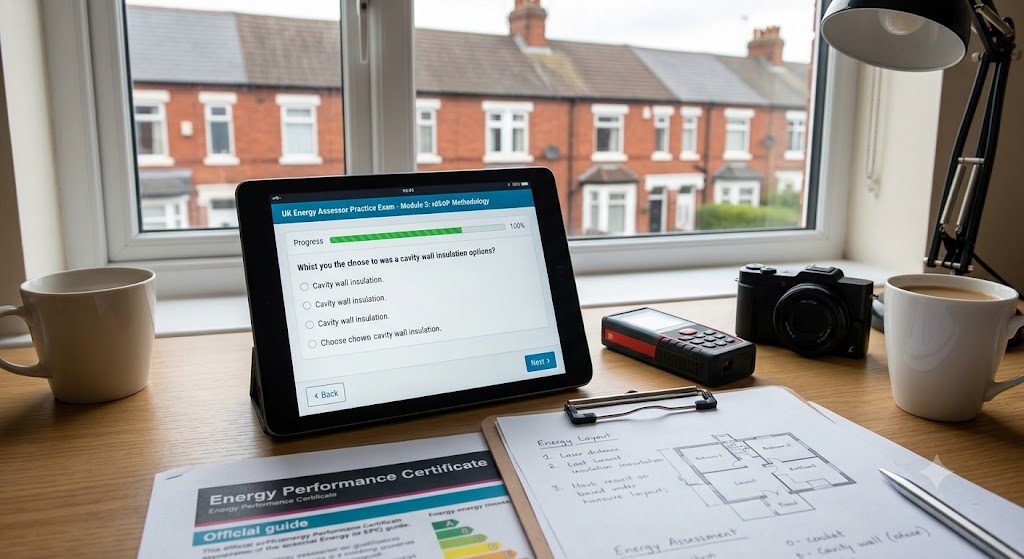
Additional Information
What the Course Entails and Exam Details
Preparing for the Energy Assessor exam requires a thorough understanding of building physics, energy software, and UK regulations. The core syllabus covered during training and reinforced through practice tests includes:
Building Construction: Identifying types of walls, roofs, floors, and glazing.
Heating and Hot Water Systems: Understanding different boiler types, controls, and renewable technology.
Insulation: Assessing levels of loft, cavity wall, and floor insulation.
rdSAP Methodology: Mastering the data collection conventions and software entry needed for accurate calculations.
The EPC: Generating, interpreting, and lodging Energy Performance Certificates.
What to Expect in the Final Exam
While training providers may differ slightly, the final assessment generally consists of a combination of multiple-choice exams and practical portfolio submissions.
The online multiple-choice exams focus heavily on rdSAP conventions, methodology, and regulations. Candidates can expect a time limit for these exams, and a high passing score, often around 70-80%, is required to demonstrate competence.
Additionally, as part of the qualification process, you must submit a portfolio of completed energy assessments for properties you have surveyed, proving your practical skills in the field.
How to Study and Exam Centers
Effective study involves combining theoretical knowledge with practical application.
Utilize Practice Tests: This is crucial. Taking multiple practice exams simulates the pressure and format of the real test, helping you build speed and identify knowledge gaps in rdSAP methodology.
Review Training Material: Thoroughly revise the course content provided by your training provider, especially the sections on building construction and conventions.
Hands-on Practice: Practice inputting data into approved rdSAP software as often as possible.
Training and exams are typically coordinated through approved training centers, colleges, or private awarding bodies across the UK. Some written components may be taken online through secure portals, while practical elements require physical property surveys. Once qualified, you must join an approved accreditation scheme (e.g., Elmhurst, Quidos, Stroma) to legally produce EPCs.
Job Opportunities from the Course
Gaining this certification opens several clear career paths within the property and sustainability sectors.
Domestic Energy Assessor (DEA)
Non-Domestic Energy Assessor (NDEA)
On Construction Domestic Energy Assessor (OCDEA)
Green Deal Advisor
Home Inspector
Property Surveyor
Sustainability Consultant
Frequently Asked Questions
Reviews
5.0
Based on 0 reviews
Leave a Review
No reviews yet. Be the first to review!