
EMT Practical Exam Medical Scenarios Questions
$69.00
- Buy to unlock unlimited access to all Quiz questions.
- After purchase you can print a PDF of the whole quiz at any point. The PDF will contain the questions and the correct answers.
About this Exam
The National Registry of Emergency Medical Technicians (NREMT) practical examination, formally known as the Psychomotor Exam, is a critical step for aspiring Emergency Medical Technicians (EMTs) across the United States. This hands-on assessment verifies that a candidate possesses the necessary psychomotor skills to provide safe and effective entry-level emergency medical care. The certification is designed for individuals who have completed a state-approved EMT course and are ready to prove their competence in real-world scenarios. Achieving NREMT certification is often the gateway to state licensure and a rewarding career in emergency medical services (EMS).
Ready to test your knowledge?
Buy Now to Access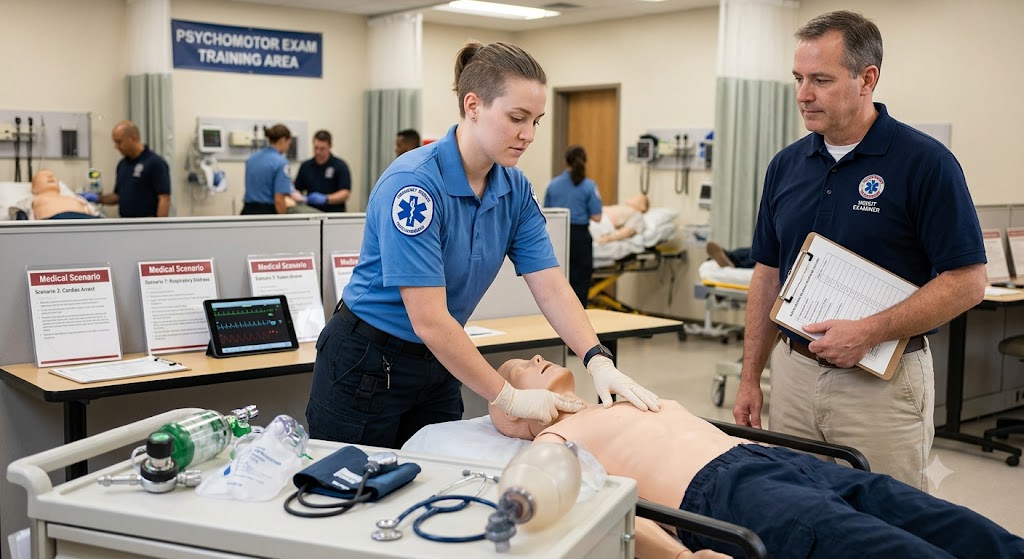
Additional Information
What the Course Entails and Exam Details
The EMT psychomotor exam is not a written test; it is a series of standalone and scenario-based skill stations where you must demonstrate your ability to act quickly and correctly under pressure. The content is rigorously developed in accordance with the current National EMS Education Standards and American Heart Association (AHA) Guidelines.
The core domains you are tested on include:
Patient Assessment and Management – Medical: This station is central to the exam. You will be given a scenario (e.g., respiratory distress, chest pain, diabetic emergency, or allergic reaction) and must perform a comprehensive assessment, formulate a field impression, and implement a treatment plan while verbalizing your findings.
Patient Assessment and Management – Trauma: Here, you will assess and manage a simulated trauma patient, prioritizing life-threatening injuries such as major bleeding, airway issues, and flail chest, demonstrating proper spinal immobilization as required.
Cardiac Arrest Management/AED: Candidates must demonstrate single-rescuer adult CPR and the proper use of an Automated External Defibrillator (AED) according to the latest standards.
Bag-Valve-Mask (BVM) Ventilation of an Apneic Adult Patient: This skill checks your ability to provide manual ventilation using a BVM, focusing on proper seal, rate, and volume.
Oxygen Administration by Non-Rebreathing Mask: You will assemble and administer oxygen using a regulator and a non-rebreathing mask.
Additionally, candidates are randomly assigned one of the following "random basic" skill stations:
Bleeding Control/Shock Management
Joint Immobilization
Long Bone Immobilization
Spinal Immobilization (Seated Patient)
What to Expect in the Final Exam
The psychomotor exam is a series of timed, pass/fail stations.
At each station, you will be met by a trained NREMT Skill Examiner who will read you a brief prompt describing the scenario. From that moment, you must act as the primary provider. You will be expected to "think out loud," verbalizing all assessments, findings, and treatments to the examiner.
Passing Score and Failure Criteria: To pass the Psychomotor Exam, you must successfully complete all mandatory stations. You do not receive a numeric score; rather, each station is marked pass or fail based on your ability to complete all critical criteria. Critical criteria are specific steps that, if missed or performed incorrectly, result in immediate failure of the entire station.
If you fail a station, the examiner will stop you and provide a brief explanation. Retest policies vary by state and the total number of stations failed. Typically, if you fail only one or two stations, you may be eligible for a same-day retest.
How to Study and Exam Centers
Preparation for the psychomotor exam requires active, physical practice.
Study Strategies:
Use Skill Sheets: The NREMT publishes the official skill sheets that examiners use to evaluate you. Study these sheets religiously. They list every step you must perform. Memorize the flow, paying special attention to "Critical Criteria."
Practice in Real-Time: Do not just read about the skills. Set up stations with a partner or a mannequin. Have your partner read the scenario, time you, and check off steps on the skill sheet. Practiceverbalizing every action.
Master the Assessment Triangle: For all medical and trauma scenarios, strictly follow the primary survey: Airway, Breathing, and Circulation (ABC) first. A structured approach ensures you miss nothing critical.
Review AHA Guidelines: Ensure your CPR and AED skills are current and conform to the newest AHA protocols.
Exam Centers:
You cannot take the psychomotor exam online. The NREMT coordinates with state EMS offices to establish authorized Psychomotor Exam Sites.
These centers are often located at EMS training academies, community colleges, or designated state testing facilities. When you register for your exam through your NREMT account, you will select an available test site near you. You must provide your Course Completion Verification during this registration process.
Job Opportunities from the Course
Earning your NREMT certification opens numerous career opportunities in emergency care. The critical thinking and hands-on skills developed are invaluable and highly transferable.
Achieving this certification unlocks the following career paths:
Emergency Medical Technician (EMT)
Ambulance EMT
Firefighter/EMT (upon completion of fire academy)
Hospital Emergency Department Technician
Tactical EMT
Industrial Safety Officer
Event Medical Staff
Private Medical Transport EMT
Flight EMT (usually requires Advanced EMT or Paramedic and field experience)
Further Education toward Paramedic, Nurse, or Physician Assistant (PA)
Frequently Asked Questions
Reviews
5.0
Based on 0 reviews
Leave a Review
No reviews yet. Be the first to review!