
EKG Practice Test for the Nurse Practitioner and Physician Assistant
$69.00
- Buy to unlock unlimited access to all Quiz questions.
- After purchase you can print a PDF of the whole quiz at any point. The PDF will contain the questions and the correct answers.
About this Exam
The EKG Practice Exam for NPs and PAs is a specialized proficiency assessment designed specifically for Advanced Practice Providers (APPs) who must possess expert-level skills in electrocardiogram interpretation. This simulation is tailor-made for Nurse Practitioner (NP) and Physician Assistant (PA) students preparing for their board certification exams (such as AANP, ANCC, or PANCE), as well as practicing clinicians seeking to validate their competency for specialized roles or institutional privileges. The exam validates an APP's ability to rapidly and accurately analyze complex 12-lead EKGs to make critical diagnostic and management decisions in diverse clinical settings, from primary care to the emergency department.
Ready to test your knowledge?
Buy Now to Access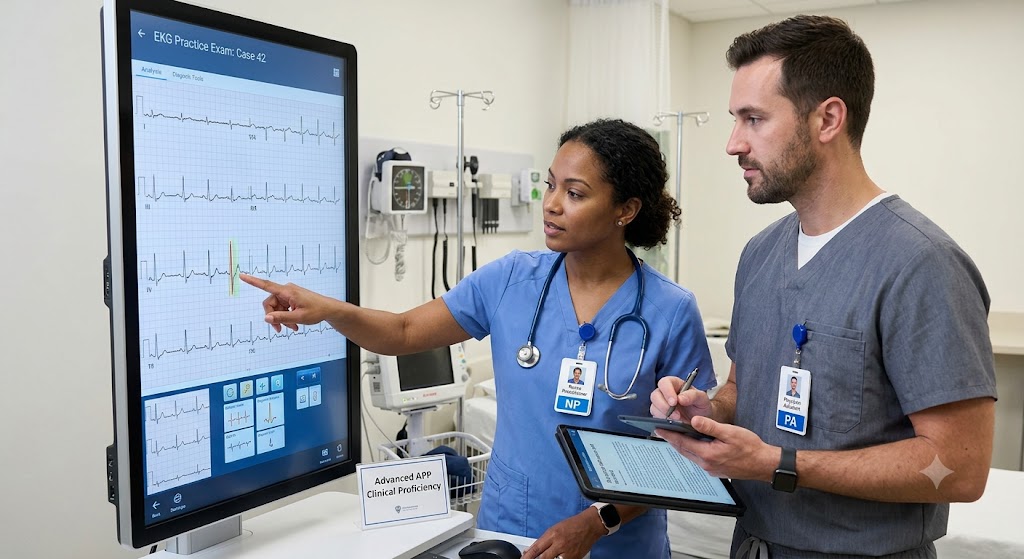
Additional Information
What the Course Entails and Exam Details
This comprehensive study module and practice exam focus exclusively on the high-level interpretation skills required of APPs. Unlike introductory courses, this program assumes a baseline understanding of cardiac anatomy and focuses on clinical application and differential diagnosis.
The core domains covered include:
Advanced analysis of cardiac electrophysiology and vector management.
Systematic interpretation of rhythm, rate, axis, and intervals (PR, QRS, QT).
Mastery of wide and narrow complex tachycardias, including differentiation of VT from SVT with aberrancy.
Precise identification of all degrees of AV block, bundle branch blocks, and fascicular blocks.
Detection of subtle and classic signs of myocardial ischemia, injury, and infarction (STEMI/NSTEMI), including posterior and right ventricular involvement.
Recognition of chamber hypertrophy (LVH, RVH, atrial enlargement).
Interpretation of metabolic and drug effects on the EKG (e.g., hyperkalemia, digitalis effect, QT prolonging agents).
Identification of miscellaneous critical conditions, such as pulmonary embolism (S1Q3T3), pericarditis, and Brugada syndrome.
What to Expect in the Final Exam
The final proficiency assessment is designed to simulate a high-pressure clinical environment, pushing examinees to demonstrate decisive, accurate interpretation. While specific formats vary by institutional or commercial testing body, the most rigorous assessments generally adhere to the following structure:
Format: The exam is typically composed of multiple-choice questions, which are heavily reliant on high-resolution image analysis of unique 12-lead EKG tracings. Some advanced modules may include case-based simulations requiring the examinee to select the next most appropriate management step based solely on the EKG finding.
Question Count: A standard, robust practice exam usually contains between 50 and 100 dedicated EKG interpretation questions.
Time Limit: To simulate real-world clinical decision-making time constraints, the exam is timed, typically allowing approximately 60 to 90 seconds per EKG strip.
Passing Score: Most institutions require a minimum passing score of 80% to demonstrate proficiency, with specialized cardiology fellowships or acute care departments often requiring 90% or higher, reflecting the zero-tolerance for misdiagnosis of critical patterns.
How to Study and Exam Centers
Preparation for this exam requires disciplined, repetitive practice focused on a systematic approach rather than rote memorization of patterns.
Recommended Study Strategies:
Master the Systematic Approach: Always assess a strip in the same order: Rate, Rhythm, Axis, Intervals, and Morphology. Never jump to a diagnosis.
Use Spaced Repetition: Interpret at least 10-20 new, diverse EKG strips daily using commercial question banks or textbooks specific to APPs.
Focus on the ‘Can’t Miss’ Diagnoses: Dedicate significant study time to flawlessly identifying STEMI mimics, subtle ischemia, ventricular tachycardia, and unstable blocks.
Form Study Groups: Collaboratively interpreting strips with peers helps refine your differential diagnosis and systematic analysis.
Exam Centers and Access:
This exam is primarily delivered through online platforms. Many specialized APP educational vendors offer these practice exams through secure, proctored web portals, allowing students to take them from any location with high-speed internet. Institutional proficiency exams (required for hospital privileges) are often administered through a facility's internal Learning Management System (LMS) or designated medical education testing centers. Some comprehensive board review courses hosted at physical conference centers may also include this assessment as part of a live workshop.
Job Opportunities from the Course
Mastery of EKG interpretation is a foundational skill for APPs that unlocks access to highly specialized and acute areas of practice. Demonstrating certified proficiency in EKG interpretation often makes a candidate more competitive for roles within the following specialized clinical environments:
Cardiology NP or PA: Inpatient consultation, outpatient general cardiology, or advanced heart failure management.
Emergency Medicine NP or PA: Rapid triaging, management of acute coronary syndrome, and handling unstable arrhythmias.
Critical Care/ICU NP or PA: Managing complex, hemodynamically unstable patients in medical, surgical, or cardiac ICUs.
Hospitalist NP or PA: Standard management for medical admissions, presurgical clearance, and evaluating syncope or chest pain on the floor.
Electrophysiology NP or PA: Specialized care for patients with complex arrhythmias, including post-ablation care and device management.
Cardiovascular Surgery NP or PA: Preoperative assessment and postoperative management of CABG and valve replacement patients.
Urgent Care NP or PA: Primary triage and appropriate transfer of patients presenting with acute cardiac symptoms.
Internal Medicine/Primary Care NP or PA: Enhancing the APP's ability to screen for underlying heart disease during routine wellness exams.
Frequently Asked Questions
Reviews
5.0
Based on 0 reviews
Leave a Review
No reviews yet. Be the first to review!