
Ege Practice Test & Exam Prep | Russia
$69.00
- Buy to unlock unlimited access to all Quiz questions.
- After purchase you can print a PDF of the whole quiz at any point. The PDF will contain the questions and the correct answers.
About this Exam
The Unified State Exam, widely known by its Russian abbreviation EGE (ЕГЭ - Единый государственный экзамен), is the definitive final assessment for secondary school students in Russia. It serves a dual purpose: it acts as a comprehensive exit examination for high school graduation and as a critical determinant for admission to universities and colleges across the Russian Federation. Designed primarily for graduating 11th-grade students, the EGE tests knowledge accumulated over the secondary school curriculum and is a standardized, objective measure of academic proficiency across various subject areas. Achieving competitive scores on the EGE is essential for students aspiring to pursue higher education in Russian institutions.
Ready to test your knowledge?
Buy Now to Access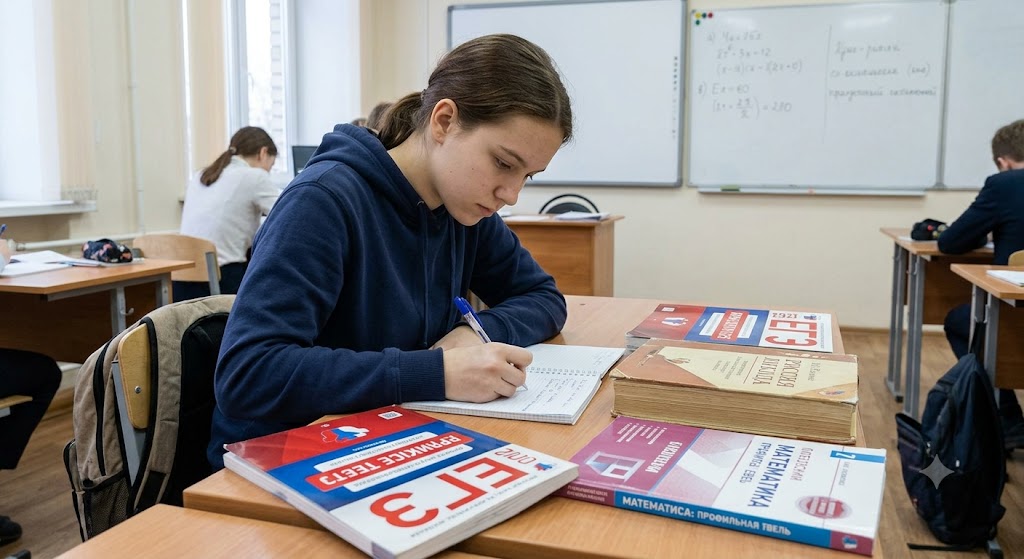
Additional Information
What the Course Entails and Exam Details
Preparing for the EGE is not just a single course but involves focused study across multiple academic disciplines determined by a student's chosen path. Effective preparation programs and study resources are designed to comprehensively cover the official curricula of these subjects as set by the Ministry of Education of the Russian Federation. The required subjects for receiving a secondary education certificate typically include the Russian Language and Mathematics. Beyond these compulsory core subjects, students must select additional elective subjects based on the entry requirements for their preferred university programs. These optional subjects span a wide spectrum:
Social Studies
Physics
History
Biology
Chemistry
Informatics and Information & Communication Technology (ICT)
Literature
Geography
Foreign Languages (such as English, German, French, Spanish, or Chinese)
Specific exam details, including the structure, syllabi, and official minimum scores, vary significantly between subjects and are regulated annually by Rosobrnadzor, the Federal Service for Supervision in Education and Science.
What to Expect in the Final Exam
The format of EGE examinations varies depending on the subject, generally involving a mix of task types within different sections. While each subject has its unique structure, many tests are composed of:
Multiple Choice Questions: Selecting the correct answer from given options.
Short Answer Tasks: Providing concise responses, such as words, numbers, or brief phrases.
Open-ended Questions & Detailed Solutions: This section (often referred to as Part C) requires comprehensive explanations, problem-solving procedures, analytical responses, and essays (especially prevalent in Russian Language, Literature, History, and Social Studies). For subjects like Mathematics, Physics, and Chemistry, these require showing full working and proofs.
Scoring and Timing: Exam durations differ, with major subjects often extending for nearly 4 hours (e.g., 3 hours 55 minutes) and others being shorter. Students must achieve the minimum primary and test points set annually for high school graduation and to be eligible for university applications.
Strict Regulations: The EGE has exceptionally strict protocols. Exams are typically written using specialized forms and black ink pens. Permitted items are usually restricted to an ID, pens, and potentially specific non-programmable calculators or rulers for technical subjects where explicitly allowed. Strict bans apply to electronic devices, including mobile phones and watches, communication equipment, and any unauthorized study materials. Exam centers operate with high security, including CCTV monitoring and independent observers.
How to Study and Exam Centers
Preparation for the EGE is often a multi-year effort, combining regular school coursework with targeted study. Recommended strategies include:
Solve Past Papers and Official Samples: Utilize official demonstration versions and the open bank of tasks provided by FIPI (Federal Institute for Pedagogical Measurements). Practicing with real past questions is crucial for understanding the format, typical tasks, and required depth of knowledge.
Focused Subject Revision: Deeply review textbooks, school notes, and reference materials for selected subjects, focusing on core concepts, definitions, formulas, rules, and analytical skills.
Practice Time Management: Complete practice tests under timed conditions to get used to the strict time limits of the actual exam and improve efficiency.
Master Open-Ended Tasks: For Part C questions, study the official scoring rubrics to understand precisely what examiners look for and practice writing detailed, logical, and structured responses.
Take Mock Exams: Participate in organized trial examinations to experience the pressure and conditions similar to the real EGE.
Seek Expert Guidance: Many students enroll in dedicated EGE preparation courses, private tutoring, or specialized educational centers to receive structured support.
Exam Centers and Registration: The EGE is held annually, generally with early, main, and additional waves (typically spanning late spring to early summer). Registration for the exams is done through official channels, often via a student’s school or regional education departments, with specific deadlines. Exams are not taken at open portals or private testing centers like Pearson VUE. Instead, students are assigned to official points of the Unified State Exam (ПУЭ - пункты проведения ЕГЭ), which are specifically authorized schools or educational institutions designated as test centers. Students will receive specific details about their assigned center before the exam dates.
Job Opportunities from the Course
Successfully completing the EGE and achieving strong scores do not directly unlock job opportunities through a specific "certification." Rather, the EGE is the indispensable gateway to higher education in Russia. Competitive performance in required subject combinations enables students to gain admission to diverse bachelor's or specialist degree programs, which then lead to various career paths upon graduation. Strong results in key combinations can pave the way toward fields such as:
Engineering, Computer Science, and Technology (Strong Math, Physics, Informatics performance)
Medicine, Healthcare, and Biotechnology (High scores in Biology, Chemistry, Russian Language)
Business, Economics, and Management (Focus on Mathematics (Profile level), Social Studies, Russian Language)
Law, Public Administration, and Politics (Strong performance in Social Studies, History, Russian Language)
Education, Social Sciences, and Humanities (Key subjects: Social Studies, History, Russian Language, Literature)
Linguistics, International Relations, and Global Affairs (Focus on Foreign Languages, History, Russian Language)
Creative Arts, Journalism, and Design (Requires EGE, often with emphasis on Literature, Russian, plus potentially specific university creative entrance exams)
Natural Sciences (Performance in Geography, Chemistry, Physics, Biology, etc.)
Essentially, the EGE opens the doors to specialized professional training that ultimately leads to a wide range of career opportunities across nearly all sectors.Here is your SEO-optimized article and a relevant image to go with it.
Frequently Asked Questions
Reviews
5.0
Based on 0 reviews
Leave a Review
No reviews yet. Be the first to review!