
EENT Practice Test Questions Answers
$69.00
- Buy to unlock unlimited access to all Quiz questions.
- After purchase you can print a PDF of the whole quiz at any point. The PDF will contain the questions and the correct answers.
About this Exam
Welcome to the essential preparation resource for the Eye, Ear, Nose, and Throat (EENT) practice assessment. This comprehensive set of practice questions and answers is specifically engineered to help students and aspiring healthcare professionals validate their knowledge in this specialized clinical domain. This is not just a recall test; it is a simulation of the core competencies required by governing boards for nursing, medical assisting, and surgical technology students. The exam is designed for individuals who have completed foundational anatomy and physiology coursework and are now focusing on the pathophysiology, assessment, and management of sensory and upper respiratory conditions. Success on this practice exam is a major step toward proving clinical readiness.
Ready to test your knowledge?
Buy Now to Access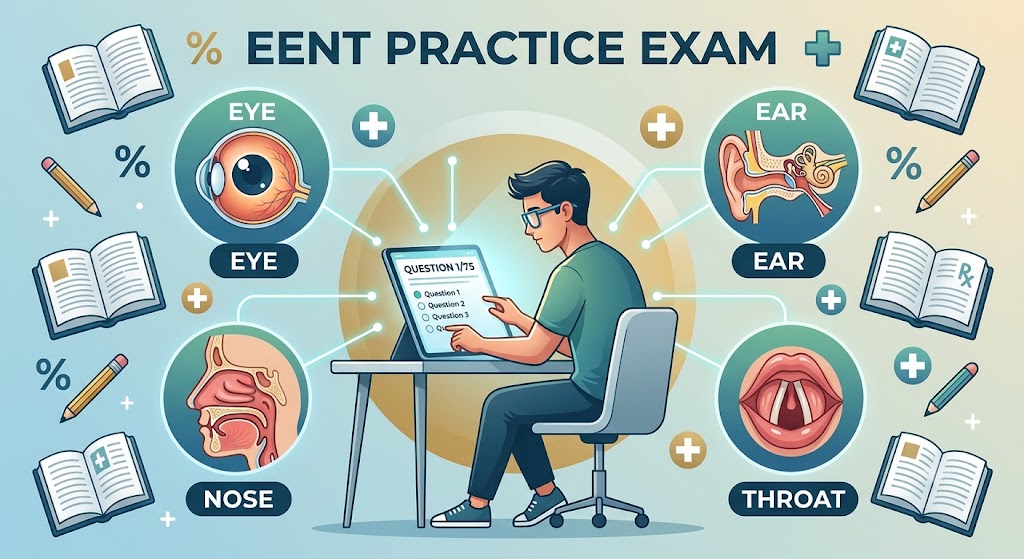
Additional Information
What the Course Entails and Exam Details
The content of this preparatory set is structured around the five core pillars of EENT medicine. You must master the integration of these systems to diagnose and treat patients effectively. The practice materials cover:
Anatomy and Physiology of the Sensory Organs: Detailed review of the ocular structures, the auditory and vestibular apparatus, the nasal cavity, and the pharynx and larynx.
Common Pathophysiology and Disorders: Understanding diseases such as glaucoma, cataract, Otitis Media, Ménière's disease, epistaxis, allergic rhinitis, and tonsillitis.
Diagnostic Testing and Assessments: Preparation for identifying typical findings from visual acuity tests (e.g., Snellen chart), tonometry, otoscopy, Weber and Rinne tuning fork tests, and nasal endoscopic findings.
Therapeutic Interventions and Pharmacology: Testing knowledge of standard pharmacological treatments, including ophthalmic drops, antibiotics, and antihistamines, as well as indications for surgical interventions like myringotomy or cataract extraction.
Patient Care and Education: Mastery of post-operative care instructions, preventive hygiene practices, and navigating emergency scenarios like orbital cellulitis.
What to Expect in the Final Exam
This EENT practice exam is a structured simulation of the final testing environment you will encounter during your licensing or certification process. The practice set contains 75 multiple-choice questions, which is a common format for intermediate medical certifications. Each question has four options, including comprehensive rationales for both correct and incorrect answers to enhance your learning. You should aim for a passing score of at least 80% on this practice set to feel confident about the final proctored exam. You are encouraged to time yourself, dedicating approximately 60 seconds per question to mimic official constraints. The test is closed-book to encourage genuine recall and critical thinking.
How to Study and Exam Centers
To maximize your score, we recommend a dynamic three-step approach:
Spaced Repetition: Engage with the practice questions multiple times over several weeks, rather than cramming. Focus your review effort heavily on the questions you answered incorrectly.
Active Recall and Visual Aid: Instead of simply reading, use the detailed rationales to create your own flashcards. Access medical diagrams for each of the four systems to ensure you can visualize the pathology described in the questions.
Simulation Testing: Dedicate an uninterrupted block of time to take the practice test in full exam-mode to build your mental stamina.
When you are ready to take your final, official certification exam, it will typically be administered at an authorized physical testing center. Major standardized medical tests are held at proctored locations such as Pearson VUE or Prometric centers worldwide. Alternatively, your accredited university or technical school may act as an authorized school portal, allowing you to take the exam on-site in a controlled environment. Ensure you verify the exact location requirements when you register for your official licensure.
Job Opportunities from the Course
Mastery of EENT competencies opens the door to numerous high-demand specializations within the medical field. By demonstrating strong performance in this area, you enhance your qualifications for the following professional roles:
Otolaryngology Medical Assistant
Ophthalmic Medical Technician
EENT Clinic Nurse (LPN/LVN/RN)
Surgical Technologist specializing in ENT procedures
Allergy and Immunology Clinical Assistant
Hearing Instrument Specialist
Medical Coder with specialized ENT designation
Frequently Asked Questions
Reviews
5.0
Based on 0 reviews
Leave a Review
No reviews yet. Be the first to review!