
DGCA AME Practice Test & Exam Prep | India
$69.00
- Buy to unlock unlimited access to all Quiz questions.
- After purchase you can print a PDF of the whole quiz at any point. The PDF will contain the questions and the correct answers.
About this Exam
The DGCA Aircraft Maintenance Engineering (AME) license is the essential certification for anyone aspiring to become a licensed Aircraft Maintenance Engineer in India. This license, issued by the Directorate General of Civil Aviation (DGCA), authorizes individuals to maintain, repair, and certify the airworthiness of aircraft. This exam preparation is crucial for students enrolled in AME training institutes or individuals seeking to pass the stringent DGCA modular examinations required to obtain this vital aviation qualification.
Ready to test your knowledge?
Buy Now to Access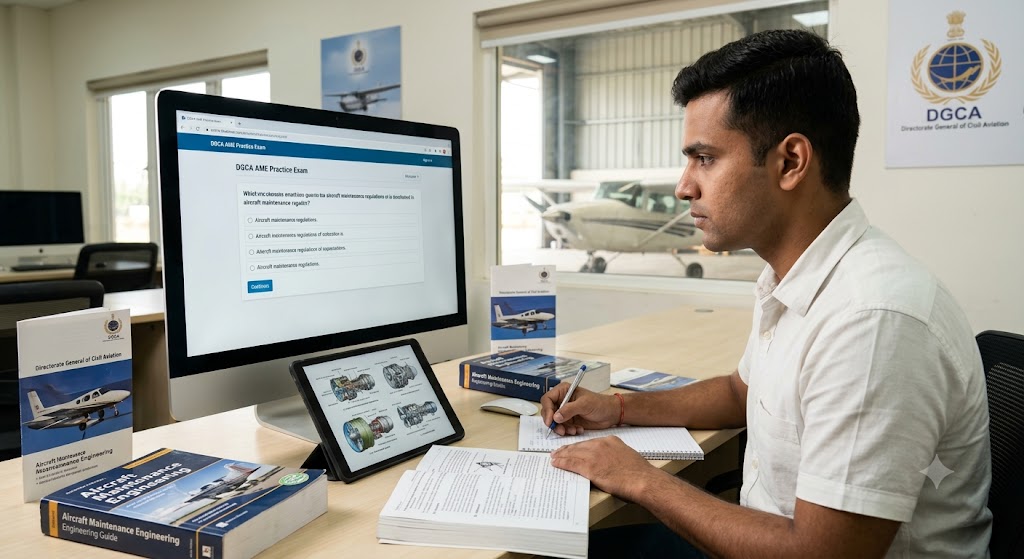
Additional Information
What the Course Entails and Exam Details
The path to obtaining a DGCA AME license involves passing a series of modular examinations (known as CAR-66 examinations). These exams cover the comprehensive syllabus mandated by the DGCA, focusing on technical knowledge necessary for aircraft maintenance. Core topics include:
Aviation Legislation: Understanding Indian aircraft rules and regulations (CAR-66, CAR-145, etc.).
Aerodynamics & Aircraft Structures: Principles of flight, airframe systems (for fixed-wing or rotary-wing).
Propulsion Systems: Knowledge of piston engines, gas turbine engines, and propeller systems.
Avionics & Electrical Systems: Electrical fundamentals, aircraft instruments, radio navigation, and communication systems.
Materials & Hardware: Properties of aviation materials and maintenance practices.
Human Factors: Understanding human performance limitations in maintenance environments.
Candidates must choose a specific category (e.g., B1.1 for Aeroplanes Turbine, B1.3 for Helicopters Turbine, or B2 for Avionics) which dictates the specific modules they need to pass.
What to Expect in the Final Exam
The DGCA AME licensing process consists of multiple written, objective-type examinations for each module. Here’s what candidates should expect:
Format: The examinations are conducted in a computer-based test (CBT) format, featuring Multiple-Choice Questions (MCQs).
Passing Score: The passing score for each module is typically 75%. Candidates must pass all required modules for their chosen category within a specified timeframe.
Time Limits: Each module exam has a strict time limit depending on the number of questions.
Practical Training: Passing the written modules is only part of the process. Candidates must also complete the mandatory practical training and gain specific maintenance experience (usually 2-4 years) at an approved Maintenance, Repair, and Overhaul (MRO) organization or airline to fully qualify for the license.
How to Study and Exam Centers
Preparation is key to success in the challenging DGCA AME exams. Here are actionable strategies:
Master the Syllabus: Utilize the official CAR-66 module textbooks and study material provided by your training institute, as these are the primary source for the exams.
Utilize Practice Tests: Regularly taking DGCA AME practice tests is essential. These mock exams help you familiarize yourself with the question format, time constraints, and identify weak areas that require more focus.
Focus on Understanding: Do not rely on rote memorization. Focus on thoroughly understanding the concepts and regulations.
Join Study Groups: Discussing concepts with peers can enhance learning and clarify complex topics.
Exam Centers: The DGCA Central Examination Organisation (CEO) conducts these examinations regularly (often quarterly). The exams are held at designated computer-based testing centers located in major cities across India, such as New Delhi, Mumbai, Bengaluru, Chennai, Hyderabad, and Kolkata. Candidates must register online through the official DGCA portal (like pariksha.dgca.gov.in) to book their exam slots at a convenient location.
Job Opportunities from the Course
Earning a DGCA AME license opens doors to rewarding career paths in the rapidly growing Indian aviation sector. Licensed AMEs are in high demand across various sectors:
Aircraft Maintenance Engineer (AME): Employed by domestic and international airlines (e.g., IndiGo, Air India, SpiceJet) to perform and certify line maintenance or base maintenance.
MRO Engineer: Working in independent Maintenance, Repair, and Overhaul (MRO) organizations specializing in heavy maintenance checks or component repair.
Technical Officer: Assisting in maintenance planning, reliability analysis, or technical documentation within aviation companies.
Quality Assurance/Quality Control (QA/QC) Inspector: Ensuring maintenance activities comply with DGCA regulations and safety standards.
General Aviation Engineer: Maintaining private jets, helicopters, or charter aircraft operations.
Frequently Asked Questions
Reviews
5.0
Based on 0 reviews
Leave a Review
No reviews yet. Be the first to review!