
Crest Practice Test & Exam Prep
Unlock the full practice quiz
Get complete access to the questions, explanations and printable quiz resources.
About this Exam
Welcome to your comprehensive guide for CREST Practice Test & Exam Prep.
CREST (the Council of Registered Ethical Security Testers) offers an internationally recognized suite of certifications that serve as the gold standard for technical information security professionals.
These exams are specifically designed for individuals pursuing careers in disciplines such as penetration testing, threat intelligence, and incident response.
CREST certifications are tiered to meet professionals at every stage of their career journey, from entry-level Practitioners, through experienced Registered testers, to elite Certified experts.
By providing a clear, structured career path, CREST enables you to demonstrate your skills, competence, and commitment to the industry, making you highly attractive to employers, governments, and regulators worldwide.
Ready to test your knowledge?
Buy Now to Access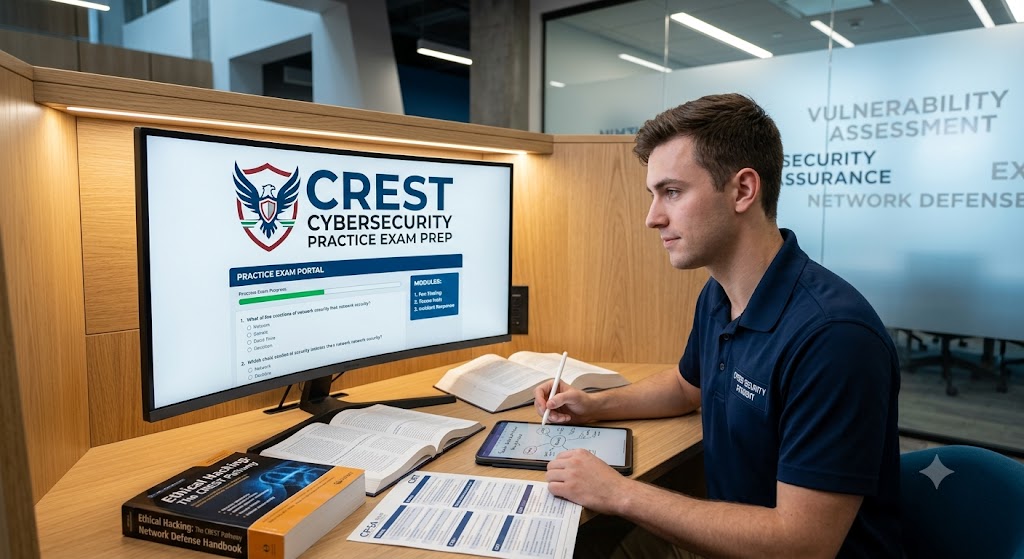
Additional Information
What the Course Entails and Exam Details
Preparing for a CREST certification is not just about memorizing facts; it is about proving practical capability in a controlled environment.
The curriculum is tailored to three core disciplines, each with its own progression:
Penetration Testing: Covering specialized areas like Infrastructure, Web Applications, and Wireless testing.
Threat Intelligence: Focusing on the analysis, management, and application of threat data.
Incident Response: Concentrating on the skills needed to detect, contain, and eradicate security breaches.
A common entry point is the CREST Practitioner Security Analyst (CPSA). This initial exam establishes a foundational knowledge base in network assessment, vulnerability scanning, and common attack vectors.
Successful candidates often then progress to the CREST Registered Penetration Tester (CRT), which demands a higher level of practical, hands-on skill, serving as a prerequisite for specialist Certified level examinations.
What to Expect in the Final Exam
While exact formats vary by level and specialization, you should expect a challenging and comprehensive testing experience.
Most lower-level Practitioner exams, such as the CPSA, are computerized, multiple-choice assessments that test theoretical knowledge and its application in scenario-based questions. They often last between two to four hours.
Registered and Certified level exams typically evolve into a rigorous hybrid model. They often include a multiple-choice component, followed immediately by a substantial, hands-on practical section.
In these practical components, you will be given access to a simulated network environment. Your task will be to perform actual security assessments, identify vulnerabilities, and exploit them in a real-world manner, simulating the tasks you would perform on the job.
Passing requires a demonstrating both a mastery of the subject matter and a high level of proficiency with professional security tools.
How to Study and Exam Centers
Preparation is the absolute key to success for any CREST exam. Practical, hands-on experience is non-negotiable.
Actionable Study Strategies:
Utilize Official Practice Labs: CREST collaborates with platforms like Hack The Box and Immersive Labs to provide experiential training aligned directly with their certifications. Leverage these official partnerships to practice offensive and defensive skills.
Analyze Syllabus and Reading Lists: Download the detailed exam syllabus and recommended reading lists from the official CREST website. Every topic is a potential question.
Build Your Own Lab: Set up virtual machines to practice scanning, exploitation, and analysis tools in a safe, legal environment. Focus on mastering the entire methodology, from reconnaissance to reporting.
Practice Time Management: Simulating exam conditions by completing full-length practice tests to improve both your accuracy and speed under pressure.
Exam Center Information:
Theoretical (multiple-choice) components are administered globally through recognized test center networks, primarily Pearson VUE. You can schedule these exams at authorized physical locations or via online proctoring where available.
Practical portions of Registered and Certified exams are typically conducted at official CREST facilities or highly controlled, secure environments.
Job Opportunities from the Course
Earning a CREST certification opens doors to specialized, high-demand, and lucrative career paths within the cybersecurity industry.
Job Titles unlocked by this certification path include:
Entry Level (Practitioner): Junior Security Analyst, Vulnerability Assessment Specialist, Junior Penetration Tester.
Mid-Level (Registered): Penetration Tester, Security Consultant, Threat Intelligence Analyst.
Senior Level (Certified): Senior Security Consultant, Lead Penetration Tester (CHECK Team Leader), Incident Response Manager, Cyber Security Manager.
Achieving these certifications not only validates your expertise but also significantly enhances your earning potential and provides a globally recognized framework for rapid career progression.
Related Quizzes
CREST Practitioner Security Analyst (CPSA) Practice
Frequently Asked Questions
Reviews
5.0
Based on 0 reviews
Leave a Review
No reviews yet. Be the first to review!