
CRCST Practice Test – Chapter 7 Decontamination: Point–of–Use Treatment and Transport
$69.00
- Buy to unlock unlimited access to all Quiz questions.
- After purchase you can print a PDF of the whole quiz at any point. The PDF will contain the questions and the correct answers.
About this Exam
The Certified Registered Central Service Technician (CRCST) designation is the premier entry-level credential for healthcare professionals working in sterile processing and distribution. This certification, recognized globally, validates that an individual possesses the essential knowledge and skills needed to decontaminate, inspect, assemble, package, and sterilize reusable surgical instruments and medical devices. The complete CRCST exam covers a broad scope of sterile processing, with specialized focus areas. This particular study guide is designed for individuals preparing for the dedicated section on CRCST Chapter 7: Decontamination, focusing specifically on Point-of-Use Treatment and Transport. Mastering this chapter is critical, as it details the first, essential step in the entire decontamination loop, preventing cross-contamination and protecting both patients and staff.
Ready to test your knowledge?
Buy Now to Access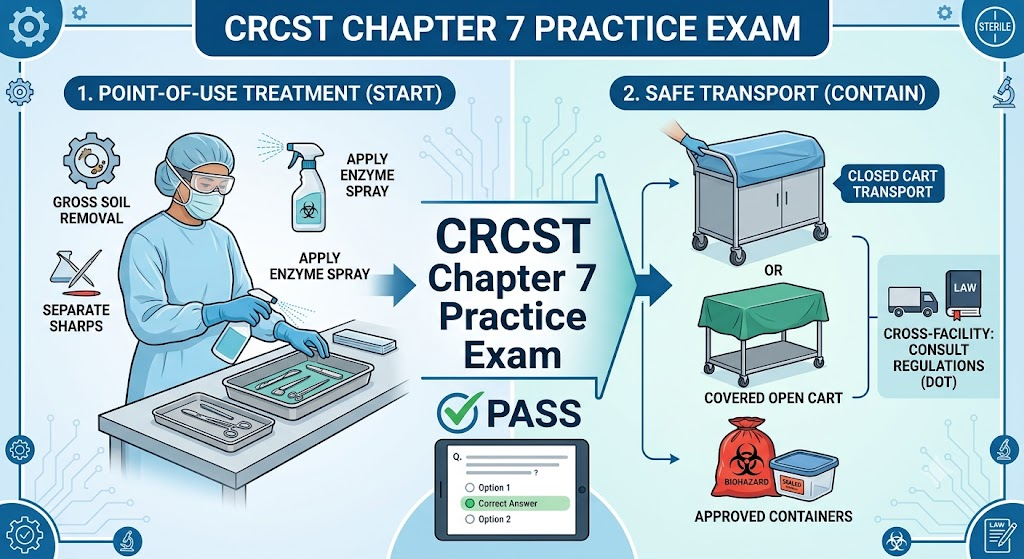
Additional Information
What the Course Entails and Exam Details
While this guide focuses on a practice test, the foundational knowledge it assesses is drawn directly from the 'Chapter 7' curriculum of the official HSPA (Healthcare Sterile Processing Association) technical manual. The exam section focuses on the detailed processes that occur before surgical instruments even arrive in the main decontamination area. Key topics include:
Point-of-Use Treatment Fundamentals: Understanding the purpose and timing of initial gross soil removal, which begins during a surgical procedure.
Step-by-Step Treatment Procedures: Detailed knowledge of proper post-procedure tasks, including removing disposable components, emptying fluids, separating reusable sharps to prevent injury, and flushing lumens and channels.
Item Separation and Containment: Best practices for separating used from unused devices, keeping instrument sets together, and identifying items needing repair.
Initial Chemical Application: Understanding when and how to apply enzyme sprays, foams, or surfactant products to prevent gross soil from drying.
Safe Transport Protocols: The critical importance of training for all transport personnel and the specific, approved methods for moving contaminated items—including the use of closed carts (the preferred method), properly covered open carts with solid bottom shelves, or approved biohazard containers and bags.
Regulatory Compliance: Understanding facility responsibility to consult US Department of Transportation (DOT) and local/state laws when transporting soiled items between facilities.
What to Expect in the Final Exam
It's important to understand the relationship between this practice guide and the full certification. The comprehensive CRCST Final Exam is the culminating test required for certification. Here are the details of that full exam, of which Chapter 7 content is a vital part:
Format: The exam consists of 150 multiple-choice questions. Of these, 125 questions are scored, and 25 are unscored pretest questions, randomly placed. You will not know which questions are unscored.
Time Limit: You will be given three hours to complete the full exam.
Scoring: Results are reported on a pass/fail basis. The specific passing score is not disclosed, and you will not receive a numerical result.
Hands-on Requirement: To receive full certification after passing the exam, you must complete 400 hours of hands-on sterile processing experience and have it verified, either before or after testing (provisional certification is available for those who pass the test first).
How to Study and Exam Centers
Effective preparation for both the general certification and the Chapter 7 specialization requires a focused approach. We recommend these strategies:
Utilize the Official Manual: Your primary resource must be the latest edition of the HSPA Technical Manual (currently the 9th edition). Study Chapter 7 in detail, focusing on every stated procedure.
Leverage Practice Tests: Use this specific study guide and seek out other high-quality practice exams. They are invaluable for familiarizing yourself with the multiple-choice format, identifying weak knowledge areas, and practicing time management, aiming for approximately 70 seconds per question.
Understand 'Best Practices': The exam often uses 'best next step' and safety-first wording. Think critically about the first or most correct action in a scenario, rather than just what 'could' be done.
Registration and Centers: To take the official CRCST exam, you must first register with the HSPA (Healthcare Sterile Processing Association). You can apply through their online portal. The actual testing is typically administered at authorized, professional third-party computer-based testing centers, such as those operated by Prometric or other authorized physical testing sites. You will receive scheduling instructions after your application is approved.
Job Opportunities from the Course
Successfully mastering the CRCST Chapter 7 content and earning your full certification unlocks numerous career paths within healthcare sterile processing and quality management. This certification is highly regarded and often mandatory for advancement in the field. Potential job roles include:
Sterile Processing Technician
Lead Sterile Processing Technician
Sterile Processing Assistant
Instrument Specialist
Quality Assurance Specialist in Sterile Processing
Clinical Educator for Sterile Processing
Sterile Processing Manager
Regional Sterile Processing Supervisor
Infection Prevention Coordinator (Specialized Path)
Frequently Asked Questions
Reviews
5.0
Based on 0 reviews
Leave a Review
No reviews yet. Be the first to review!