
CRCST Practice Test – Chapter 1 Introduction to Sterile Processing
$69.00
- Buy to unlock unlimited access to all Quiz questions.
- After purchase you can print a PDF of the whole quiz at any point. The PDF will contain the questions and the correct answers.
About this Exam
The Certified Registered Central Service Technician (CRCST) certification, administered by the Healthcare Sterile Processing Association (HSPA), is the premier credential for professionals working in sterile processing departments (SPD).
This certification validates a technician’s knowledge and skills in the critical area of cleaning, decontaminating, sterilizing, and distributing medical instruments and equipment.
Achieving CRCST certification demonstrates a commitment to patient safety and is often a prerequisite for employment in many healthcare facilities.
This specific practice test covers Chapter 1, which provides the essential foundational knowledge required for all subsequent topics in the CRCST curriculum. It is designed for aspiring sterile processing technicians who are starting their journey and want to gauge their understanding of the fundamental concepts of the field.
Ready to test your knowledge?
Buy Now to Access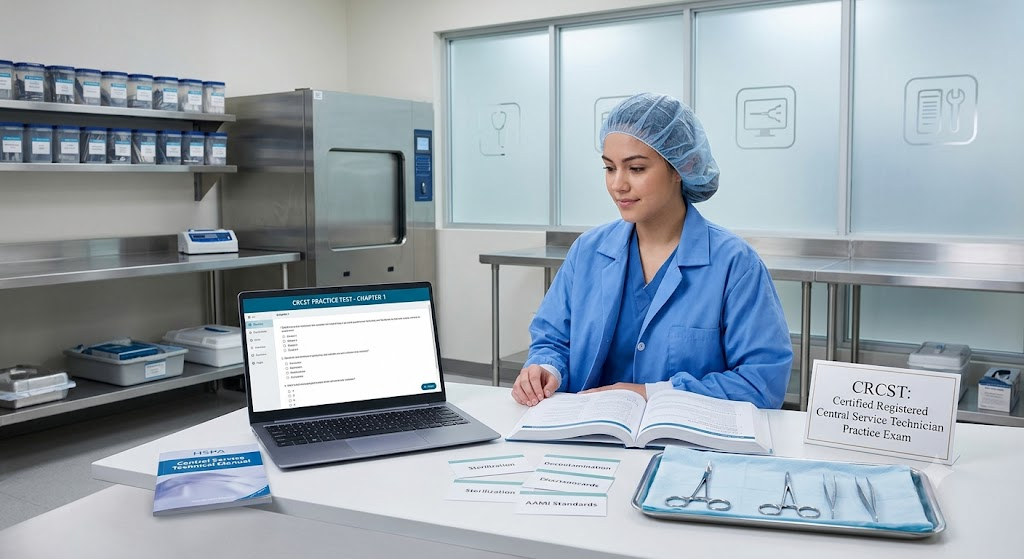
Additional Information
What the Course Entails and Exam Details
The Introduction to Sterile Processing course, often the first module in a CRCST program, builds the foundation for your entire career. It covers the crucial roles, responsibilities, and workflows within the Central Service Department.
Key topics covered in this foundational chapter include:
The History of Sterile Processing: Understanding the evolution of sterilization practices and why modern techniques are critical.
The Role of the Central Service Department: Defining the SPD's function within the broader healthcare ecosystem, emphasizing its role in infection prevention.
Workflow and Design: Mastering the standardized flow from decontamination to sterilization and sterile storage.
Key Regulatory Agencies and Standards: Introduction to organizations that set guidelines, such as AAMI, CDC, OSHA, and the Joint Commission.
Safety Practices and Personal Protective Equipment (PPE): Learning the essential safety protocols to protect yourself and others.
Basic Microbiology and Terminologies: Grasping the fundamental concepts of microorganisms and the specific terminology used in the sterile processing field.
A Chapter 1 practice test typically contains 20-30 multiple-choice questions designed to assess your recall and understanding of these core principles before moving on to more complex technical subjects like sterilization methods or instrumentation.
What to Expect in the Final Exam
While a Chapter 1 practice test is a short, focused assessment, the final CRCST certification exam is a comprehensive, rigorous test covering all chapters of the standard HSPA manual.
Here is a general outline of what to expect from the full, official CRCST exam:
Exam Format: The full exam consists of 150 multiple-choice questions. A certain number of these are pretest questions that do not count toward your final score.
Time Limit: Candidates are typically given 3 hours (180 minutes) to complete the entire exam.
Passing Score: The HSPA uses scaled scoring, but candidates generally need to achieve a raw score equivalent to 70% or higher to pass. You will receive your results immediately after completing the exam at the testing center.
Proctored Environment: The exam is administered in a secure, proctored environment at an official testing center (such as Prometric). You will need to bring government-issued photo identification and will be monitored throughout the test. No external resources are permitted during the exam.
How to Study and Exam Centers
Preparation is paramount for the CRCST exam. Because this foundational chapter sets the stage for all others, you must master the basic concepts before moving on.
Here are actionable study strategies:
Utilize the HSPA Textbook: The primary study resource should always be the current edition of the HSPA Central Service Technical Manual. Read Chapter 1 multiple times, focusing on the key bolded terms, objectives, and review questions.
Make and Review Flashcards: Create physical or digital flashcards for every key term and regulatory body introduced in Chapter 1. Consistent repetition is essential for memory retention.
Take Multiple Practice Tests: Do not rely on a single practice test. Take various tests from different sources to ensure you can apply your knowledge in different question formats. Thoroughly review the rationale for any answers you missed.
Form or Join a Study Group: Discussing concepts with peers can clarify confusing topics and expose you to different perspectives. Teaching a concept to others is one of the best ways to master it yourself.
Exam Centers
The official CRCST certification exam is administered through HSPA's partner, Prometric. They have thousands of secure testing centers worldwide. You cannot take the official exam online from home.
To schedule your exam, you must first apply through the HSPA website and receive your eligibility ID. Once you have this, you can schedule your testing appointment directly on the Prometric website, selecting a physical location that is convenient for you.
Job Opportunities from the Course
Earning your CRCST certification is a significant career milestone that can dramatically increase your employability and earning potential. Hospitals and ambulatory surgical centers have a constant need for certified technicians to ensure patient safety.
This certification unlocks a clear career path with roles such as:
Sterile Processing Technician
Central Service Technician (CST)
Decontamination Technician
Instrumentation Technician
SPD Lead Technician
Endoscopy Technician (often requires additional specialization)
Sterile Processing Supervisor (requires experience)
SPD Manager (requires significant experience and often further education)
Frequently Asked Questions
Reviews
5.0
Based on 0 reviews
Leave a Review
No reviews yet. Be the first to review!