
CPC Medical Terminology Practice Test – Question Answers
$69.00
- Buy to unlock unlimited access to all Quiz questions.
- After purchase you can print a PDF of the whole quiz at any point. The PDF will contain the questions and the correct answers.
About this Exam
The Certified Professional Coder (CPC) credential is the gold standard for medical coding in physician office settings. This certification, offered by AAPC (American Academy of Professional Coders), validates proficiency in reviewing documentation and translating medical services into standardized codes. A robust understanding of medical terminology is the absolute foundation of this skillset. This practice resource is designed specifically for aspiring medical coders, billing specialists, and student administrators who need to master anatomy and medical language to accurately assign CPT, ICD-10-CM, and HCPCS Level II codes. Mastering medical terminology ensures that you can understand the diagnoses, procedures, and conditions described in medical charts.
Ready to test your knowledge?
Buy Now to Access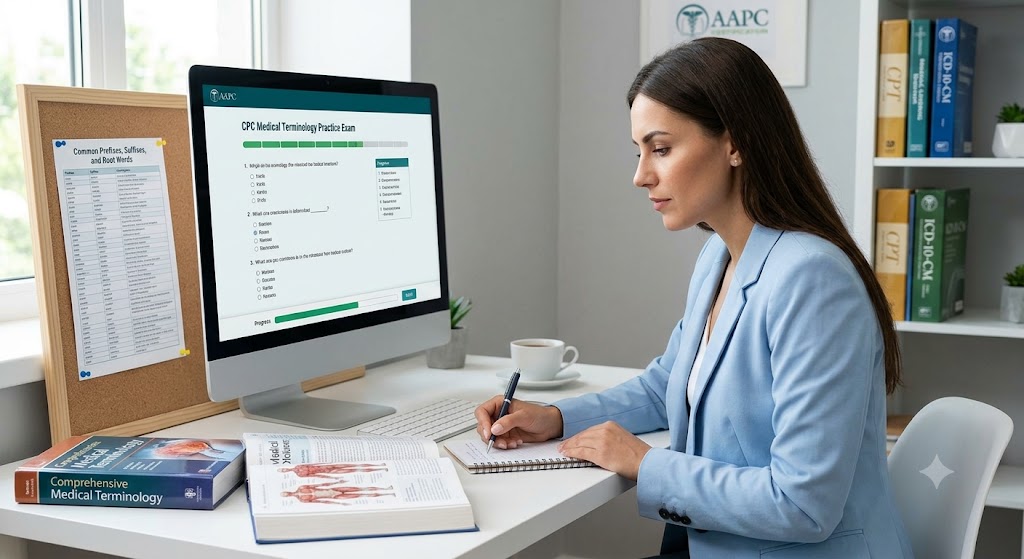
Additional Information
What the Course Entails and Exam Details
While the general CPC course covers the full spectrum of coding guidelines and regulations, the medical terminology foundation is vital. This foundational knowledge entails breaking down complex medical terms into their constituent parts: prefixes (beginnings), suffixes (endings), and word roots (core meanings), along with combining vowels.
You must become proficient in the terminology related to all major human body systems, including the musculoskeletal, cardiovascular, respiratory, digestive, urinary, nervous, and endocrine systems.
Understanding medical terminology directly translates to exam success, as many CPC exam questions require you to correctly interpret a medical term within a clinical scenario before you can even begin to select the correct procedure or diagnosis code.
What to Expect in the Final Exam
The actual CPC certification exam is a rigorous test of your coding knowledge and speed. The full CPC exam consists of 100 multiple-choice questions, which must be completed within 4 hours. It is an open-book exam, allowing you to use approved editions of the AMA's CPT, ICD-10-CM, and HCPCS Level II codebooks.
Medical terminology is a core component of the exam. You will encounter questions that explicitly test your knowledge of terminology and anatomy, often embedded within broader medical coding scenarios.
AAPC does not provide a separate breakdown of passing scores for medical terminology alone, but a passing score of 70% or higher on the entire 100-question CPC exam is required to earn the credential.
How to Study and Exam Centers
Effective study strategies are crucial for mastering medical terminology for the CPC.
AAPC Resources: The most reliable study materials come directly from AAPC. Consider enrolling in their official Medical Terminology Course, purchasing their CPC Study Guide, or taking their official practice exams. These resources directly align with the exam content.
Flashcards and Active Recall: Use flashcards (physical or digital apps like Anki) to memorize root words, prefixes, suffixes, and anatomical terms. This is a very effective way to build fluency.
Focus on Word Building: Practice breaking down new medical terms into their components to understand their meaning rather than just trying to memorize whole definitions.
Anatomy Visualization: Use diagrams and charts to visualize the location of organs and body systems, as this will help contextually understanding the associated terminology.
Exam Centers: The official CPC exam is proctored and can be taken in two ways:
Electronic Proctoring (Live Online): You can take the exam from the comfort of your own home or office, proctored live via a webcam.
Physical Testing Centers: AAPC schedules in-person exams at various locations, including local AAPC chapters and authorized testing centers globally. You can find locations and schedule your exam through the AAPC website.
Job Opportunities from the Course
A CPC certification, supported by a strong command of medical terminology, opens doors to various career paths within the healthcare administrative sector. Here are common job titles available to certified coders:
Certified Professional Coder (CPC)
Medical Coder
Outpatient Medical Coder
Medical Billing Specialist
Medical Records Technician
Health Information Technician (HIT)
Coding Auditor
Risk Adjustment Coder
Frequently Asked Questions
Reviews
5.0
Based on 0 reviews
Leave a Review
No reviews yet. Be the first to review!