
CPC Anesthesia Practice Test – Questions Answers
$69.00
- Buy to unlock unlimited access to all Quiz questions.
- After purchase you can print a PDF of the whole quiz at any point. The PDF will contain the questions and the correct answers.
About this Exam
The [CPC Anesthesia Practice Test] is a critical preparatory tool for experienced medical coders seeking to validate their specialized expertise in anesthesia and pain management coding.
Designed for professionals aiming for advanced credentials such as the AAPC’s Certified Anesthesia and Pain Management Coder (CANPC™) designation, this practice exam bridges the gap between general CPC knowledge and the nuanced intricacies of the anesthesia department.
Successful anesthesia coders are essential to the financial health of surgical teams, ensuring accurate reimbursement for complex procedures, and this practice test ensures you are ready for the challenge.
Ready to test your knowledge?
Buy Now to Access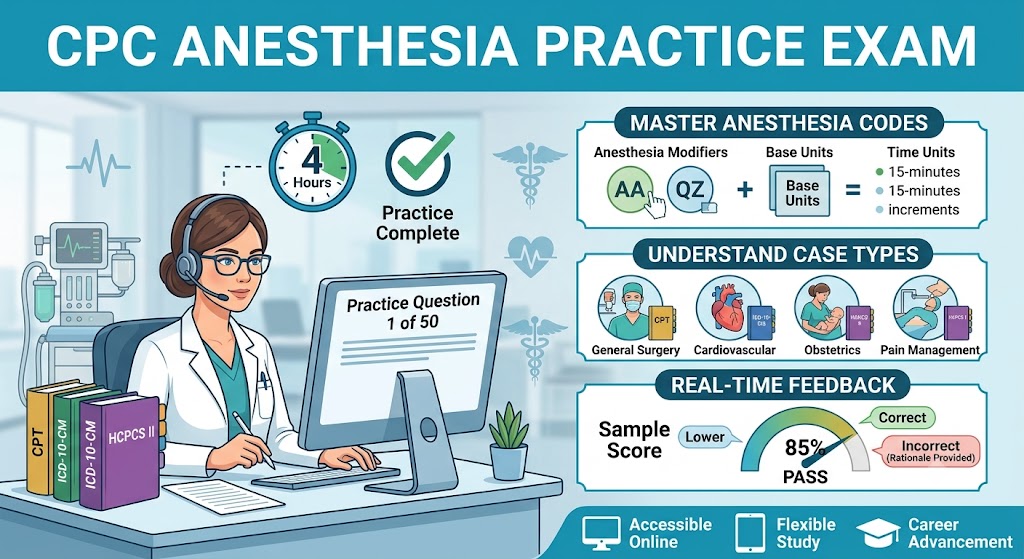
Additional Information
What the Course Entails and Exam Details
While this is a [practice test] and not a full course, it is structured to test your knowledge of the core concepts required for the specialized CANPC™ certification.
The material covered includes the entire anesthesia coding lifecycle, from pre-anesthesia evaluation to post-operative pain management.
Key topics you will be tested on include:
Anesthesia CPT Coding: Mastering the 00100–01999 code range, including anesthesia for surgical procedures on all body systems.
Time Reporting and Calculations: Understanding how to report anesthesia time in minutes, calculate time units, and determine base units from the Crosswalk® guide.
Specialized Modifiers: Accurately applying critical modifiers such as anesthesia modifiers (AA, QZ, QX, QY), physical status modifiers (P1–P6), and qualifying circumstances (e.g., extreme age, emergency).
Anatomical and Medical Terminology: Proving fluency in terms relevant to anesthesia, such as specific nerve blocks, monitoring techniques, and drug delivery systems.
ICD-10-CM Diagnosis Coding: Linking diagnoses to support medical necessity for anesthesia services and pain management.
What to Expect in the Final Exam
The actual CANPC™ certification exam is a rigorous test of endurance and accuracy. By utilizing a [CPC Anesthesia Practice Test], you can familiarize yourself with this intense format.
The final official exam will be:
Format: A closed-room, proctored setting.
Structure: Composed of 100 multiple-choice questions, many based on unique coding scenarios or case studies.
Time Limit: You are given 4 hours to complete the exam.
Open Book: You are permitted to use current, approved editions of the AMA CPT®, ICD-10-CM, and HCPCS Level II codebooks.
Passing Score: A minimum score of 70% is required to earn your certification.
How to Study and Exam Centers
Preparation is the definitive key to success for this specialized exam. The most effective way to prepare is to integrate highly realistic [CPC Anesthesia Practice Test] attempts into your study schedule.
Actionable Strategies:
Simulate the Real Thing: Take full-length, timed practice tests to build mental stamina and master time management (approximately 2.4 minutes per question).
Tabbing Your Books: Efficiently use the open-book rule by heavily tabbing your codebooks. Create custom sections for anesthesia guidelines, common anesthesia modifiers, and the Crosswalk® sections.
Review Rationale: Never just check if you got a question right; meticulously review the rationale for every correct and incorrect answer to understand the ‘why’ behind the code selection.
Exam Centers and Location: You cannot take the final CANPC™ exam directly through this practice test portal. Once you are confident in your practice scores, you must register for the official exam through the AAPC. The exam is administered in two formats:
Online, Live Remote Proctored: Taken from your home or office in a secure, distraction-free environment, requiring an external webcam and a reliable internet connection.
In-Person Testing Centers: Scheduled at a physical testing center, such as Meazure Learning or specialized AAPC authorized locations worldwide.
Job Opportunities from the Course
Earning a specialized anesthesia coding certification, validated by your success on the [CPC Anesthesia Practice Test], unlocks a distinct competitive advantage in the healthcare market.
Employers actively seek coders with proven specialized knowledge, often offering higher salaries and more remote opportunities.
Potential career paths and job titles include:
Certified Anesthesia Coder
Pain Management Coding Specialist
Anesthesia Auditor
Surgical Coding Specialist (with anesthesia emphasis)
Revenue Cycle Analyst, Anesthesia Department
Medical Billing Specialist, Anesthesia and Interventional Pain
Coding Educator or Consultant, Anesthesia Specialties
Frequently Asked Questions
Reviews
5.0
Based on 0 reviews
Leave a Review
No reviews yet. Be the first to review!