
Court Interpreter Practice Test & Exam Prep
$69.00
- Buy to unlock unlimited access to all Quiz questions.
- After purchase you can print a PDF of the whole quiz at any point. The PDF will contain the questions and the correct answers.
About this Exam
The Court Interpreter certification validates a bilingual individual's proficiency and readiness to ensure equal access to justice in legal proceedings. It is a critical qualification for those who wish to work as professional interpreters within the judicial system. The role demands an exceptional level of fluency in both English and a non-English language, unwavering impartiality, and a strict adherence to ethical standards. This study guide and practice test series are designed for aspiring and current interpreters who are dedicated to mastering the specialized skills and knowledge required to become a certified court interpreter, facilitating accurate communication in courts, depositions, and other legal environments
Ready to test your knowledge?
Buy Now to Access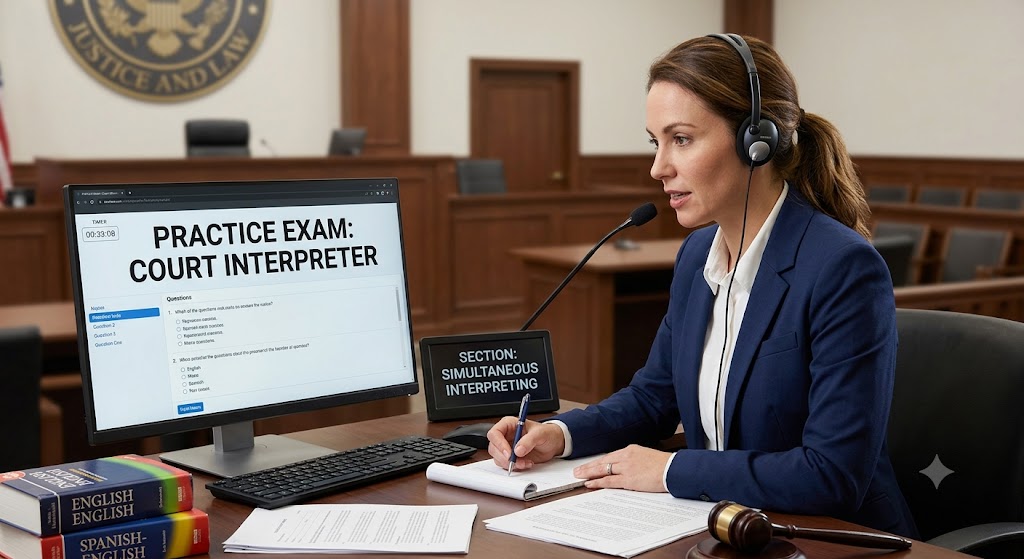
Additional Information
What the Course Entails and Exam Details
This comprehensive "practice test & exam prep"
pathway encompasses all areas tested across various certification
jurisdictions, including both state and federal court systems. The core focus
is on developing and verifying a high degree of competence in the three main
modes of interpreting. You will cover simultaneous interpreting, which involves
listening to one language and rendering it in another in real time. It also
covers consecutive interpreting, the process of interpreting after a speaker
finishes a segment, and sight translation, where you must provide an oral
translation of a written legal document on the spot. Beyond the core modes,
your preparation will include mastering complex legal terminology, extensive
general vocabulary in both languages, nuances of style and register, and,
crucially, a deep understanding of the code of professional ethics and
responsibility for court interpreters. The practice exams will mirror these
skill-specific components, helping you assess your strengths and identify areas
for improvement.
What to Expect in the Final Exam
While the exact structure may vary by jurisdiction (e.g., federal
versus specific state models like the one from the National Center for State
Courts), the certification journey always involves a minimum of two distinct
phases. You must first successfully navigate a written examination. This part
is frequently a computer-based, multiple-choice test that assesses your command
of English vocabulary and grammar, knowledge of common court-related
terminology and procedures, and your ability to apply ethical standards to
practical scenarios. You generally must pass the written exam with a
predetermined score, often around 70-80%, to become eligible to take the more
intensive oral performance examination. The final oral exam is the
performance-based hurdle that you will practice most intensely for. It
evaluates your skills in all three interpreting modes under timed, proctored
conditions, often using actual case transcripts. Your performance will be
recorded and scored by human raters against specific "scoring
units"—key phrases and words that must be translated with 100?curacy.
To achieve certification, you typically must pass each section of the oral exam
(simultaneous, consecutive, and two sight translations) in a single sitting
with a minimum score, often required to be 70% per section. Time limits are
strict, simulating the rapid pace of real court proceedings.
How to Study and
Exam Centers
Effective preparation is key to success on this challenging
exam. We recommend a multi-faceted study strategy. Begin by taking official
written and oral practice tests to familiarize yourself with the format and
identify specific weaknesses. You should proactively record your practice
interpretations for oral tasks, and then meticulously critique them for
omissions, additions, and inaccuracies. Expanding your specialized legal
vocabulary in both languages is paramount, so make a habit of reading actual
court documents, legal codes, and high-quality news sources related to law
enforcement and justice in both of your languages. You can also join a virtual
or in-person interpretation practice group to challenge your skills with peers.
As you approach test readiness, register for and take the written exam. This
part of the process is typically conducted at authorized physical testing
centers, such as those run by Prometric or Pearson VUE, which are located
throughout various regions. In some specific programs, it may also be offered
as an online-proctored exam. Upon passing the written section, you will then
become eligible to register for the oral performance examination. This crucial,
performance-based test is almost exclusively administered in person at
designated state supreme courts, administrative offices of the courts, or
specific physical locations authorized by the certifying body. Always check
with your specific state's language access coordinator or the federal program
website for their exact testing center locations and registration protocols.
Job Opportunities from the Course
A Court Interpreter certification unlocks a range of
rewarding and influential career paths within and adjacent to the judicial
system. Achieving this credential not only demonstrates a high level of
language and professional skill but also a commitment to fairness and equity. The
specific job titles available include:
- Certified
State Court Interpreter
- Certified
Federal Court Interpreter (a separate, distinct, and highly respected
credential)
- Remote
Legal Interpreter (working for court systems, law firms, or language
service providers)
- Freelance
Court Interpreter (providing services on a contract basis for courts and
legal professionals)
- Deposition
Interpreter (working alongside attorneys during pre-trial testimony)
- Immigration
Court Interpreter (a highly in-demand specialization)
- Conference
Interpreter with a legal and/or political specialization
- Language
Services Manager within a court system or government agency
These roles can be full-time, part-time, or freelance, and
they often offer flexibility and competitive compensation for qualified
professionals. Beyond the immediate legal sphere, your refined interpreting and
language skills can also lead to opportunities in other demanding fields, including
international business, diplomacy, and high-level medical interpretation.
Frequently Asked Questions
Reviews
5.0
Based on 0 reviews
Leave a Review
No reviews yet. Be the first to review!