
Cms Sommelier Practice Test & Exam Prep
$69.00
- Buy to unlock unlimited access to all Quiz questions.
- After purchase you can print a PDF of the whole quiz at any point. The PDF will contain the questions and the correct answers.
About this Exam
The Court of Master Sommeliers (CMS) provides a worldwide curriculum and examinations for hospitality professionals. Its progressive levels—Introductory, Certified, Advanced, and Master Sommelier—test expertise in wine, spirits, beer, service, and blind tasting. Earning CMS credentials validates high levels of knowledge and professional skills, opening doors to advanced careers in the wine industry. This guide focuses on preparation for the examinations on the CMS path.
Ready to test your knowledge?
Buy Now to Access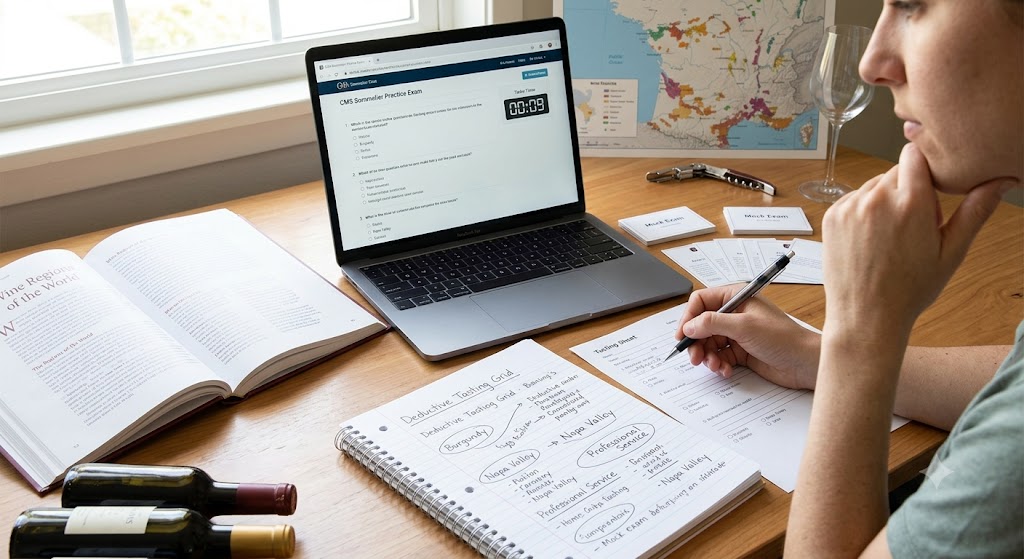
Additional Information
What the Course Entails and Exam Details
The core CMS syllabus covers several key areas. These
include: Global wine regions, grape varieties, wine production methods, and
classic wine styles. Beyond wine, candidates must master spirits, beer, cider,
sake, and major global beverages. Crucially, the training emphasizes
professional service standards, food and wine pairing, and the art of wine stewardship.
Theory knowledge is extensive, involving geography, history, laws, labels, and
technical specifications across major and lesser-known regions. Practical
service techniques, such as proper decanting, sparkling wine service, and
high-level hospitality, are tested. A central component is blind tasting, where
candidates learn the Deductive Tasting Method to identify key markers of
classic wines.
What to Expect in
the Final Exam
The structure of CMS examinations evolves significantly
through the levels, increasing in complexity.
Introductory Sommelier Examination: This is the entry
point. It is a one-and-a-half-day course followed immediately by a
multiple-choice examination. There is no blind tasting or practical service
component in the exam (the course teaches these). The exam has
approximately 70 multiple-choice questions. A minimum score of 60% is required
to pass. The time limit for the exam is typically about an hour.
Certified Sommelier Examination: This is typically a
single-day examination, usually separate from a course. It consists of three
parts, which must be passed individually and in combination:
- Theory
Paper: Multiple-choice, short-answer, definitions, and short essays.
This covers global regions, production, grapes, service, and beverage
knowledge.
- Tasting:
Blind tasting of four wines (two white, two red) within 30 minutes, using
the Deductive Tasting Grid.
- Service:
A practical service demonstration where candidates must show
professionalism, safety, efficiency, and correct service procedures at a
mock table.
Passing requirements generally involve achieving a minimum
average score, with no single component below a certain threshold (often around
60%). The complete exam takes several hours. The Advanced and Master levels are
exponentially more demanding, multi-day exams testing the same categories at
the highest proficiency.
How to Study and
Exam Centers
Success in CMS examinations requires combining rigorous
independent study with hands-on practice. Use official Court of Master
Sommeliers recommended reading lists and study guides. Map work is crucial for
memorizing regions, classifications (like AOCs, DOCGs), and locations. Form or
join a study group to practice blind tasting using the Deductive Tasting Method
(DTM) consistently. Practice descriptive terminology and tasting grids.
Practice professional service drills, including sparkling wine service,
decanting, opening cork-finished bottles, and food and wine pairing scenarios,
focusing on smoothness and guest service standards. Deepen your knowledge of
major global spirits, cocktails, and other beverages. Take mock theory exams
regularly.
Exam Centers: The Court of Master Sommeliers holds
examinations at varying locations globally. To view upcoming courses and exams,
you must create a profile on their official website and register. The exams are
conducted in person at physical host locations such as hotels, culinary
centers, and specialized wine academies. Intro courses with exams are often
held in major cities. Certified exams have specific locations announced
periodically. Check the official CMS website frequently for schedules, as
spaces fill quickly. There are typically few, if any, online options for the
main exams due to the practical tasting and service requirements.
Job Opportunities
from the Course
Achieving CMS credentials unlocks significant opportunities
in the hospitality, beverage, and related industries. Specific job titles and
career paths this certification path can unlock include:
Hospitality & Service: Sommelier, Lead Sommelier,
Head Sommelier, Wine Director, Restaurant Manager, General Manager, Food and
Beverage Director.
Beverage Management: Beverage Manager, Bar Manager,
Cellar Manager, Purchasing Manager (for wine and beverage programs).
Retail & Sales: Wine Shop Owner, Wine Shop
Manager, Fine Wine Retailer, Wine Buyer, Distributor Sales Representative,
Broker.
Education & Media: Wine Educator, Wine Writer,
Wine Journalist, Wine Blogger, Wine Consultant, Tasting Room Manager.
Production & Marketing: Winery Manager, Brand
Ambassador for a wine region or producer, Wine Marketing Manager.
Frequently Asked Questions
Reviews
5.0
Based on 0 reviews
Leave a Review
No reviews yet. Be the first to review!