
Clep Practice Test & Exam Prep
$69.00
- Buy to unlock unlimited access to all Quiz questions.
- After purchase you can print a PDF of the whole quiz at any point. The PDF will contain the questions and the correct answers.
About this Exam
The College-Level Examination Program (CLEP) is a rigorous credit-by-examination program that allows students from diverse backgrounds to demonstrate their mastery of college-level material in introductory subjects. This innovative program is designed for wide application, serving high school students seeking early college credit, adult learners returning to education, military personnel maximizing their training, and international students looking to accelerate their degree path. By achieving a passing score on a CLEP exam, students can bypass entry-level courses and earn three or more transferable college credits, effectively fast-tracking their academic goals and significantly reducing tuition costs.
Ready to test your knowledge?
Buy Now to Access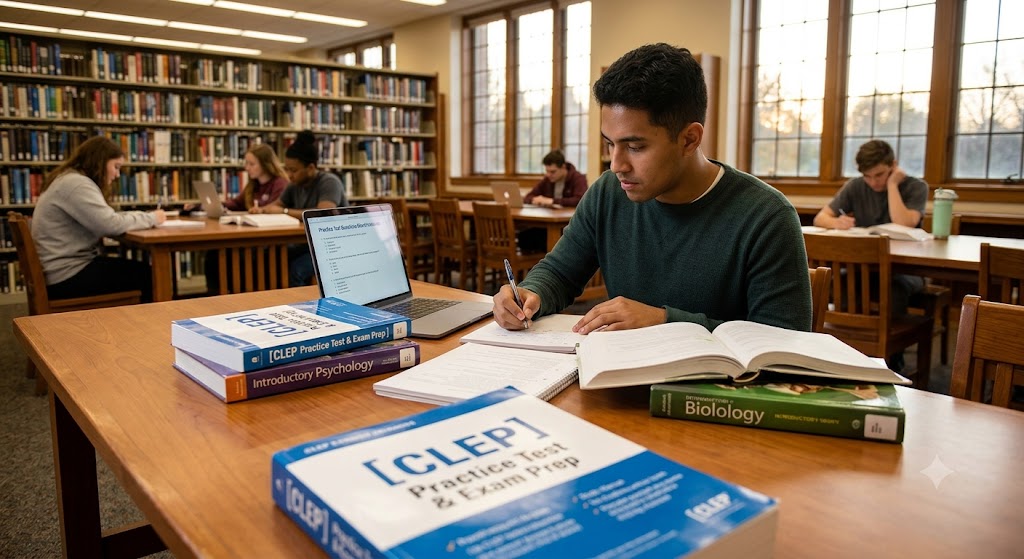
Additional Information
What the Course Entails and Exam Details
Preparing for a CLEP exam involves a comprehensive review of the material typically covered in a semester or year-long introductory college course. While there is no mandatory "CLEP course," successful candidates must master a detailed syllabus for their chosen subject. CLEP offers 34 exams across five broad categories: Business (e.g., Financial Accounting, Marketing), Composition and Literature (e.g., American Literature, Analyzing Literature), History and Social Sciences (e.g., US History I & II, Macroeconomics), Science and Mathematics (e.g., Calculus, Chemistry, Biology), and World Languages (e.g., Spanish, French, German). For instance, the College Algebra syllabus requires an in-depth understanding of algebraic operations, equations and inequalities, functions and their graphs, and number systems. The Intro to Psychology exam covers topics ranging from the biological bases of behavior and cognition to personality theories and social psychology.
What to Expect in the Final Exam
Each CLEP exam is a proctored, computer-based test, primarily composed of 90 to 120 multiple-choice questions designed to be completed within a strict 90-minute timeframe. A few exceptions exist: language exams include listening sections, and the College Composition exam includes a mandatory essay section (completed in 50 minutes, in addition to the 50-minute multiple-choice section). The exams assess a combination of factual knowledge and analytical skills, requiring not only memorization but also the ability to interpret and apply concepts to new scenarios.
CLEP scores are reported on a scaled system ranging from 20 to 80. The College Board, which administers the program, recommends that colleges grant credit for a scaled score of 50 or higher, which is generally equivalent to earning a 'C' grade in the corresponding college course. However, individual colleges and universities set their own policies for required passing scores and the amount of credit awarded, so it is crucial to verify these details with your institution’s registrar.
How to Study and Exam Centers
Effective preparation is key to CLEP success. A robust study strategy should begin with a self-assessment using the official examination description to understand the scope of the material. Essential resources include the official College Board CLEP study guides, relevant college textbooks, and high-quality online courses or study tools.
The most critical component of a winning study plan is consistent practice. Taking comprehensive CLEP practice tests under timed conditions is invaluable. This not only reinforces your knowledge and highlights areas needing further review but also builds the necessary stamina and familiarity with the question formats you will encounter on exam day. Utilize a mix of official practice resources and reputable third-party tests to ensure you are well-prepared for any angle the test may take.
You can register for a CLEP exam on the official College Board website. These exams are administered year-round at over 2,000 authorized testing centers worldwide, often located on college campuses and military bases. More recently, remote proctoring options have become available for certain CLEP exams, providing the flexibility to take your test from a secure, private location. When registering, you will select your preferred testing center (physical or virtual) and pay the examination fee, and then you must contact the chosen physical testing center directly to schedule your appointment.
Job Opportunities from the Course
While CLEP exams do not grant a direct professional certification or license for a specific job, they are a powerful accelerant toward achieving the college degree that is often a prerequisite for your chosen career. Earning CLEP credit can unlock dozens of professional paths by enabling you to graduate sooner, focus on advanced major-specific coursework earlier, and manage the overall cost of your education.
For example, a student pursuing a career in Business Management can use CLEP exams in Financial Accounting, Marketing, and Management to fulfill prerequisite requirements. By completing these early, they can start specialized, advanced business courses sooner, positioning themselves for competitive internships. Similarly, an aspiring software engineer can use the CLEP Calculus exam to satisfy general math requirements, moving faster toward core computer science and engineering coursework.
Ultimately, by efficiently navigating introductory requirements, you can earn your bachelor's or associate's degree faster, saving time and money and accelerating your entry into the workforce in fields like Entry-Level Management, Marketing Coordination, Financial Analysis, Healthcare Administration, STEM professions, and Education.
Frequently Asked Questions
Reviews
5.0
Based on 0 reviews
Leave a Review
No reviews yet. Be the first to review!