
Civil Service Practice Test & Exam Prep | Ireland
$69.00
- Buy to unlock unlimited access to all Quiz questions.
- After purchase you can print a PDF of the whole quiz at any point. The PDF will contain the questions and the correct answers.
About this Exam
The Irish Civil Service forms the backbone of Ireland's government administration, responsible for implementing public policy and delivering essential services across the nation. To secure a position within this prestigious and vital sector, candidates must pass a rigorous, structured assessment process known as the Civil Service Aptitude Tests. This examination is designed to evaluate a candidate’s cognitive abilities, personality traits, and situational judgement, rather than specific academic knowledge. Managed primarily by publicjobs.ie, this competition is the primary gateway for entry-level roles such as Clerical Officer and Executive Officer, as well as specialist and graduate-level positions, ensuring that the service recruits individuals with the core competencies necessary for public service excellence.
Ready to test your knowledge?
Buy Now to Access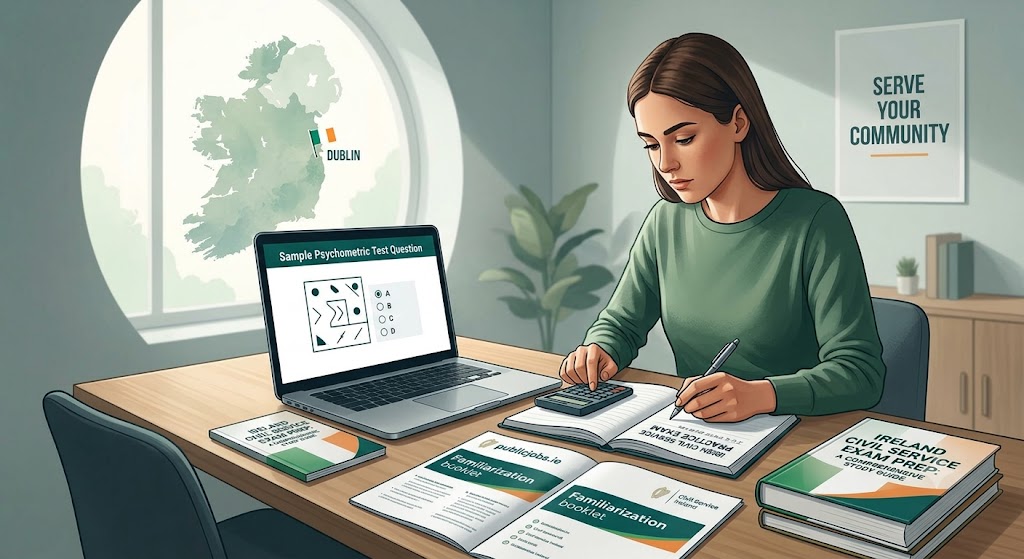
Additional Information
What the Course
Entails and Exam Details
Preparing for the Irish Civil Service exams does not involve
a standard syllabus but requires mastering a specific set of psychometric and
competency-based assessments.
The core topics and test types typically covered in the
examination process include:
- Verbal
Reasoning: This test assesses your ability to read, understand, and
interpret complex written information. Candidates must analyze short
passages of text and quickly evaluate statements as true, false, or cannot
say based solely on the provided information.
- Numerical
Reasoning: This section evaluates your skill in working with numbers,
charts, graphs, and data tables. It focuses on your ability to make
logical deductions, perform basic calculations (such as percentages,
ratios, and averages), and interpret financial or statistical information
accurately.
- Situational
Judgement Test (SJT): This assessment presents real-world scenarios
likely to be encountered in a Civil Service role. It measures your
decision-making, interpersonal skills, and alignment with the Civil
Service's core values—integrity, impartiality, and a commitment to public
service—by asking you to select the most and least effective courses of
action.
- Job
Simulation / E-Tray Exercise: For higher-level roles, such as
Executive Officer or Administrative Officer, this complex test simulates a
day in the office. Candidates must manage an inbox, prioritize tasks,
analyze data, and respond to various simulated stakeholder requests,
testing organizational skills, delegation, and strategic thinking under
time pressure.
What to Expect in the Final Exam
While the exact configuration of tests varies based on the
specific job campaign and role level, the final examination stage commonly
involves a series of separate, computer-based assessments.
- Format:
The vast majority of the tests (Numerical, Verbal, SJT) are
multiple-choice and computer-administered. The E-tray exercise is more
interactive but still digital.
- Time
Limits: Time management is a critical factor for success. The exams
are strictly timed. For instance, you may face 18-36 numerical questions
in ~20-25 minutes, and 40 verbal reasoning questions in ~20 minutes. The
E-tray exercise is a longer, intensive session, often lasting up to 2.5
hours.
- Passing
Score Requirements: There is no single "passing score"
across all tests. Instead, your results from each section contribute to an
overall profile. Candidates must achieve a minimum standard in all
required areas and compete to be placed on an "Order of Merit"
panel. Your ranking on this panel determines if and when you are called
for the next stage, which is usually a competency-based interview.
- Rules:
The exams are often administered online, either unsupervised with
integrated integrity checks or via remote proctoring, where you are
monitored via webcam. Cheating is strictly forbidden, and specific
equipment (like a simple calculator, pen, and paper) is typically
permitted only as detailed in the official
- campaign
information.
How to Study and Exam Centers
Effective preparation is the single biggest differentiator
for success in the Irish Civil Service assessments.
- Utilize
Official Resources: Your first and most important step should be to
thoroughly study the "Competition Information Booklet" and
"Familiarisation Material" provided by publicjobs.ie for your
specific campaign. These contain invaluable sample questions and explain
the precise format you will encounter.
- Take
Online Practice Tests: Since the exams are unique, you must practice
with test-style materials. Use the self-assessment tools on the
publicjobs.ie website. Consider dedicated prep platforms that offer timed
mock exams, as building speed and accuracy under pressure is essential.
- Focus
on Skill Areas: If you struggle with numerical data, dedicate time to
reviewing basic mathematics and interpreting graphs. For verbal reasoning,
practice active reading and critical analysis. For the SJT, study the
Civil Service code of conduct and capability frameworks to understand the
expected behaviors.
- Understand
the Testing Process: As all assessments are computer-based, ensure you
have a reliable internet connection and a distraction-free environment if
taking them remotely. The official recruitment body, publicjobs.ie, does
not use third-party physical centers like Pearson VUE; they coordinate the
online testing process directly. In rare instances, supervised on-site
testing may occur in specific, pre-arranged locations, which will be
clearly detailed in the competition instructions.
Job Opportunities from the Course
Successfully navigating the Civil Service exam and interview
process opens doors to a diverse range of stable, impactful, and
progression-oriented careers within the Irish Government.
The specific job titles and career paths this process
unlocks include:
- Clerical
Officer (CO): Providing administrative support across all government
departments.
- Executive
Officer (EO): Junior management roles with responsibilities for
specific teams or projects.
- Administrative
Officer (AO): The graduate entry role, offering rapid career
progression and high-level policy work.
- Higher
Executive Officer (HEO): Middle management positions, responsible for
leading functional areas.
- Specialist
Roles: Opportunities for qualified professionals, including
Economists, Lawyers, ICT Specialists, Engineers, Translators, and
Statisticians.
Senior Management: Progression paths to Assistant Principal, Principal Officer, Assistant Secretary, and Secretary
Frequently Asked Questions
Reviews
5.0
Based on 0 reviews
Leave a Review
No reviews yet. Be the first to review!