
CIP4 Science Progression Practice Test
$69.00
- Buy to unlock unlimited access to all Quiz questions.
- After purchase you can print a PDF of the whole quiz at any point. The PDF will contain the questions and the correct answers.
About this Exam
The CIP4 Science Progression examination is a specialized assessment designed to evaluate and validate a candidate's comprehensive understanding of core scientific principles and their ability to apply this knowledge across a variety of disciplines. This certification is primarily intended for students seeking to demonstrate academic readiness for advanced scientific study, as well as professionals in technical fields looking to formalize their foundational science knowledge for career advancement. By taking this practice test, you are making a critical step toward identifying knowledge gaps and mastering the concepts necessary to succeed in the final official examination. Preparing with dedicated practice resources builds necessary testing stamina and significantly boosts confidence
Sample Questions
Explanation:
Explanation:
Explanation:
Explanation:
Explanation:
Ready to test your knowledge?
Buy Now to Access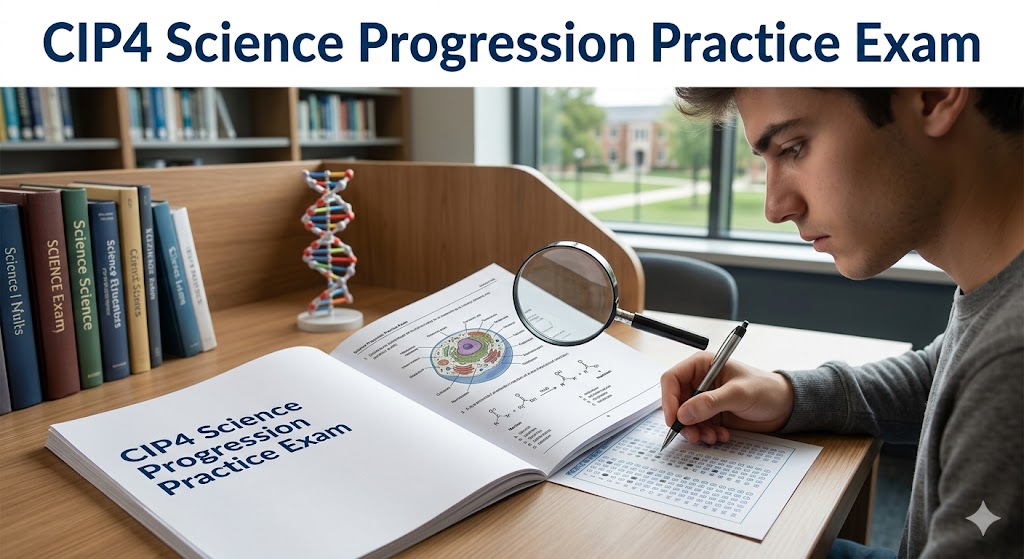
Additional Information
What the Course Entails and Exam Details
This comprehensive science progression course and its
associated exam cover a broad spectrum of foundational scientific topics
designed to ensure a well-rounded proficiency. The syllabus is structured
around four main pillars of scientific understanding: Biology, Chemistry,
Physics, and Scientific Inquiry Methods. Candidates will explore key concepts
such as cellular structure and function, genetic principles, chemical bonding
and reactions, the laws of motion and energy, and data analysis techniques. Furthermore,
the curriculum emphasizes the development of critical thinking skills required
to interpret experimental data, construct scientific arguments, and solve
complex, multi-disciplinary problems. The final exam details are meticulously
aligned with these core learning outcomes.
What to Expect in the Final Exam
The final CIP4 Science Progression examination is a
rigorously timed assessment that primarily utilizes a multiple-choice format to
evaluate a candidate’s knowledge and application skills. The test consists of
approximately 100 questions to be completed within a three-hour time limit,
demanding both speed and accuracy. Questions are distributed across the four
core modules to provide a balanced evaluation of proficiency in Biology,
Chemistry, Physics, and Scientific Inquiry. While the exact passing score may
vary slightly depending on the specific exam version and administering body,
candidates generally need to achieve a minimum of 70% to receive certification.
It is crucial to note that this is a closed-book examination, and the use of
reference materials or unauthorized electronic devices is strictly prohibited.
How to Study and Exam Centers
Effective preparation for the CIP4 Science Progression exam
requires a structured study plan that combines deep theoretical review with
extensive practical application. We recommend beginning your study journey by
thoroughly reviewing official textbooks and coursework for each of the core
scientific disciplines covered in the syllabus. Supplement this learning by
utilizing high-quality practice exams, like this one, to familiarize yourself
with the question format, identify your weakest areas, and practice managing
your time effectively under simulated exam conditions. Many students find that
creating flashcards for key scientific terms, formulas, and concepts is an
excellent way to reinforce memory retention. Group study sessions can also be
beneficial for discussing complex topics and gaining different perspectives on
scientific problem-solving.
Candidates have several flexible options for taking the
final official exam. The primary method is through authorized testing centers
managed by global assessment providers such as Pearson VUE, which have a vast
network of secure physical locations worldwide. In some regions, the exam may
also be administered through authorized schools, colleges, or specific
vocational training centers. Additionally, many administering bodies now offer
secure, proctored online testing portals, allowing you to take the exam from
the comfort of your home or office, provided you meet the necessary technical
and environmental requirements. Be sure to register for your preferred date and
location well in advance.
Job Opportunities from the Course
Successfully achieving the CIP4 Science Progression
certification demonstrates a verified level of scientific competence that is
highly valued across multiple technical and analytical industries. This
qualification serves as a versatile foundation that can unlock numerous
entry-level positions or provide a significant advantage for those seeking
specialized career paths. Here are clear examples of job titles and career
paths this certification can help open for you:
- Science
Laboratory Technician
- Junior
Environmental Analyst
- Quality
Control Associate (Chemical or Pharmaceutical)
- Technical
Support Specialist (Scientific Equipment)
- Science
Educator or Tutor (Foundation Level)
- Clinical
Research Coordinator Assistant
- Data
Analyst (Technical or Scientific Data)
- A
stepping stone toward Advanced Degrees in STEM fields
Frequently Asked Questions
Reviews
5.0
Based on 0 reviews
Leave a Review
No reviews yet. Be the first to review!