
CHSE Odisha Higher Secondary Vocational Exam Prep | India
$69.00
- Buy to unlock unlimited access to all Quiz questions.
- After purchase you can print a PDF of the whole quiz at any point. The PDF will contain the questions and the correct answers.
About this Exam
The Council of Higher Secondary Education (CHSE), Odisha, conducts the Higher Secondary (+2) Vocational Examination. This program is specifically designed for students who have completed their 10th standard and wish to pursue specialized skill-based education alongside their regular senior secondary academic curriculum.
The primary goal of this vocational stream is to equip students with practical skills and theoretical knowledge relevant to specific industries. This path is ideal for students aiming for immediate entry-level employment after completing their +2 education, or for those who plan to pursue further specialized technical diplomas or degree programs in their chosen fields.
Ready to test your knowledge?
Buy Now to Access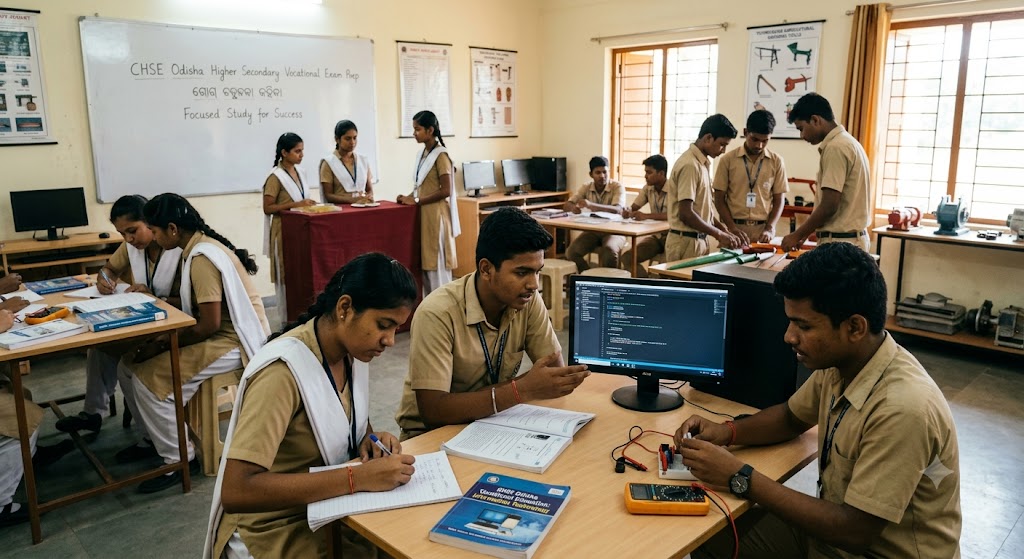
Additional Information
What the Course Entails and Exam Details
The Higher Secondary Vocational course in Odisha offers a diverse range of trade specializations, catering to various industry sectors. The curriculum is a blend of general academic subjects and trade-specific vocational subjects.
The core areas generally include:
Foundation Courses: Languages (English, Odia) and General Foundation Courses (GFC).
Elective Subjects: Students often choose standard academic electives from the Arts, Science, or Commerce streams.
Vocational Trade Subjects: This is the core focus. Common trades offered include Information Technology (IT), Healthcare, Agriculture, Tourism and Hospitality, Electronics & Hardware, Beauty & Wellness, Retail, and Automobile Technology, among others.
The course structure balances classroom-based theory with significant practical, hands-on training conducted in laboratories or workshops within the vocational institutions.
What to Expect in the Final Exam
The CHSE Odisha Higher Secondary Vocational examination consists of two main components: Theory and Practical assessment.
Theory Examinations: These are written, pen-and-paper exams covering the foundation courses, elective subjects, and the theoretical aspects of the chosen vocational trade. The format typically includes objective questions (multiple choice), short-answer questions, and descriptive/long-answer questions. These exams follow the structure prescribed by the CHSE Odisha board.
Practical Examinations: A crucial element of the vocational stream, these assessments evaluate the students' hands-on skills and proficiency in their specific trade. These practical exams are often conducted within the student's own institution (Self-Center), utilizing the required machinery, software, or equipment, and are often evaluated by both internal and external examiners.
Passing Requirements: Students must secure the minimum prescribed pass marks in both the theory and practical components separately to be awarded the Higher Secondary Vocational Certificate. The specific time limits for each exam vary depending on the subject and maximum marks but generally align with standard board examination durations (e.g., 2.5 to 3 hours).
How to Study and Exam Centers
Preparation for the CHSE Odisha Vocational Exam requires a balanced approach focusing on both knowledge and skill acquisition.
Study Strategies:
Master the Syllabus: Obtain the official syllabus prescribed by CHSE Odisha for your specific trade and academic subjects.
Focus on Practical Skills: Dedicate substantial time to practical lab sessions. Mastery of the practical aspects of your vocational trade is critical for success in the practical exam.
Use Official Textbooks: Prioritize studying from the textbooks recommended by the Odisha board.
Solve Previous Years’ Papers: Practice with previous years' question papers to understand the exam pattern, mark distribution, and common question types for theory exams.
Maintain Consistent Notes: Create clear, concise notes during classes and practical sessions for effective revision.
Exam Centers: The final theory examinations are conducted at various CHSE-authorized exam centers, which are typically affiliated Higher Secondary Schools or Colleges located across different districts in Odisha. Students are assigned specific centers, and details are provided on their admit cards. The practical examinations are usually conducted internally at the students' own parent institution to utilize the available vocational trade facilities and labs.
Job Opportunities from the Course
Upon successful completion of the Higher Secondary Vocational course, graduates are eligible for various entry-level positions relevant to their specialized trade. This certification provides a direct pathway into the workforce or further technical training.
Specific career opportunities depend heavily on the chosen vocational trade, but common paths include:
IT/ITES Stream: Data Entry Operator, Junior IT Support Executive, DTP Operator.
Healthcare Stream: General Duty Assistant (GDA), Patient Care Assistant, Laboratory Attendant.
Tourism & Hospitality Stream: Front Office Executive, Food & Beverage Service Associate, Tour Guide Assistant.
Electronics & Hardware Stream: Electronics Repair Technician (Junior), Assembly Line Operator, Electrician Helper.
Automobile Stream: Assistant Automobile Mechanic, Service Advisor Trainee.
Beauty & Wellness Stream: Beauty Therapist, Hair Stylist Assistant.
Graduates also have the option to pursue higher education, such as polytechnic diplomas, specialized ITI courses, or degree programs (like B.Voc) in their respective domains.
Frequently Asked Questions
Reviews
5.0
Based on 0 reviews
Leave a Review
No reviews yet. Be the first to review!