
CHSE Odisha Higher Secondary Compulsory Exam Prep | India
$69.00
- Buy to unlock unlimited access to all Quiz questions.
- After purchase you can print a PDF of the whole quiz at any point. The PDF will contain the questions and the correct answers.
About this Exam
The CHSE Odisha Higher Secondary Compulsory Exam is a critical academic milestone for students in the state of Odisha, India. Conducted by the Council of Higher Secondary Education (CHSE), Odisha, this examination serves as the final assessment for the standard 12, or Higher Secondary level. These compulsory subjects are foundational for students across all academic streams—Arts, Science, and Commerce—and are necessary for successfully obtaining the Higher Secondary Certificate. The exam is designed for students who are completing their +2 education in schools and colleges affiliated with CHSE Odisha. Successfully passing this examination is required for progression to higher education, including bachelor's degrees, professional courses, and various competitive entrance exams in India.
Ready to test your knowledge?
Buy Now to Access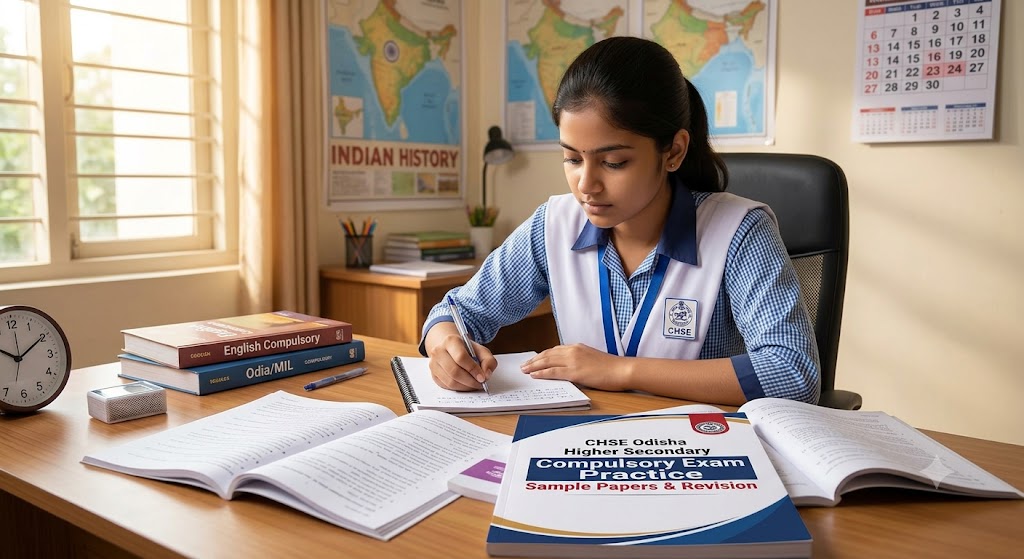
Additional Information
What the Course Entails and Exam Details
This examination specifically assesses students on the compulsory subjects mandated by the CHSE Odisha curriculum. The core areas covered typically include:
English: Focusing on language proficiency, prose, poetry, creative writing skills, grammar, and comprehension.
Modern Indian Language (MIL): Students can choose from a range of regional and national languages, such as Odia, Hindi, Bengali, Telugu, Urdu, etc. The syllabus covers language, literature, and compositional skills in the chosen language.
Environmental Education: A fundamental subject aimed at fostering ecological awareness and understanding of environmental issues.
The syllabus is structured according to the Class XII curriculum prescribed by CHSE Odisha. The exam details are typically notified by the council and involve written theory papers for each compulsory subject. Each subject has a prescribed weightage and duration, generally 3 hours for the theory exam.
What to Expect in the Final Exam
The final examination for the CHSE Odisha Higher Secondary Compulsory subjects usually follows a structured format as per the council's regulations. Here’s what students should typically expect:
Exam Type: Written theory papers.
Question Paper Pattern: A mix of objective type questions, very short answer questions, short answer questions, and long answer/essay type questions. The exact pattern and weightage for each type of question can vary from subject to subject, and from year to year. Students should refer to the latest question paper designs and blueprints provided by CHSE.
Passing Marks: Students must secure a minimum of 33% marks (or as specified by CHSE for that academic year) in both theory and practical/internal assessments, if applicable, to pass the subject.
Duration: The duration of the theory exam for each compulsory subject is typically 3 hours.
Examination Atmosphere: The exam is conducted in a disciplined environment at specified exam centers across Odisha, under the supervision of invigilators appointed by the council. Use of calculators or mobile phones is generally prohibited during the examination.
How to Study and Exam Centers
Actionable Study Strategies and Practice Methods
Understand the Syllabus: Start by thoroughly reviewing the prescribed syllabus for all compulsory subjects. Know the weightage of each chapter and topic to allocate your study time effectively.
Refer to CHSE Textbooks: The official textbooks recommended by CHSE Odisha should be your primary study material. They are usually the basis for question paper preparation.
Create a Study Plan: Develop a practical study schedule that allows sufficient time for covering all subjects, including regular revision and practice sessions. Be consistent and dedicated.
Practice Previous Year Question Papers: This is one of the most effective ways to prepare. Solving last few years' question papers helps you understand the exam pattern, the types of questions asked, time management, and identify important topics.
Solve Model Papers: Use model/sample question papers to simulate exam conditions and practice writing answers within the time limit. This builds confidence and improves accuracy.
Make Concise Notes: While studying, create short, summary notes for each chapter. This will be invaluable for quick revision in the days leading up to the exam.
Seek Clarification: If you have doubts, don't hesitate to ask your teachers or peers. Group study, if focused, can also be beneficial.
Exam Center Information
The CHSE Odisha Higher Secondary examinations are not conducted online. They are held in offline, physical testing centers across the state.
How and Where to Take the Exam: The examinations are conducted in specific, authorized schools and colleges designated as exam centers by the CHSE Odisha council. Students do not choose their exam center; instead, they are assigned to a center typically located within a reasonable distance from their own institution.
Admit Card: The information about the assigned exam center, including its name and address, is clearly mentioned on the student's admit card. Students are required to download or collect their admit card well in advance of the exam dates.
On Exam Day: Students must reach their designated exam center at least 30-45 minutes before the commencement of the exam, carrying their original admit card and necessary writing materials. Following all center guidelines and discipline is crucial.
Job Opportunities from the Course
Successfully clearing the CHSE Odisha Higher Secondary Compulsory Exam, along with the other subjects, significantly expands a student's future career prospects. While it may not directly unlock specific job titles immediately, it is an essential eligibility requirement for numerous higher education programs and career paths in India.
Here is a list of job titles and career paths this certification unlocks:
Pursue Bachelor's Degree: Students can enroll in diverse undergraduate programs like BA (Bachelor of Arts), B.Sc. (Bachelor of Science), B.Com (Bachelor of Commerce), and other vocational and professional courses. These degrees then lead to a wide range of job opportunities in fields like education, government, finance, technology, research, etc.
Professional Courses: Completion of +2 is mandatory for appearing in various entrance exams and pursuing professional courses such as Engineering (B.Tech), Medicine (MBBS), Law (Integrated LLB), Nursing, Pharmacy, and management courses like BBA and BCA.
Defense Services Entry: Successful completion of Higher Secondary allows candidates to appear for the National Defence Academy (NDA) and Naval Academy examination conducted by UPSC, opening doors to officer-level positions in the Indian Army, Navy, and Air Force.
Government Job Examinations: Many entry-level government job examinations, such as those conducted by Staff Selection Commission (SSC) for positions like Lower Division Clerk (LDC), Data Entry Operator (DEO), Postal Assistant/Sorting Assistant through CHSL (Combined Higher Secondary Level) exam, require a minimum qualification of Class 12.
Banking Sector: Some clerical and initial-level jobs in the banking sector (like bank clerks and assistants) may require a minimum qualification of Class 12, though competitive exams are usually part of the selection process and degree is often preferred.
State Police Recruitment: Various states, including Odisha, conduct recruitment for positions like police constables, for which a Higher Secondary pass certificate is the base qualification.
Entry-Level Private Sector Jobs: A Class 12 qualification makes you eligible for various entry-level positions in the private sector across different industries.
Frequently Asked Questions
Reviews
5.0
Based on 0 reviews
Leave a Review
No reviews yet. Be the first to review!