
CFII Practical Test Standards (PTS) Practice
$69.00
- Buy to unlock unlimited access to all Quiz questions.
- After purchase you can print a PDF of the whole quiz at any point. The PDF will contain the questions and the correct answers.
About this Exam
The Certified Flight Instructor – Instrument (CFII) Practical Test Standards (PTS) Practice Exam is a vital preparatory tool for experienced flight instructors who are ready to expand their teaching privileges. This certification is designed for already-certificated CFIs who wish to provide instrument flight instruction in airplanes, helicopters, or powered-lifts.
Earning your CFII demonstrates a high level of mastery in instrument procedures, advanced aircraft systems, and the art of teaching complex concepts in challenging environments. This practical exam rigorously evaluates your ability to not only fly with precision solely by reference to instruments but also to effectively instruct and manage a student in simulated or actual instrument meteorological conditions (IMC). Passing this checkride is the final step to becoming a highly sought-after instructor in the aviation industry.
Ready to test your knowledge?
Buy Now to Access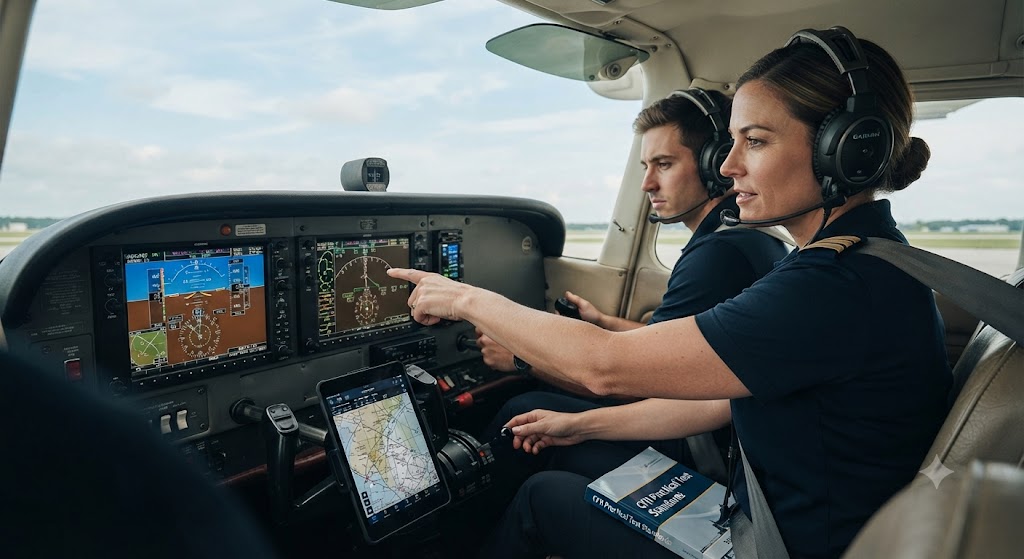
Additional Information
What the Course Entails and Exam Details
The CFII course and its corresponding practical exam are
governed by the FAA’s CFII Practical Test Standards (FAA-S-8081-9D). It is
important to note that the FAA is transitioning from PTS to Airman
Certification Standards (ACS); however, the core competencies remain
consistent.
The syllabus is extensive, requiring candidates to possess
deep knowledge and instructional proficiency across several key areas. These
include:
- Fundamentals
of Instruction (FOI): While often covered in the initial CFI exam, the
CFII candidate must apply these principles effectively in an instrument
training environment.
- Preflight
Preparation: This includes advanced weather analysis, interpreting
prognostic charts and METAR/TAF reports, cross-country flight planning
specific to IFR operations, and ensuring aircraft airworthiness for IFR
flight.
- Instrument
Flight Systems: A thorough understanding of avionics, navigation
systems (VOR, GPS, ILS), and autoflight systems is mandatory.
- Instrument
Approaches: Candidates must demonstrate mastery of precision (e.g.,
ILS) and non-precision (e.g., RNAV/GPS, VOR) approaches, including holding
procedures and missed approaches from both the left and right seats.
- Emergency
Operations: Managing partial panel scenarios (failure of primary
flight instruments), unexpected system failures, and recovery from unusual
attitudes is critical.
- Postflight
Procedures: Conducting thorough debriefings and providing constructive
feedback.
The exam requires candidates to teach these maneuvers and
procedures to the Examiner, who acts as a student pilot during the flight
portion.
What to Expect in the Final Exam
The CFII Practical Test is a formal "checkride"
administered by an FAA-designated Pilot Examiner (DPE) or an authorized FAA
inspector. It is split into two distinct sections: the ground evaluation (oral
exam) and the flight evaluation.
- Ground
Evaluation: The oral exam is comprehensive, typically lasting 3 to 5
hours. It assesses your aeronautical knowledge and your ability to apply
the Fundamentals of Instruction. The DPE will present scenarios to test
your decision-making, weather interpretation, and understanding of IFR
regulations and procedures. You must be prepared to teach these concepts
clearly and accurately.
- Flight
Evaluation: Following a successful oral exam, the flight portion
evaluates your instructional ability from the right seat. You must
demonstrate the maneuvers and approaches outlined in the PTS/ACS while
simultaneously monitoring the "student's" (DPE's) actions,
explaining the procedures, and maintaining a safe flight environment. The
flight portion usually takes 1.5 to 2.5 hours.
There is no numerical "score" for the practical
test. Instead, you must meet or exceed the standards established in the CFII
PTS for every task, demonstrating mastery of the aircraft, knowledge, and
instructional skill.
How to Study and
Exam Centers
Preparing for the CFII Practical Test requires a disciplined
and structured approach. Here are actionable strategies:
- Master
the PTS/ACS: The Practical Test Standards (or ACS) is your roadmap.
Review it constantly to ensure you understand exactly what is expected for
every task.
- Ground
Training with a Mentor: Do not study alone. Find an experienced CFII
or a senior flight instructor to mentor you. Practice teaching the
lessons, explaining complex weather scenarios, and discussing regulations
aloud.
- Right-Seat
Flying: The flight portion must be flown from the right seat. This
requires significant practice to develop the necessary coordination and
muscle memory for maneuvers, approaches, and radio communications from the
opposite side of the cockpit.
- Utilize
Simulators: An Advanced Aviation Training Device (AATD) or Basic
Aviation Training Device (BATD) is invaluable for practicing instrument
approaches, holding patterns, and partial-panel scenarios
cost-effectively.
- Scenario-Based
Training: Practice applying knowledge to real-world scenarios. For
example, "Plan a flight from A to B with these specific weather
conditions; what are your alternate options, and how would you teach the
decision-making process to a student?"
Where and How to Take the Exam:
The CFII Practical Test is not taken at a computer-based
testing center like the knowledge tests. Instead, you must schedule the
checkride directly with an FAA-designated Pilot Examiner (DPE). You can find a
DPE through the FAA’s online Designee Locator System or by asking for
recommendations from local flight schools. It is advisable to book the exam
well in advance, as DPE schedules can fill up quickly.
Job Opportunities
from the Course
Earning your CFII rating is a significant career milestone
for any professional pilot. It immediately increases your value and
employability within the aviation industry. This certification qualifies you to
provide the specialized flight instruction required for pilots to obtain and
maintain their instrument rating, which is a prerequisite for nearly all
commercial aviation jobs.
Specific job titles and career paths unlocked by the CFII
rating include:
- Certified
Flight Instructor – Instrument (CFII): The primary role, providing
focused instrument training in aircraft and simulators.
- Instrument
Flight Instructor within a Part 141 or Part 61 Flight School: Highly
respected positions responsible for structured instrument curricula.
- Airline
Transport Pilot (ATP) Pathway: While an ATP requires 1500 hours, many
pilots build this time while working as CFIIs, gaining invaluable
experience and mentorship skills.
- Corporate
Pilot / First Officer: Many corporate flight departments and regional
airlines look favorably upon candidates with CFII experience, as it
demonstrates deep knowledge of IFR systems and procedures.
- Charter
Pilot (Part 135 Operations): Requires solid IFR proficiency, which is
validated by the CFII rating.
- Aviation
Safety Inspector / FAA Roles: Advanced ratings like the CFII are often
required or preferred for careers in aviation regulation and safety.
- Flight
School Chief Flight Instructor: With experience, a CFII can advance to
leadership roles, overseeing training standards and other instructors.
By becoming a CFII, you are not only advancing your own
career but also contributing to the safety and proficiency of the next
generation of instrument-rated pilots.
Frequently Asked Questions
Reviews
5.0
Based on 0 reviews
Leave a Review
No reviews yet. Be the first to review!