
CFD Emergency Vehicle Operations Course (EVOC) Practice Exam
$69.00
- Buy to unlock unlimited access to all Quiz questions.
- After purchase you can print a PDF of the whole quiz at any point. The PDF will contain the questions and the correct answers.
About this Exam
The CFD EVOC is not just a driver's license test; it's a specialized program designed to equip emergency responders with the knowledge and skills necessary to safely navigate the unique challenges of operating fire apparatus and ambulances in a major metropolitan environment.
This course is mandatory for all members of the Chicago Fire Department who are assigned to drive department vehicles, including fire engines, trucks, ambulances, and chief's cars. It's designed for individuals who already possess a valid driver's license but need specialized training to handle the immense responsibility of driving emergency vehicles code-3 (with lights and sirens) through busy city streets, often in adverse weather conditions and under tight time constraints. The goal is to minimize accidents, protect the public, and ensure the safe arrival of personnel and equipment to emergency scenes.
Ready to test your knowledge?
Buy Now to Access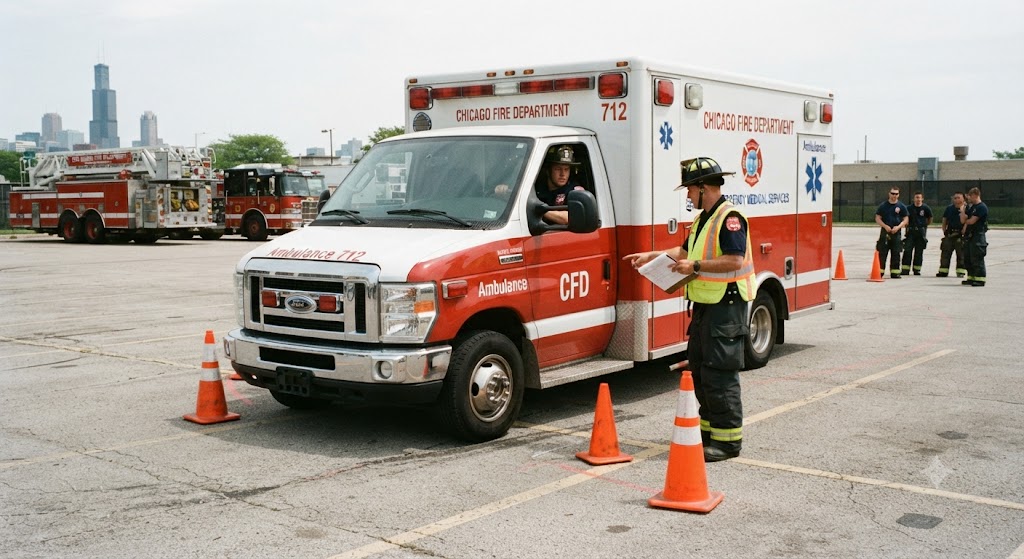
Additional Information
What the Course Entails and Exam Details
The CFD EVOC is a comprehensive program that combines
classroom instruction with hands-on driving practice. The curriculum covers a
wide range of topics critical for safe emergency vehicle operations, including:
- Legal
Aspects of Emergency Vehicle Operation: Understanding Illinois Vehicle
Code exemptions, the legal responsibilities of emergency drivers, and the
implications of negligence.
- Vehicle
Dynamics and Handling: Learning the physics of operating heavy
vehicles, including braking distances, cornering techniques, and the
effects of weight transfer.
- Defensive
Driving Principles: Recognizing and anticipating hazards, maintaining
proper following distances, and using Smith System and T.R.A.P.
principles.
- Intersection
Safety: Strategies for navigating intersections safely, including
coming to a complete stop, making eye contact with other drivers, and
clearing lanes.
- Code-3
Operations: Protocols for operating with emergency lights and sirens,
including considerations for speed, lane usage, and yielding right-of-way.
- Backing
and Spotting: Proper procedures for backing fire apparatus and
ambulances, including the use of a spotter.
- Vehicle
Inspection and Maintenance: Pre-trip inspection procedures and
identifying potential mechanical issues.
- Adverse
Weather Driving: Techniques for operating safely in rain, snow, ice,
and high winds.
- Stress
Management: Coping with the psychological and physiological stress
associated with emergency driving.
The EVOC final exam typically consists of two main
components:
Written Exam: This is a
multiple-choice test that assesses your understanding of the classroom
instruction, including Illinois traffic laws, department Standard Operating
Procedures (SOPs), and defensive driving principles.
Practical Driving Exam:
This is a hands-on evaluation where you must demonstrate your ability to safely
and competently operate a designated emergency vehicle through a controlled
driving course. This typically includes maneuvers like backing, serpentine,
parallel parking, controlled braking, and navigating simulated intersections.
What to Expect in
the Final Exam
The CFD EVOC final exam is challenging and designed to
ensure that only qualified individuals are entrusted with the responsibility of
driving CFD vehicles. Here's what you can expect:
- Written
Exam Format: The written exam typically contains 50-100
multiple-choice questions. The questions are scenario-based, requiring you
to apply your knowledge to real-world situations. You'll need a solid
understanding of the material covered in the classroom sessions.
- Passing
Score: The passing score for the written exam is typically 80% or
higher. The practical exam is usually graded on a pass/fail basis, with
specific deductions for errors. You must pass both the written and
practical portions to become certified.
- Time
Limits: There is usually a time limit for the written exam, such as 90
minutes. You'll need to manage your time effectively. The practical exam
is not timed but is evaluated on precision and safety.
- Rules
and Protocols: The exam is strictly proctored. Any form of cheating
will result in immediate failure and potential disciplinary action. For
the practical exam, you must wear appropriate safety gear (e.g., bunker
gear, helmet) as required by department policy. Failure to follow safety
protocols during the practical exam will result in immediate failure.
- Retakes:
If you fail either the written or practical exam, you will typically be
allowed one or more retakes, but there may be a waiting period and
additional training requirements.
How to Study and
Exam Centers
Preparing effectively for the CFD EVOC exam is crucial for
success. Here are some actionable study strategies:
- Review
Course Materials: Thoroughly study your class notes, handouts, and any
textbooks or manuals provided during the course. Pay close attention to
department SOPs and Illinois traffic laws.
- Take
Practice Exams: Look for practice exams online or from colleagues who
have already taken the course. This will help you familiarize yourself
with the format and types of questions asked on the written exam.
- Create
Flashcards: Use flashcards to memorize key terms, definitions, and
procedures. This is a great way to reinforce your learning and test your
recall.
- Form
a Study Group: Study with other students from your EVOC class. This
allows you to discuss concepts, quiz each other, and share different
perspectives.
- Visualize
the Practical Exam: Mentally rehearse the maneuvers you will need to
perform on the practical exam. This can help reduce anxiety and improve
your performance.
- Practice
Driving: If possible, practice the required driving maneuvers in a
safe and controlled environment, such as an empty parking lot. Use cones
to simulate the driving course.
- Get
Plenty of Rest: Ensure you are well-rested before both the written and
practical exams. Fatigue can impair your cognitive function and driving
abilities.
The CFD EVOC exam is administered directly by the Chicago
Fire Department. Information on exam dates, locations, and registration
procedures will be provided to you during the course. The written exam is
typically held at a CFD training facility, while the practical exam is
conducted on a designated driving course, often at the Fire Academy.
Job Opportunities
from the Course
Earning your CFD EVOC certification is a significant
achievement that opens up new career opportunities within the Chicago Fire
Department. This certification is a prerequisite for many specialized positions
that involve operating emergency vehicles.
Here are some of the job titles and career paths that this
certification unlocks:
- Firefighter/Driver
Operator: This is the primary position for which EVOC certification is
required. Firefighter/Driver Operators are responsible for safely and
efficiently driving and operating fire engines, trucks, and other
apparatus to emergency scenes. They also maintain the vehicle and its
equipment.
- Ambulance
Driver: Paramedics and EMTs who operate CFD ambulances must be EVOC
certified. This involves safely transporting patients to hospitals, often
under code-3 conditions.
- Tower
Ladder Operator: This specialized position requires additional
training and certification, but EVOC is the foundational qualification for
operating heavy aerial apparatus.
- Squad
Driver: CFD Squads are specialized rescue companies that respond to a
wide range of incidents, including heavy rescue, hazardous materials, and
water rescue. Driving a Squad truck requires advanced EVOC skills.
- Chief's
Aide: Chief's Aides are responsible for driving and assisting
Battalion Chiefs and District Chiefs. This position requires a high level
of driving proficiency and the ability to navigate quickly and safely to
multiple incident locations.
- Apparatus
Instructor: Experienced Firefighter/Driver Operators can become EVOC
instructors, teaching the course to new personnel and conducting
recertification training.
- Fleet
Services Personnel: While not directly involved in emergency response,
some fleet services personnel who are responsible for maintaining and
testing CFD vehicles may be required to have EVOC certification to operate
the vehicles they service.
By successfully completing the CFD Emergency Vehicle
Operations Course and passing the certification exam, you demonstrate your
commitment to safety, professionalism, and operational excellence. This
certification is a valuable asset that enhances your skills, protects your
fellow firefighters and the public, and paves the way for a rewarding career in
the Chicago Fire Department.
Frequently Asked Questions
Reviews
5.0
Based on 0 reviews
Leave a Review
No reviews yet. Be the first to review!