
CFD Academy EMS Exam 1 Practice
$69.00
- Buy to unlock unlimited access to all Quiz questions.
- After purchase you can print a PDF of the whole quiz at any point. The PDF will contain the questions and the correct answers.
About this Exam
Ready to test your knowledge?
Buy Now to Access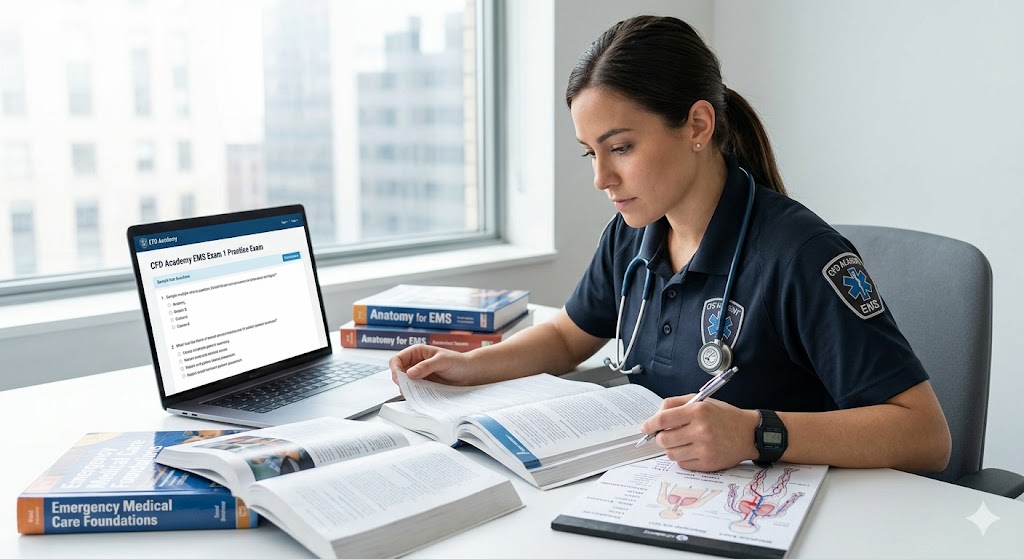
Additional Information
What the Course Entails and Exam Details
This examination covers the core curriculum required for introductory EMS certification. Students must master several complex subject areas focused on both theoretical knowledge and practical application.
The core topics included in this practice exam are:
EMS Systems and Operations: Understanding the structure of emergency services, legalities, and the history of the profession.
Medical Terminology, Anatomy, and Physiology: A vital foundation in the language of medicine and the primary systems of the human body.
Pathophysiology: Recognizing how the body functions when impacted by disease or injury.
Patient Assessment: The structured process for evaluating both medical and trauma patients quickly and accurately.
Airway Management and Respiration: High-priority techniques for maintaining oxygenation in critical patients.
Documentation and Communication: Mastering the essential skill of accurate patient reporting and radio communication protocols.
What to Expect in the Final Exam
The actual final exam at the CFD Academy is a demanding and rigorous evaluation of competency. It is designed not just to test recall, but to ensure critical decision-making abilities under pressure.
Candidates should expect the following format details:
Format: The exam predominantly consists of computer-based multiple-choice questions, which may include case-study scenarios demanding synthesis of knowledge.
Number of Questions: The final exam typically contains between 75 and 100 questions.
Time Limit: Students generally have two hours to complete the written portion of the assessment.
Passing Score: A strong passing score, often 70% or higher, is strictly enforced to ensure competence.
Practical Component: In addition to the written exam, a final practical skills exam (testing scenarios like airway management and patient packaging) is usually required to obtain certification.
How to Study and Exam Centers
Preparation is the key to success in EMS training. Success requires active study techniques rather than passive review.
Effective study strategies include:
Utilize Active Recall: Regularly quiz yourself on anatomy, key acronyms, and patient assessment algorithms.
Take Multiple Practice Exams: Use resources like this one frequently to build testing endurance and identify weak spots.
Scenario-Based Review: Discuss complex medical and trauma scenarios with study partners, vocalizing critical thinking processes.
Know Your Textbooks: Thoroughly review all assigned reading material, paying special attention to standard protocols.
Regarding exam locations, the final examination is typically administered by authorized training facilities. The specific exam centers for the CFD Academy exams are generally located within the academy's dedicated training complex or recognized affiliate testing centers, using their secure computer labs. Always check the official academy announcements for precise scheduling and location details.
Job Opportunities from the Course
Successfully passing the EMS Exam 1 and completion of the full training program opens diverse and stable career pathways in public safety and healthcare.
Completing this course is a foundational step toward the following job opportunities:
Emergency Medical Technician (EMT-Basic)
Firefighter/EMT (A prerequisite for many fire department hires)
Paramedic Student (Required starting point for advanced life support training)
Hospital Emergency Room Technician
Specialized Medical Transport Provider (Non-emergency transport services)
First Responder (For law enforcement or specialized industrial roles)
Frequently Asked Questions
Reviews
5.0
Based on 0 reviews
Leave a Review
No reviews yet. Be the first to review!