
Certification of Pharmacy Technicians (ExCPT) Practice
$69.00
- Buy to unlock unlimited access to all Quiz questions.
- After purchase you can print a PDF of the whole quiz at any point. The PDF will contain the questions and the correct answers.
About this Exam
Welcome to this comprehensive guide on preparing for the Certification of Pharmacy Technicians (ExCPT) exam. Administered by the National Healthcareer Association (NHA), the ExCPT is a prestigious credential designed to validate that entry-level pharmacy technicians possess the knowledge and skills essential for supporting pharmacists and serving patients safely and effectively.
Passing this exam demonstrates your competency in critical areas such as pharmacology, law, sterile and non-sterile compounding, and medication safety. This certification is intended for aspiring pharmacy technicians who have completed a training program or have equivalent work experience and are ready to launch a rewarding career in healthcare. Achieving the ExCPT designation is a significant milestone that enhances your professional credibility and opens doors to diverse job opportunities across the United States.
Ready to test your knowledge?
Buy Now to Access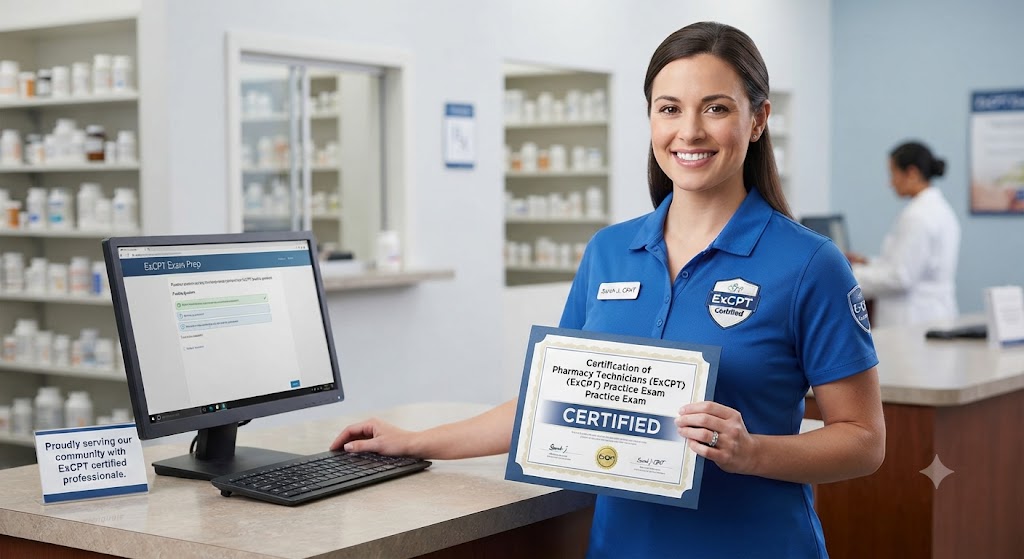
Additional Information
What the Course Entails and Exam Details
The ExCPT exam is a rigorous assessment covering the full
scope of a pharmacy technician's responsibilities. An effective preparation
course or self-study plan will be structured around the NHA's exam content
outline, which typically focuses on three main domains:
- Domain
1: Medications (approx. 29% of exam) This section tests your knowledge
of top-selling medications (both generic and brand names),
classifications, indications, contraindications, side effects, and dosage
forms. You must understand drug storage requirements and
look-alike/sound-alike medications.
- Domain
2: Federal Requirements for Medications and Pharmacy Operations (approx.
25% of exam) A critical component of the job is adhering to laws and
regulations. This domain covers the roles of the FDA, DEA, and Boards of
Pharmacy. It includes knowledge of controlled substance schedules,
prescription requirements, HIPAA privacy rules, and safety protocols (like
OSHA standards).
- Domain
3: Order Processing and Dispensing (approx. 46% of exam) This is the
largest section and focuses on the practical workflow in a pharmacy. It
covers the entire prescription process, from receiving and entering orders
to calculating dosages, preparing and packaging medications (including
compounding), managing inventory, and understanding billing and
reimbursement.
What to Expect in the Final Exam
Understanding the mechanics of the final exam is crucial for
test-day success. The ExCPT is a computer-based test (CBT).
- Format:
The exam consists of 110 questions, all of which are multiple-choice.
There are 100 scored questions and 10 pre-test questions that are not
scored but are used for statistical purposes. Each question presents four
possible answers, with only one correct option.
- Time
Limit: You will have 2 hours and 10 minutes (130 minutes) to complete
the entire exam. This allows for an average of just over one minute per
question, so pacing is important.
- Passing
Score: The ExCPT uses a scaled score. The passing score is 390 on a
scale of 200 to 500. It is essential to not only know the material but
also to practice answering questions efficiently under timed conditions to
ensure you can complete all sections.
- Rules:
As a proctored exam, strict rules apply. You will not be allowed to bring
personal items, study materials, or electronic devices into the testing
room. A simple, non-programmable calculator may be provided or available
on-screen for dosage calculation questions.
How to Study and
Exam Centers
Preparing for the ExCPT requires a strategic and disciplined
approach. Here are actionable study methods to help you succeed:
- Start
with a Review Guide: Use an official ExCPT study guide or a reputable
review book that covers all three exam domains. This will serve as your
roadmap.
- Take
Multiple Practice Exams: This is the single most effective study
strategy. Taking full-length, timed ExCPT practice exams helps you become
familiar with the question format, identify your weak areas, and build
test-day stamina. Review the rationale for every question you answer,
whether correct or incorrect.
- Use
Flashcards: Create flashcards for the top 200-300 drugs, their
classifications, and common uses. Consistency is key; review them daily.
- Master
Calculations: Pharmacy math is a significant portion of the exam.
Practice dosage calculations, flow rates, and day supply calculations
until they become second nature.
Where and How to Take the Exam: The ExCPT exam is
administered through two main channels:
- PSI
Testing Centers: The NHA partners with PSI, which operates a vast
network of professional testing centers across the country. When you
register for the exam on the NHA website, you will be able to schedule
your test at a specific PSI location near you.
- Live
Remote Proctoring (LRP): For added convenience, the NHA also offers
the option to take the ExCPT online from your home or another secure
location. This option requires a reliable computer, webcam, and high-speed
internet connection, with a live proctor monitoring you remotely through
your webcam.
Job Opportunities from the Course
Earning your ExCPT certification qualifies you for a variety
of roles within the pharmacy field. It demonstrates to employers that you have
the foundational knowledge and commitment to patient safety required for these
positions. This certification is recognized by most major pharmacy chains and
healthcare systems.
Specific job titles and career paths you can pursue include:
- Retail
Pharmacy Technician: Work in community pharmacies (like CVS,
Walgreens, Rite Aid, or independent pharmacies), assisting pharmacists in
filling prescriptions, interacting with patients, and managing inventory.
- Hospital
Pharmacy Technician: Work in a hospital or health system inpatient
pharmacy. Responsibilities may include preparing IV admixtures, delivering
medications to nursing units, and managing automated dispensing cabinets.
- Long-Term
Care (LTC) Pharmacy Technician: Specialize in providing medications
and consulting services to patients in nursing homes, assisted living
facilities, and other long-term care settings.
- Mail-Order
Pharmacy Technician: Work in high-volume, centralized pharmacy
settings that process prescriptions for mail delivery.
- Compounding
Pharmacy Technician: Focus on the specialized preparation of
customized medications, either sterile or non-sterile, based on physician
prescriptions.
- Nuclear
Pharmacy Technician: Assist pharmacists in preparing and dispensing
radioactive materials used for diagnostic and therapeutic procedures.
Beyond these entry-level roles, ExCPT certification can be a
stepping stone to advanced positions such as a Lead Pharmacy Technician,
Pharmacy Operations Manager, or even a pathway to becoming a Pharmacist or
Pharmacy Educator.
Frequently Asked Questions
Reviews
5.0
Based on 0 reviews
Leave a Review
No reviews yet. Be the first to review!