
CDR Gerontology Nutrition Practice
$69.00
- Buy to unlock unlimited access to all Quiz questions.
- After purchase you can print a PDF of the whole quiz at any point. The PDF will contain the questions and the correct answers.
About this Exam
The Board Certified Specialist in Gerontological Nutrition (CSG) certification is a prestigious credential for RDNs who possess specialized knowledge and experience in gerontological nutrition. The exam is designed to rigorously test an RDN's ability to apply the principles of nutrition science to the unique physiological, pathological, and psychosocial changes that occur with aging.
This certification is ideal for RDNs working in various settings with older adults, including:
Hospitals
Long-term care facilities and skilled nursing homes
Assisted living communities
Rehabilitation centers
Outpatient clinics
Community nutrition programs (e.g., Meals on Wheels)
Private practice
Earning the CSG credential not only enhances your professional credibility but also demonstrates your commitment to providing the highest quality of nutrition care to the growing aging population.
Ready to test your knowledge?
Buy Now to Access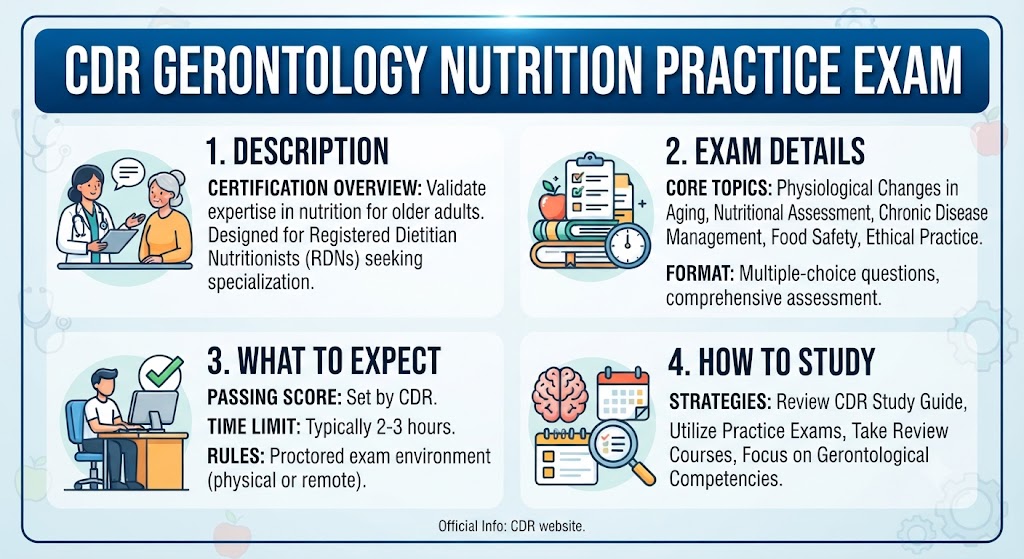
Additional Information
What the Course Entails and Exam Details
The CSG exam is based on a detailed content outline that
reflects the core competencies required for effective gerontological nutrition
practice. The exam covers a broad range of topics, organized into major
domains:
Domain 1: Physiology of Aging and Nutritional Assessment
(approximately 25% of the exam) This domain covers the normal physiological
changes of aging and their impact on nutritional status. It includes:
- Body
composition changes
- Changes
in organ function (e.g., gastrointestinal, renal, cardiovascular)
- Sensory
changes (taste, smell, vision)
- Oral
health issues
- Comprehensive
nutritional assessment, including anthropometric, biochemical, clinical,
and dietary data collection specific to older adults
- Screening
tools for malnutrition risk
Domain 2: Nutritional Care for Chronic and Acute Diseases
in Older Adults (approximately 40% of the exam) This is the largest section
and focuses on the medical nutrition therapy (MNT) for common conditions
affecting older adults. It includes:
- Cardiovascular
disease (hypertension, heart failure)
- Diabetes
mellitus
- Renal
disease
- Gastrointestinal
disorders (constipation, dysphagia, GERD)
- Neurological
conditions (dementia, Parkinson's disease, stroke)
- Bone
health and osteoporosis
- Oncology
- Anemia
- Pressure
ulcers (prevention and treatment)
- Unintentional
weight loss and failure to thrive
Domain 3: Psychosocial, Economic, and Functional Aspects
of Aging (approximately 15% of the exam) This domain addresses the
non-biological factors that influence nutrition and health. It includes:
- Social
isolation and loneliness
- Depression
and cognitive impairment
- Economic
constraints (food insecurity)
- Activities
of Daily Living (ADLs) and Instrumental ADLs (IADLs) and their impact on
food preparation and intake
- Cultural
and religious dietary practices
Domain 4: Food, Nutrition, and Service Systems in
Gerontology (approximately 10% of the exam) This domain covers the
provision of food and nutrition services in various care settings. It includes:
- Menu
planning for older adults (texture-modified diets, therapeutic diets)
- Food
safety and sanitation
- Regulation
and standards of care in long-term care (e.g., CMS regulations)
- Ethical
considerations in end-of-life care and hydration
Domain 5: Education, Communication, and Research
(approximately 10% of the exam) This final domain focuses on professional
skills and application of evidence-based practice. It includes:
- Counseling
techniques and behavior change strategies for older adults and caregivers
- Interdisciplinary
team collaboration
- Evaluating
and applying research to practice
What to Expect in
the Final Exam
The CDR Gerontology Nutrition Practice Exam is a
computer-based test (CBT) administered by CDR's testing vendor, currently
Pearson VUE. Here are the key details about the exam format and administration:
- Exam
Format: The exam consists of multiple-choice questions. Some may be
standalone questions, while others may be case-based, requiring you to
analyze a patient scenario and answer multiple questions related to it.
- Number
of Questions: The total number of questions is typically around 175,
with approximately 150 being scored and 25 being pretest questions (not
scored).
- Time
Limit: You will be given a specific amount of time to complete the
exam, usually 3 hours. It is important to manage your time effectively
throughout the test.
- Passing
Score: The passing score for the CSG exam is determined by a
criterion-referenced standard-setting process, meaning you must achieve a
minimum scaled score (typically 500 on a scale of 200 to 800) to pass. The
raw score needed to achieve this scaled score may vary slightly between
different versions of the exam.
- Testing
Environment: The exam is taken at a secure Pearson VUE testing center.
You will be required to present valid identification and will be subject
to strict security procedures (e.g., no personal belongings allowed in the
testing room).
- Scoring:
Your unofficial score will be provided to you immediately upon completing
the exam at the testing center. Official score reports are typically
mailed or made available online by CDR within a few weeks.
How to Study and Exam Centers
Preparing for the CSG exam requires a dedicated and
structured study plan. Here are some recommended strategies:
Study Strategies:
Review the CDR Study Guide and
Content Outline: Start by thoroughly reviewing the official CSG Candidate
Handbook and Exam Content Outline provided on the CDR website. This will be
your roadmap for what to study.
Utilize Recommended Textbooks:
Refer to key textbooks in gerontological nutrition and dietetics. Relevant
texts often include the "Academy of Nutrition and Dietetics Pocket Guide
to Gerontological Nutrition" and other comprehensive references on MNT.
Take a Review Course: Consider
enrolling in a review course specifically designed for the CSG exam. These
courses, offered by the Academy of Nutrition and Dietetics or other
professional organizations, provide a structured overview of the exam content
and often include practice questions.
Join Study Groups: Connect
with other RDNs who are also preparing for the CSG exam. Studying with peers
can be a great way to discuss complex concepts and share resources.
Focus on Your Weaknesses: Based
on your review of the content outline and performance on practice tests,
identify the domains where you feel less confident and dedicate more study time
to those areas.
Practice Methods:
CDR Practice Exam: The
most valuable practice tool is the official online practice exam offered by
CDR. It simulates the actual exam format and content and can help you become
familiar with the types of questions asked.
Analyze Practice Questions:
Don't just answer practice questions; take the time to understand why the
correct answer is right and why the other options are wrong. This will deepen
your understanding of the material.
Exam Centers:
- The
exam is administered at Pearson VUE testing centers located throughout the
United States and internationally.
- When
you are ready to take the exam, you must first apply to CDR and pay the
examination fee. Once your application is approved, you will receive an
Authorization to Test (ATT) email with instructions on how to schedule
your exam appointment directly through the Pearson VUE website.
- You
will be able to select a testing center location and a date and time that
is convenient for you from the available options.
Job Opportunities from the Course
Earning the Board Certified Specialist in Gerontological
Nutrition (CSG) credential opens doors to specialized and rewarding career
opportunities within the field of dietetics. Here are some of the specific job
titles and career paths that this certification can unlock:
- Gerontological
Nutritionist: Work directly with older adults in various settings,
providing comprehensive nutritional assessments and developing
individualized MNT plans.
- Clinical
Dietitian - Geriatrics Specialist: Specialize in geriatrics within a
hospital or rehabilitation setting, managing the complex nutritional needs
of older patients with multiple chronic conditions.
- Long-Term
Care Dietitian / Consultant: Serve as the lead dietitian or consultant
for a skilled nursing facility or assisted living community, overseeing
menu planning, ensuring regulatory compliance (e.g., CMS), and managing
resident nutrition care.
- Manager
of Nutrition Services in Senior Living: Lead the dining and nutrition
services department in an assisted living or continuing care retirement
community (CCRC).
- Community
Program Coordinator - Older Adults: Develop and manage nutrition
education and meal programs (like congregate meal sites or Meals on
Wheels) for community-dwelling older adults.
- Nutrition
Support Specialist - Geriatrics: Focus on providing specialized
nutrition support (enteral and parenteral nutrition) to frail older adults
in acute or subacute care settings.
- Researcher
in Gerontological Nutrition: Participate in or lead research studies
focused on nutrition and aging, contributing to the evidence base for
gerontological practice.
- Educator
/ Professor: Teach courses on gerontological nutrition in dietetic
internship programs or university nutrition and dietetics departments.
- Private
Practice - Geriatric Nutrition: Establish a private practice
specializing in providing personalized nutrition counseling and coaching
to older adults and their families.
The demand for RDNs with expertise in gerontology is growing
rapidly as the population ages. Holding the CSG credential sets you apart as a
highly qualified professional prepared to meet the unique challenges and
opportunities of this vital field.
Frequently Asked Questions
Reviews
5.0
Based on 0 reviews
Leave a Review
No reviews yet. Be the first to review!