
CDL Vehicle Combination Practice Test
$69.00
- Buy to unlock unlimited access to all Quiz questions.
- After purchase you can print a PDF of the whole quiz at any point. The PDF will contain the questions and the correct answers.
About this Exam
The CDL Combination Vehicles endorsement is a mandatory requirement for any Commercial Driver's License (CDL) holder who wishes to operate a combination vehicle, commonly known as a "semi-truck" or "tractor-trailer." This endorsement, typically designated as a 'Class A' license requirement, is essential for professional truck drivers engaged in interstate or intrastate commerce.
This exam is designed to test your knowledge of the specialized safety procedures and operating techniques required for driving vehicles with more than one unit. Because combination vehicles have unique handling characteristics, braking systems, and coupling mechanisms compared to straight trucks, this endorsement ensures that drivers are fully prepared to manage the increased size, weight, and complexity of these heavy-duty rigs. Whether you are a new driver entering the trucking industry or an experienced professional looking to upgrade your license, mastering this material is a critical step in your career.
Ready to test your knowledge?
Buy Now to Access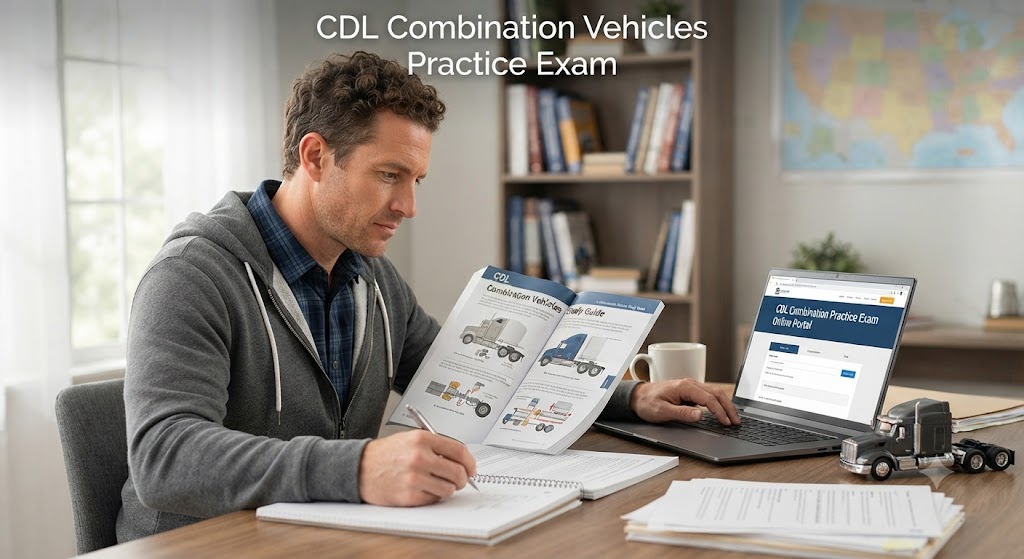
Additional Information
What the Course
Entails and Exam Details
The study material for the CDL Combination Vehicles
endorsement focuses heavily on the safe operation and inspection of coupled
vehicles. The curriculum is structured to provide a deep understanding of both
the theoretical knowledge and practical skills needed on the road.
Core Topics Covered:
- Combination
Vehicle Safety: Understanding the specific safety dynamics of a
tractor-trailer, including off-tracking, rollover risks, and proper speed
management.
- Coupling
and Uncoupling: A detailed, step-by-step process for securely
connecting and disconnecting the tractor and the trailer, including
electrical lines, air lines, and the fifth wheel.
- Air
Brake Systems for Combinations: While the general air brake exam is
separate, this section covers the specific components and operation of air
brake systems as they apply to combination vehicles, such as trailer air
lines and the protection valve.
- Antilock
Braking Systems (ABS): Understanding how ABS functions on
tractor-trailers to prevent wheel lock-up during emergency braking.
- Pre-Trip
Inspection: A rigorous focus on the specific inspection points for
combination vehicles, including the coupling system, gladhands, and
trailer connections.
What to Expect in the Final Exam
The final exam for the Combination Vehicles endorsement is a
written (or computerized) test administered by your state's Department of Motor
Vehicles (DMV) or an authorized third-party testing facility. It is crucial to
remember that this endorsement test is taken in addition to the general
knowledge exam and any other endorsements you may need (like Hazardous
Materials or Tanker).
Exam Format:
- Type:
Multiple-choice questions.
- Number
of Questions: The exam typically consists of 20 to 25 questions, though
this can vary slightly by state.
- Passing
Score: You generally need to answer at least 80% of the questions
correctly to pass.
- Time
Limit: There is usually a time limit, often around 30 to 60 minutes,
which is ample time if you are well-prepared.
Key Rules:
- You
must pass the general CDL knowledge tests (General Knowledge, Air Brakes)
before you can take the Combination Vehicles endorsement exam.
- The
questions are drawn directly from your state's CDL Driver's Manual.
How to Study and
Exam Centers
Preparing effectively for the CDL Combination Vehicles exam
requires a combination of diligent study and practical application.
Actionable Study Strategies:
Master the CDL Manual: The
official state CDL Driver's Manual is your primary resource. Read the
"Combination Vehicles" section thoroughly multiple times. Every
question on the exam is based on the information in this manual.
Take CDL Practice Tests:
Utilize online practice tests specifically for combination vehicles. These
simulate the actual exam format, help you identify areas where you need more
study, and build your confidence. Take as many practice tests as possible.
- Use
Flashcards: Create flashcards for key terms, coupling procedures, and
air brake components. This is an excellent way to memorize critical
information.
- Observe
Experienced Drivers: If possible, watch a licensed Class A driver
perform the coupling and uncoupling process, paying close attention to the
safety checks.
Where and How to Take the Exam:
- Scheduling:
You will typically need to schedule an appointment at your local DMV or a
designated state testing facility. Many states now allow you to schedule
appointments online.
- Documentation:
Be prepared to bring your current driver's license, proof of residency,
and any required medical certification.
- Test
Fees: There will be a testing fee for the endorsement exam.
- CDL
Testing Centers: The exam is taken at official state CDL testing
locations. In some cases, private truck driving schools that are
authorized by the state can administer the written exams as well.
Job Opportunities from the Course
Earning your CDL Class A license with the Combination
Vehicles endorsement is a significant achievement that unlocks a vast array of
career opportunities in the transportation and logistics industry. This
endorsement is a fundamental requirement for the most common and high-demand
trucking jobs.
Specific Job Titles and Career Paths:
- Over-the-Road
(OTR) Truck Driver: Transporting goods across long distances, often
spanning multiple states. This is the classic long-haul trucking role.
- Regional
Truck Driver: Operating within a specific geographic area (e.g., the
Midwest or the Southeast), allowing for more frequent home time than OTR
driving.
- Local
Delivery Driver: Driving tractor-trailers for regional or local
deliveries, often returning home daily.
- Line-Haul
Driver: Moving freight between distribution centers on regular,
scheduled routes.
- Team
Driver: Working with a partner to keep a truck moving for longer
periods, maximizing efficiency and often earning a higher income.
- Hazmat
Transport Driver: With additional endorsement, hauling hazardous
materials in tanker or dry van combination vehicles.
- Car
Hauler: Specializing in the transport of new and used vehicles on
specialized combination trailers.
- Heavy
Haul/Oversized Load Driver: Transporting exceptionally large or heavy
equipment, requiring advanced skills and specialized combination
configurations.
Frequently Asked Questions
Reviews
5.0
Based on 0 reviews
Leave a Review
No reviews yet. Be the first to review!