
CDL General Knowledge Practice
$69.00
- Buy to unlock unlimited access to all Quiz questions.
- After purchase you can print a PDF of the whole quiz at any point. The PDF will contain the questions and the correct answers.
About this Exam
The CDL General Knowledge Exam is the foundational hurdle for anyone pursuing a career in professional trucking and commercial transportation. Passing this rigorous exam is mandatory before you can obtain a Commercial Learner’s Permit (CLP) and advance to behind-wheel training or specialized endorsements like HazMat or Tankers.
Designed for aspiring commercial drivers, this comprehensive test assesses your understanding of critical safe driving principles, vehicle inspection protocols, federal regulations, and road rules necessary for safely operating heavy vehicles. It is the essential first step toward a stable, high-demand career in the logistics industry, ensuring you possess the baseline knowledge required to protect yourself and the public on the road.
Ready to test your knowledge?
Buy Now to Access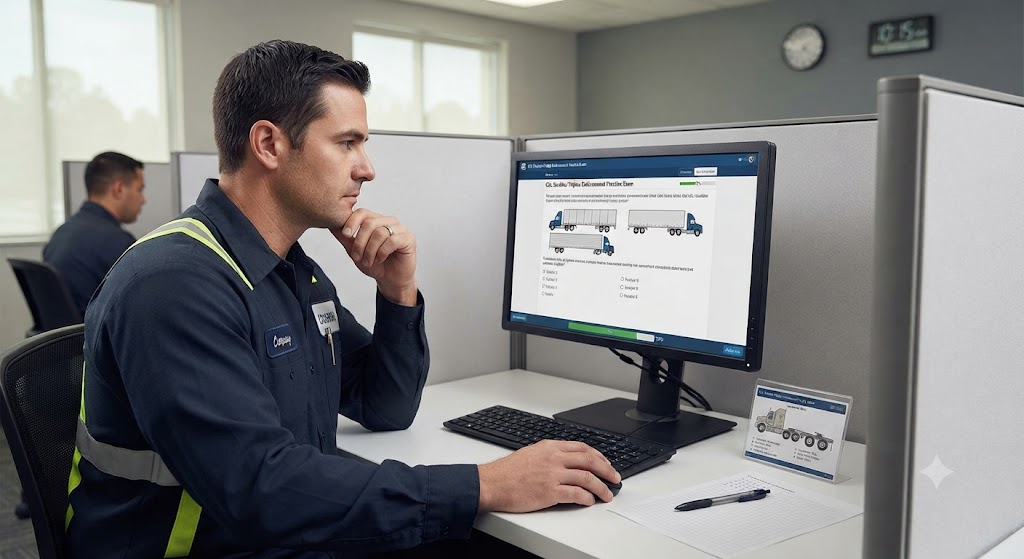
Additional Information
What the Course Entails and Exam Details
To succeed, candidates must master the core competencies
outlined in the official Federal Motor Carrier Safety Administration (FMCSA)
standards, which are detailed in every state’s CDL driver’s manual. The
curriculum covers a wide array of subjects designed to build a comprehensive
foundation in commercial vehicle safety.
You will be tested on vital topics including vehicle control
systems (steering, braking, shifting gears), proper pre-trip, en-route, and
post-trip inspection procedures, and basic safe driving practices like managing
speed, space, and visual awareness. Additionally, the exam rigorously covers
managing hazardous conditions (such as extreme weather, night driving, or
mountain roads), accident procedures, emergency maneuvers, and the regulations
surrounding cargo securement. Understanding the strict rules regarding
distracted driving, impaired driving (DUI/DWI), and hours-of-service
requirements is also critical for success on this exam.
What to Expect in the Final Exam
The official CDL General Knowledge Exam is a standardized,
timed test administered primarily at state Driver License Centers, DMVs, or
authorized third-party testing facilities. The format consists entirely of
multiple-choice questions sourced directly from your state's official CDL
Driver’s Manual.
While the exact number of questions varies slightly by
state, the exam typically contains between 50 and 70 questions. To pass, you
generally need to achieve a score of at least 80% or higher. You are usually
allotted a strict time limit, often ranging from 60 to 90 minutes, to complete
the test, which is ample time if you are well-prepared. This is a closed-book
exam, and absolutely no study materials, notes, or electronic devices are
permitted in the testing room, ensuring that your certification is earned
through genuine knowledge retention.
How to Study and Exam Centers
Preparing effectively for the CDL General Knowledge Exam
requires dedication, focused study habits, and strategic review. The single
most important resource is your state’s official CDL Driver’s Manual; read it
cover-to-cover multiple times, as it is the definitive source for all exam
material.
Supplement your reading with active study techniques. Break
down complex chapters, create flashcards for key statistics (like stopping
distances and weight limits), and utilize high-quality, state-specific CDL
practice tests online. These practice exams simulate the real testing
environment, familiarize you with the question formats, and help identify areas
where you need further review. Aim to consistently score above 90% on these
practice tests before attempting the real exam. Once you are confident, schedule
your test in person at your local state DMV, Driver and Vehicle Services (DVS),
or an authorized CDL testing center. Be sure to check ID requirements,
residency documents, and testing fees beforehand.
Job Opportunities from the Course
Passing the CDL General Knowledge Exam and obtaining your
Commercial Learner’s Permit (CLP) is the prerequisite that unlocks a wide array
of lucrative and stable career paths in the transportation sector. This
certification is the essential first step toward earning a Class A, B, or C
Commercial Driver’s License (CDL).
With a valid CDL, you become eligible for diverse roles such
as a Long-Haul OTR (Over-the-Road) Truck Driver, regional freight hauler, or
local delivery driver for major retail and logistics companies. Furthermore,
this general knowledge serves as the mandatory foundation for acquiring
specialized endorsements, which significantly expands your career
opportunities. This includes roles as a HAZMAT Tanker Driver, Passenger Bus
Operator, School Bus Driver, or a driver for heavy specialized equipment. A
career in professional driving offers excellent earning potential, job
security, and opportunities for career advancement across the entire supply
chain industry.
Frequently Asked Questions
Reviews
5.0
Based on 0 reviews
Leave a Review
No reviews yet. Be the first to review!