
CDL Class A Practice
$69.00
- Buy to unlock unlimited access to all Quiz questions.
- After purchase you can print a PDF of the whole quiz at any point. The PDF will contain the questions and the correct answers.
About this Exam
Passing the CDL Class A exam is your gateway to a lucrative and stable career in professional trucking. This certification is essential for anyone who wants to operate combination vehicles with a Gross Combination Weight Rating (GCWR) of 26,001 pounds or more, provided the towed vehicle is heavier than 10,000 pounds. Designed for safety-conscious individuals seeking high-demand roles, the CDL Class A opens doors to interstate commerce, heavy specialized hauling, and regional transport positions. This comprehensive study guide is tailored to help you prepare effectively for the rigorous testing process and launch your professional driving career with confidence.
Ready to test your knowledge?
Buy Now to Access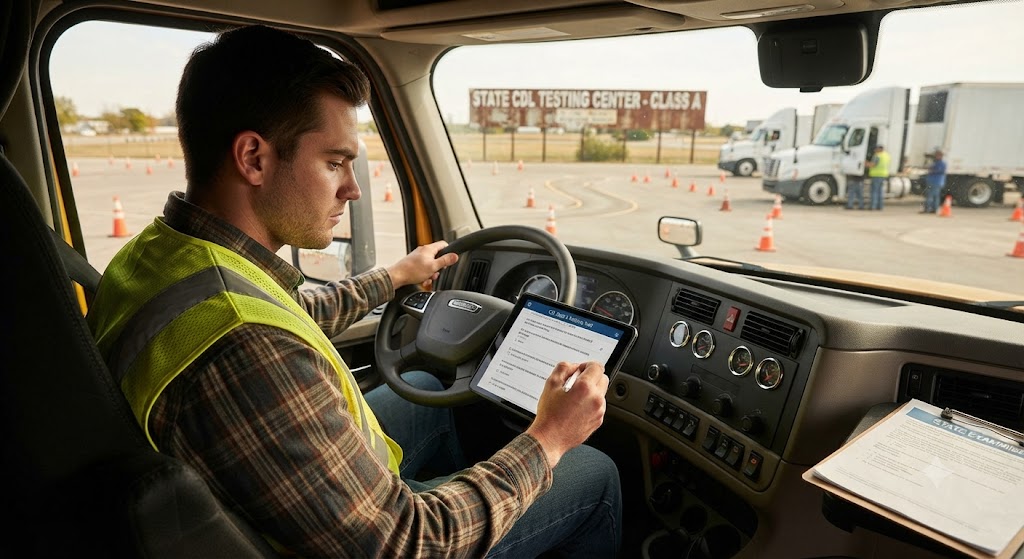
Additional Information
What the Course Entails and Exam Details
The path to obtaining your CDL Class A involves mastering
both theoretical knowledge and practical driving skills. Before taking the
final exam, candidates must complete mandatory Entry-Level Driver Training
(ELDT), which covers critical safety protocols and operational standards.
The theoretical portion of the exam assesses your
understanding of the CDL General Knowledge requirements. This includes
essential topics such as:
- Safe
Vehicle Operation: Speed management, space management, and hazard
perception.
- Vehicle
Inspection: Mastering the comprehensive pre-trip, during-trip, and
post-trip inspection processes.
- Basic
Control: Backing, shifting, and docking maneuvers.
- Advanced
Operating Conditions: Driving in extreme weather, mountainous terrain,
and heavy traffic.
- Emergency
Procedures: Handling breakdowns, fires, and accident scenes.
Additionally, to operate specific types of vehicles or
cargo, you must pass endorsement exams, including:
- Air
Brakes: Understanding the complexities of air brake systems, including
inspection and testing.
- Combination
Vehicles: Specific knowledge for safely operating tractor-trailers.
- Tanker
(N): Regulations for hauling liquids in bulk.
- HazMat
(H): Stringent rules for transporting hazardous materials (requires
background check).
- Doubles/Triples
(T): Specific handling characteristics for multiple trailers.
- School
Bus (S) and Passenger (P): Endorsements for carrying passengers.
What to Expect in
the Final Exam
The CDL Class A exam is structured in three distinct parts,
all of which must be passed to earn your license.
Part 1: Knowledge Tests These are computerized
multiple-choice exams taken at your local DMV or authorized testing facility.
The primary General Knowledge test usually consists of 50-70 questions, and you
must achieve a score of at least 80% to pass. Additional endorsement tests
(like Air Brakes and Combination Vehicles) are required for the Class A and
have their own question counts and passing requirements. You must pass the
General Knowledge and applicable endorsement tests to receive your Commercial
Learner’s Permit (CLP).
Part 2: Pre-Trip Inspection Test This is a practical
exam where you must demonstrate your ability to conduct a thorough inspection
of the vehicle. You will be required to point to and explain various components
(engine, brakes, lights, coupling system, tires, etc.) and explain why
you are checking them. This test ensures you can identify defects that could
compromise safety.
Part 3: Basic Control Skills Test and Road Test The
final stage involves hands-on driving. The Basic Control Skills test evaluates
your ability to maneuver the vehicle, including straight-line backing, offset
backing, and parallel or alley docking. Successfully passing this phase allows
you to proceed to the Road Test. The Road Test assesses your actual driving
skills on public roads, where you must demonstrate safe operation in varied
traffic conditions, including turns, intersections, railroad crossings, and
highway driving.
How to Study and Exam Centers
Effective preparation is critical for success on the CDL
Class A exam. Begin by thoroughly studying the official CDL Driver’s Manual
for your specific state, as it contains all the information needed for the
knowledge tests.
Leverage technology by utilizing a reliable CDL Class A
Practice Test. Taking multiple practice exams will help you familiarize
yourself with the question format, identify areas where you need further
review, and build confidence. Supplement your studying with flashcards for
pre-trip inspection components and air brake systems.
Once you are consistently scoring high on practice tests and
have completed your required ELDT training, you are ready to schedule your
exam. CDL knowledge tests are typically administered at state DMV or BMV
locations. The practical skills tests (Pre-Trip, Control Skills, and Road
Test) are conducted at designated state-operated CDL testing facilities
or by authorized third-party testing centers often affiliated with
certified truck driving schools. Be sure to schedule your appointments in
advance, as slots can fill quickly.
Job Opportunities
from the Course
Earning your CDL Class A is a significant achievement that
unlocks numerous high-paying and stable career paths in the transportation
industry. With this certification, you are qualified for roles that demand
skill, responsibility, and professionalism.
Career opportunities include:
- Over-the-Road
(OTR) Truck Driver: Transporting goods across long distances, often
across multiple states.
- Regional
Driver: Hauling freight within a specific geographic region, allowing
for more frequent home time.
- Local
Delivery Driver: Making deliveries within a city or local area,
typically returning home daily.
- HazMat
Driver: Specializing in the transport of hazardous materials, which
commands higher pay due to specialized training and endorsements.
- Tanker
Driver: Operating vehicles designed to carry liquid or gaseous bulk
cargo.
- Heavy
Equipment Hauler: Transporting oversized machinery and construction
equipment.
- Ice
Road Trucker: A specialized, high-risk, and high-reward niche
requiring exceptional driving skills in extreme conditions.
- Owner-Operator:
Eventually purchasing your own truck and managing your own business
hauling freight.
Each of these roles offers competitive salaries, benefits
packages, and the freedom of the open road. By preparing diligently for your
CDL Class A exam, you are investing in a rewarding and resilient future.
Frequently Asked Questions
Reviews
5.0
Based on 0 reviews
Leave a Review
No reviews yet. Be the first to review!