
CDL Class A
$69.00
- Buy to unlock unlimited access to all Quiz questions.
- After purchase you can print a PDF of the whole quiz at any point. The PDF will contain the questions and the correct answers.
About this Exam
Embarking on a career as a commercial truck driver is an exciting step toward financial stability and professional freedom. To operate the largest and heaviest vehicles on the road, you must obtain a Commercial Driver's License (CDL) Class A. This certification is designed for individuals who intend to drive combinations of vehicles, specifically with a Gross Combination Weight Rating (GCWR) of 26,001 or more pounds, provided the towed vehicle is in excess of 10,000 pounds.
Whether you dream of long-haul trucking across the country or prefer local routes that get you home every night, the Class A CDL is your gateway. However, before you get behind the wheel for the final skills test, you must first master the extensive knowledge portion of the exam. This comprehensive CDL Class A practice test study guide is crafted to help you understand what to expect, how to prepare, and ultimately, how to pass with flying colors on your first attempt.
Ready to test your knowledge?
Buy Now to Access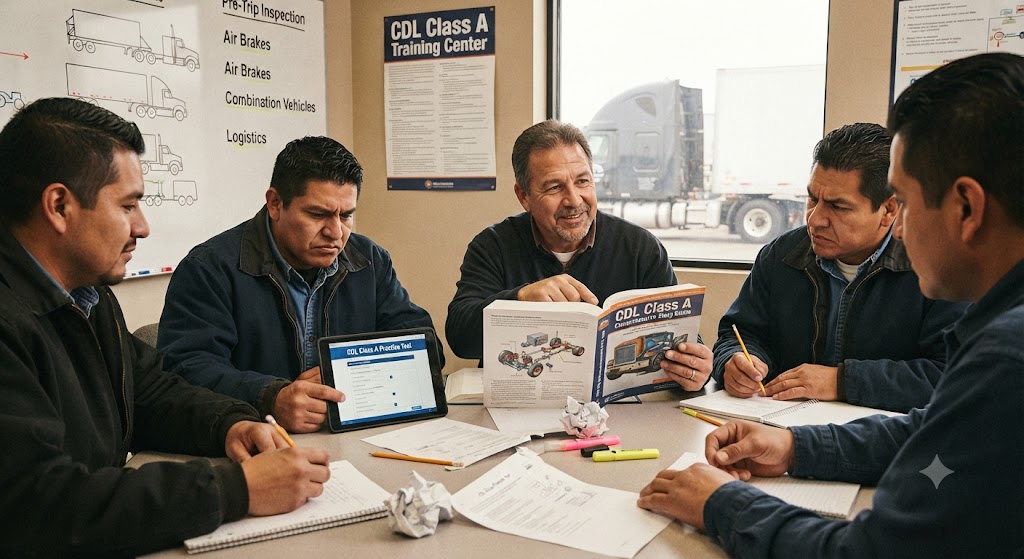
Additional Information
What the Course Entails and Exam Details
The journey to your Class A CDL begins with understanding
the material outlined in your state’s Commercial Driver’s License manual. The
written knowledge exam is rigorous because it covers critical safety
information necessary for operating combination vehicles.
The course and the corresponding exam entail a deep dive
into several core areas. You will need to study general commercial driving
knowledge, including vehicle inspections, basic control, shifting, and managing
space and speed. For the Class A specifically, a significant portion of the
exam is dedicated to combination vehicles, covering topics like coupling and
uncoupling trailers and understanding air brake systems.
- FurthermoreTanker
(N): Necessary for hauling liquids in bulk.
- Hazmat
(H): Permits the transport of hazardous materials. This endorsement
requires a separate, federal Transportation Security Administration (TSA)
background check.
- Doubles/Triples
(T): Allows you to pull multiple trailers.
- Passenger
(P): Required if you plan to drive a passenger vehicle, such as a
large bus.
The written exam is not just about memorizing facts; it's
about understanding the 'why' behind the safety regulations that govern the
trucking industry.
What to Expect in the Final Exam
The final exam for your CDL Class A learner's permit is
administered at your local state Driver and Vehicle Services office or an
authorized third-party testing facility. It is a computerized multiple-choice
test.
The number of questions varies by state, but you can expect
a comprehensive examination. For example, the general knowledge test might
consist of 50 questions, while the combination vehicle test adds another 20,
and air brakes another 25. To pass, you typically need to achieve a minimum
score of 80% on each section.
It is important to note that these are timed exams. While
the time limit is usually generous (e.g., one hour for the general knowledge
test), you must be prepared to work efficiently. You will not be allowed to use
study aids, cell phones, or talk to other applicants during the exam.
Because the failure of any single section means you cannot
proceed to the behind-the-wheel training and final skills test, thorough
preparation using CDL Class A practice tests is crucial.
How to Study and Exam Centers
Successfully passing the CDL Class A written exam requires a
strategic approach. Here is a recommended study plan:
- Start
with the Manual: Your state’s CDL driver’s manual is the primary
source material. Read it cover to cover, multiple times.
- Take
CDL Class A Practice Tests Regularly: This is the most effective study
method. Use reputable online resources that simulate the real exam's
format and question style. Take practice tests for general knowledge, air
brakes, and combination vehicles repeatedly until you are consistently
scoring above 90%.
- Focus
on Weak Areas: Don't just keep taking the same easy quizzes. If you
struggle with air brake components or coupling procedures, dedicate
focused study time to those specific chapters in the manual before
returning to practice tests.
- Use
Flashcards: Create flashcards for key terms, braking distances, and
inspection points to reinforce memorization.
- Form
a Study Group: Discussing scenarios and regulations with fellow
aspiring drivers can help solidify complex concepts.
Once you are consistently passing your practice exams, you
are ready for the real thing. To take the exam, locate your nearest state
Driver Licensing Office. Many states require appointments for CDL testing, so
check the official website for your state's Department of Motor Vehicles (DMV)
or equivalent agency to schedule your visit. Be prepared to bring proof of
identity, residency, and any required medical certification.
Job Opportunities from the Course
Earning your Class A CDL opens the door to a wide array of
lucrative and stable career paths in the transportation and logistics industry.
This certification is not just a license; it's a qualification for numerous
roles that are in high demand across the country.
Upon passing your exam and completing any necessary
behind-the-wheel training, you will be qualified for the following positions:
- O数据显示TR (Over-the-Road) Truck Driver:
Transport goods across long distances, often spanning several states,
enjoying the freedom of the open road.
- Regional
Truck Driver: Haul freight within a specific geographic area (e.g.,
the Midwest or the Northeast), allowing for more frequent home time than
OTR driving.
- Local
Delivery Driver: Operate Class A vehicles for shorter routes within a
city or region, typically returning home daily.
- Hazmat
Driver: Specialize in transporting hazardous materials, a role that
commands higher pay due to the specialized training and endorsements
required.
- Tanker
Driver: Drive tanker trucks to transport liquids or gases, such as
fuel, milk, or chemicals.
- Heavy
Haul Driver: Move oversized or extremely heavy equipment and
machinery, requiring specialized skills and permits.
- Team
Driver: Partner with another driver to keep a truck moving nearly
24/7, maximizing earning potential on long routes.
The earning potential for Class A CDL holders is
significant, with opportunities for bonuses, benefits, and career advancement
into roles like driver trainer, safety supervisor, or fleet manager.
By diligently preparing for your exam using CDL Class A
practice tests and this guide, you are taking the first essential step toward a
rewarding and prosperous career in the trucking industry. Good luck!
Frequently Asked Questions
Reviews
5.0
Based on 0 reviews
Leave a Review
No reviews yet. Be the first to review!