
CDCA Objective Structured Clinical Examination (OSCE) Practice
$69.00
- Buy to unlock unlimited access to all Quiz questions.
- After purchase you can print a PDF of the whole quiz at any point. The PDF will contain the questions and the correct answers.
About this Exam
The Chemical Dependency Counselor Assistant (CDCA) Objective Structured Clinical Examination (OSCE) is a critical milestone for aspiring addiction counselors in Ohio. Designed to test practical application rather than just theoretical knowledge, the CDCA OSCE evaluates your ability to handle real-world clinical scenarios. This certification is the essential first step for individuals beginning their careers in substance use disorder counseling, demonstrating to employers and boards that you possess the foundational competencies required to provide ethical and effective care.
Ready to test your knowledge?
Buy Now to Access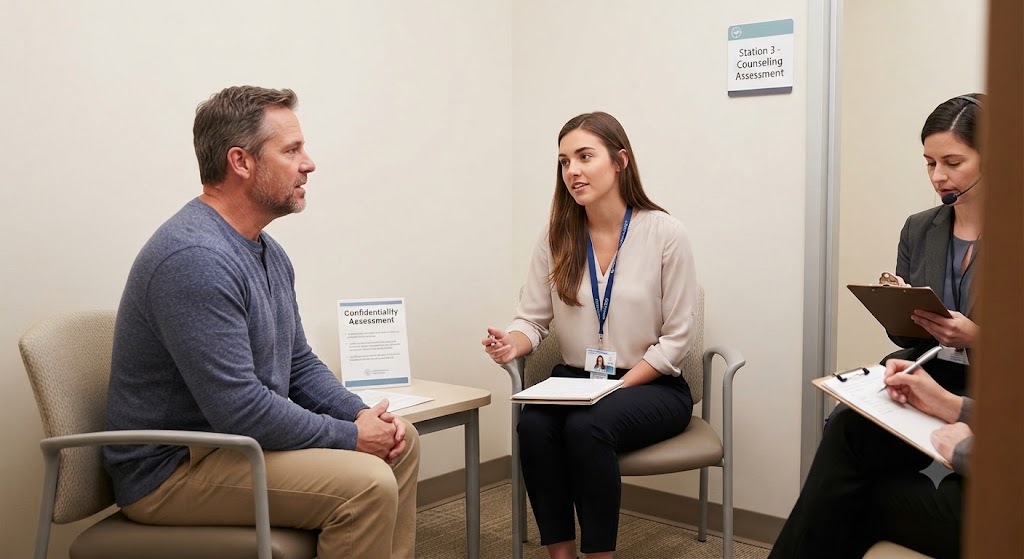
Additional Information
What the Course Entails and Exam Details
While the CDCA Preliminary (Phase I) requires specific
education hours, the CDCA Renewable (Phase II) requires passing the OSCE. The
curriculum and the exam focus on the core functions of a counselor assistant,
heavily emphasizing the Twelve Core Functions developed by NAADAC.
Candidates must demonstrate proficiency in the following key
areas:
- Screening:
Gathering data and determining the appropriateness of treatment.
- Intake:
The initial contact and administrative processes for admission.
- Orientation:
Describing program goals, rules, and services to the client.
- Counseling:
Individual and group skills (active listening, empathy, basic motivational
interviewing).
- Client
Education: Providing information about substance use and recovery
resources.
- Crisis
Intervention: Recognizing and responding to acute client needs.
- Referral:
Identifying needs that cannot be met by the counselor and assisting the
client in utilizing support systems.
- Reports
and Record Keeping: Maintaining accurate documentation of the
counseling process.
- Consultation:
Conferring with colleagues to ensure comprehensive client care.
- Professional
and Ethical Responsibility: Adhering to established professional codes
of ethics.
What to Expect in
the Final Exam
The CDCA OSCE is not a traditional written test. It is a
practical, performance-based examination. You will not answer multiple-choice
questions about counseling; you will be the counselor.
The exam consists of a series of simulation stations, often
referred to as "encounters." In each station, you will interact with
a Standardized Client (SC)—an actor trained to portray a specific person in a
specific situation related to addiction treatment.
Exam Format:
- Role-Play
Scenarios: You will be given a brief prompt before entering a station,
describing the client and the immediate goal (e.g., "Complete a brief
screening with 'John' who presents with alcohol dependency
concerns").
- Observation:
A trained examiner (rater) will be present in the room, observing your
interaction and scoring your performance based on specific, predetermined
behavioral checklists.
- Timing:
Each station is strictly timed, typically ranging from 10 to 20 minutes,
depending on the specific task (e.g., an intake interview might take
longer than a crisis intervention simulation).
Passing the Exam:
- To
pass, you must demonstrate competence across all evaluated domains.
- The
focus is on safety, ethics, and foundational clinical skills. You must
show you can build rapport, communicate effectively, and handle the
scenario ethically.
How to Study and
Exam Centers
Preparing for a practical exam requires a different approach
than traditional studying. Rereading textbooks will not suffice; you must
practice doing the counseling.
Study Strategies:
- Role-Playing:
This is the most effective preparation method. Find a colleague,
classmate, or mentor willing to act as a client. Use practice scenarios
(available through the Ohio Chemical Dependency Professionals Board or
reputable test prep providers) and practice conducting intakes,
screenings, and basic counseling sessions.
- Self-Recording:
Record your role-play practice sessions. Watch them back to critique your
active listening skills, body language, and the clarity of your questions.
Are you using too much jargon? Are you interrupting the client?
- Review
the Core Functions: Deeply understand the Twelve Core Functions. You
must be able to identify which function you are performing in any given
scenario and demonstrate the corresponding skills.
- Ethics
First: Familiarize yourself with the NAADAC Code of Ethics and Ohio’s
specific counselor assistant code. In the OSCE, an ethical breach (such as
giving advice instead of counseling, or promising confidentiality you
cannot keep) often results in an automatic failure of that station.
Where and How to Take the Exam:
- The
CDCA OSCE is administered by the Ohio Chemical Dependency Professionals
Board (OCDP Board) or their designated testing vendors.
- Unlike
computerized multiple-choice exams, the OSCE is typically held at specific
testing sites in Ohio that are equipped for practical assessments.
- You
must apply for the exam through the OCDP Board website. Once approved, you
will receive instructions on how to schedule your exam date and location
through their online portal. Registration often fills up quickly, so
register as soon as you are eligible.
Job Opportunities
from the Course
Earning your CDCA and passing the OSCE opens the door to
entry-level positions in the behavioral health field. This certification
signifies that you are qualified to work under supervision in various addiction
treatment settings.
Specific job titles and career paths include:
- Chemical
Dependency Counselor Assistant (CDCA): The standard title for working
directly with clients in addiction treatment centers.
- Substance
Abuse Counselor Assistant: Working in hospitals, detox centers, or
outpatient clinics.
- Addiction
Technician: Assisting senior counselors with documentation, groups,
and client monitoring.
- Case
Management Aide: Helping clients navigate social services, housing,
and employment resources.
- Residential
Monitor/Recovery Support Specialist: Working in halfway houses or
recovery residences, providing support and oversight to residents.
- Behavioral
Health Technician: A broader role in mental health and addiction
facilities, supporting clinical staff.
By successfully completing the CDCA OSCE, you are not just
passing an exam; you are proving you have the foundational skills necessary to
begin a rewarding career helping individuals on their journey to recovery.
Frequently Asked Questions
Reviews
5.0
Based on 0 reviews
Leave a Review
No reviews yet. Be the first to review!