
CDCA Local Anesthesia Practice Exam
$69.00
- Buy to unlock unlimited access to all Quiz questions.
- After purchase you can print a PDF of the whole quiz at any point. The PDF will contain the questions and the correct answers.
About this Exam
The CDCA Local Anesthesia Practice Exam is an essential preparatory tool for dental hygienists and dental students aiming to achieve licensure in the administration of local anesthesia. Administered by the Commission on Dental Competency Assessments (CDCA), this rigorous evaluation is designed to confirm that candidates possess the necessary theoretical knowledge and clinical judgment to safely and effectively administer local anesthetic agents. This certification is a critical step for professionals looking to expand their scope of practice, improve patient comfort during complex procedures, and enhance their overall employability within the dental field.
Ready to test your knowledge?
Buy Now to Access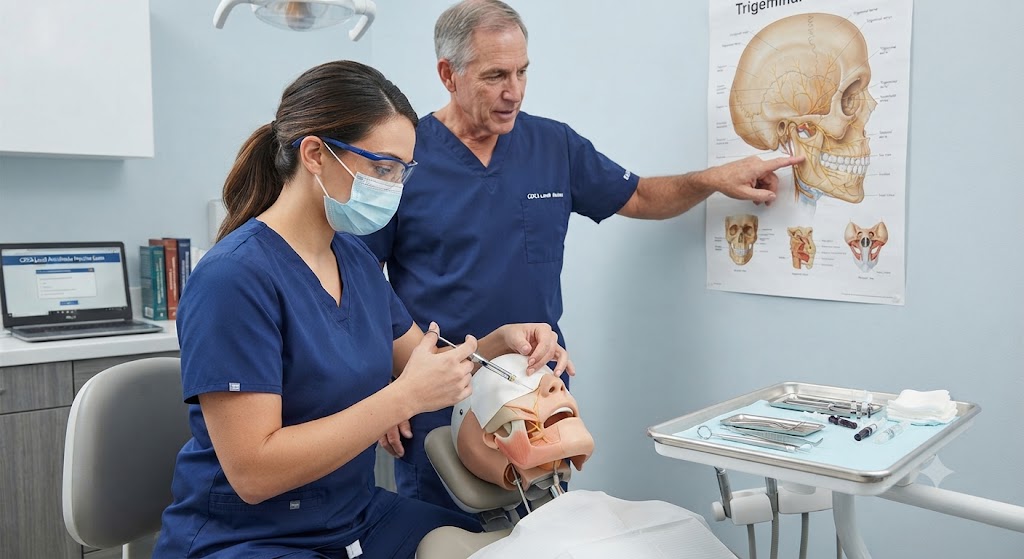
Additional Information
What the Course Entails and Exam Details
To successfully pass the CDCA Local Anesthesia exam,
candidates must demonstrate comprehensive understanding across several core
domains. The curriculum and examination typically cover the following key
areas:
- Neurophysiology:
Understanding the mechanism of action of local anesthetics, nerve impulse
conduction, and the physiology of pain perception.
- Pharmacology
of Anesthetic Agents: In-depth knowledge of amide and ester-type
anesthetics, vasoconstrictors, preservatives, and maximum safe dosages
(MRD) based on patient weight and health status.
- Patient
Assessment and Management: Evaluating medical history, recognizing
contraindications, taking vital signs, and managing potential medical
emergencies related to anesthesia.
- Anatomy:
Detailed head and neck anatomy, specifically related to nerve pathways
(trigeminal nerve), bony landmarks, and blood vessels relevant to
injection sites.
- Technique
and Administration: Knowledge of specific injection techniques,
including infiltration, supraperiosteal, and various block injections
(e.g., IA, PSA, mental/incisive).
- Armamentarium:
Proper selection and care of syringes, needles, cartridges, and safety
protocols.
What to Expect in
the Final Exam
The CDCA Local Anesthesia examination is structured to
evaluate both cognitive understanding and clinical competency. It is crucial to
understand the format beforehand to prepare effectively.
The examination is typically divided into two main
components:
- Computer-Based
Component (CBT): This is the written portion of the exam. It consists
of multiple-choice questions designed to test your knowledge of the
subjects outlined above (pharmacology, anatomy, technique, safety). The
exam is timed, and candidates are given a specific window (usually several
hours) to complete the questions.
- The
Examination Sequence: Candidates must achieve a passing score on the
written/CBT component before being allowed to challenge the
clinical/practical component (though this structure can vary slightly by
jurisdiction and specific CDCA modules offered).
- Passing
Requirements: The CDCA sets a minimum passing scaled score for the
written examination. Specific details regarding scoring and the number of
questions can be found in the official CDCA Candidate Guide, which is
updated annually.
How to Study and Exam Centers
Preparing for the CDCA Local Anesthesia exam requires a
strategic and dedicated approach, combining didactic review with practical
application.
- Utilize
Official Resources: The most reliable study source is the official
CDCA Candidate Manual and any supplementary outlines provided directly by
the Commission. This ensures you are studying the correct material for the
current testing cycle.
- Review
Course Materials: Thoroughly re-examine your textbooks and notes from
your primary dental hygiene or dental anesthesia coursework. Focus heavily
on anatomy diagrams and pharmacology charts.
- Take
Practice Tests: Utilize a CDCA Local Anesthesia Practice Exam to
familiarize yourself with the question format, pacing, and types of
scenarios presented. Practice exams are invaluable for identifying areas
of weakness that require further review.
- Flashcards
and Study Groups: Create flashcards for anatomical landmarks, local
anesthetic agents, dosages, and emergency protocols. Study groups can be
effective for quizzing each other on injection techniques and
pharmacology.
- Exam
Centers and Scheduling: The computer-based component of the CDCA exam
is administered through a major testing service, typically Pearson VUE.
Pearson VUE operates numerous secure testing centers globally. Candidates
must register on the official CDCA website first to receive authorization,
and then schedule their specific testing date and location through the
Pearson VUE portal. Ensure you locate a center near you well in advance of
your desired exam date.
Job Opportunities
from the Course
Successfully passing the CDCA Local Anesthesia exam and
obtaining state licensure unlocks significant career advancement opportunities
for dental hygienists. The ability to administer anesthesia is a highly valued
skill that directly impacts a practice's efficiency and patient care
capabilities.
Specific job titles and career paths available to certified
professionals include:
- Licensed
Dental Hygienist (with Local Anesthesia Endorsement): This is the
primary role, allowing hygienists to perform scaling, root planing, and
other therapeutic procedures with enhanced patient comfort.
- Expanded
Functions Dental Hygienist: In many states, anesthesia certification
is a prerequisite for performing other advanced duties, such as placing
restorative materials.
- Public
Health Dental Hygienist: Working in community clinics or mobile dental
units, where administering anesthesia is necessary for providing
comprehensive care to underserved populations.
- Periodontal
Hygienist: Specialized roles within periodontal practices that
frequently involve procedures requiring effective pain management.
- Clinical
Educator/Instructor: Experienced hygienists who have obtained advanced
certification may teach local anesthesia courses at dental hygiene
schools.
- Travel/Temp
Hygienist: Dental staffing agencies often prioritize candidates with
local anesthesia certification, leading to higher hourly rates and greater
job flexibility.
Frequently Asked Questions
Reviews
5.0
Based on 0 reviews
Leave a Review
No reviews yet. Be the first to review!