
CCHT Environment Practice Test
$69.00
- Buy to unlock unlimited access to all Quiz questions.
- After purchase you can print a PDF of the whole quiz at any point. The PDF will contain the questions and the correct answers.
About this Exam
The Certified Clinical Hemodialysis Technician (CCHT) designation is the premier national certification for dialysis technicians, administered by the Nephrology Nursing Certification Commission (NNCC). This examination is meticulously designed to validate the knowledge, skills, and abilities required to provide safe and effective hands-on care to patients undergoing hemodialysis. While the full exam covers comprehensive patient care, a critical portion focuses specifically on the technical and environmental aspects of the dialysis unit. Our "Environment Practice Test" is tailored to help you excel in this domain, which includes crucial topics like infection control, water treatment, and equipment safety. It is designed for individuals who have already completed a training program and have the required clinical experience, providing the final layer of focused preparation needed for exam success. This certification signifies to employers and patients your commitment to maintaining the highest standards of safety in a complex clinical setting.
Ready to test your knowledge?
Buy Now to Access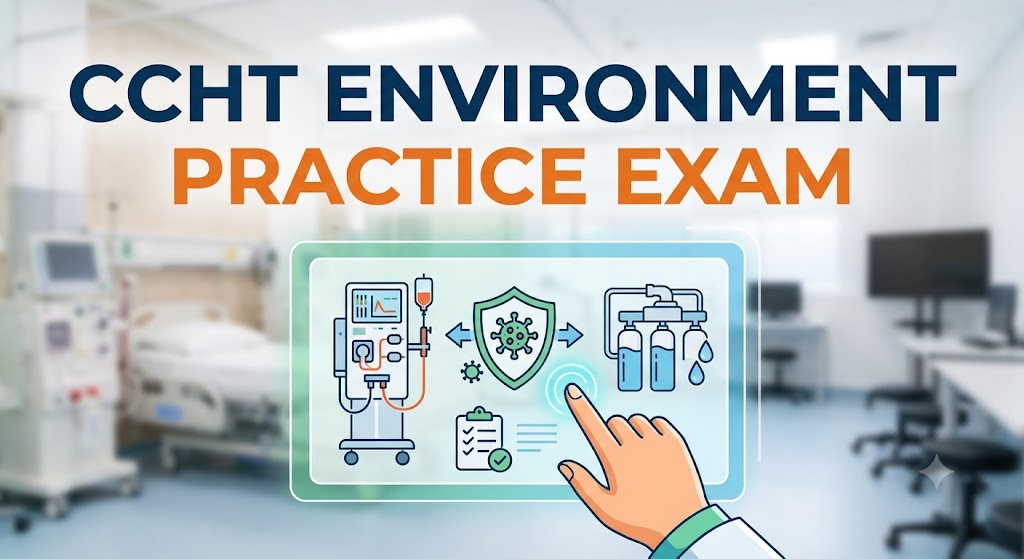
Additional Information
What the Course Entails and Exam Details
This specialized practice guide focuses on the technical and safety domains outlined by the NNCC. It covers the essential skills and knowledge base necessary for the environmental control segment of the CCHT test blueprint. The core areas you will review include:
Infection Control Principles and Practices: This is paramount, covering aseptic technique, sterilization, disinfection protocols for equipment and surfaces, and proper handling of biohazardous materials.
Water Treatment Systems: You must understand the comprehensive process of creating ultra-pure water for dialysis, including the function of carbon tanks, water softeners, reverse osmosis units, and the monitoring of water quality parameters like chlorine, chloramines, and bacteria/endotoxin levels.
Dialysis Equipment Operation and Maintenance: This area tests your knowledge of how hemodialysis machines function, including safety alarms (e.g., conductivity, temperature, blood leak detectors), proper setup, and basic troubleshooting.
Environmental Safety: This includes knowledge of hazardous material handling (Safety Data Sheets/SDS), emergency procedures, and maintaining a clutter-free, compliant physical space.
What to Expect in the Final Exam
When you sit for the full NNCC CCHT final exam, you should expect a standard, proctored experience. The full CCHT exam is a computer-based test (CBT) consisting of 150 multiple-choice questions, which you must complete within a three-hour time limit. It is important to know that approximately 25 of these are unscored pilot questions being validated for future tests. Your raw score is converted to a scaled score ranging from 0 to 99, and the passing standard is a scaled score of 74. You will receive your official score report immediately upon completion. The environmental control section is one of several key domains, typically representing a substantial percentage (often over 20-30%) of the scored questions, meaning mastery here is absolutely essential to achieving a passing grade. You should expect questions to be situational, asking how you would apply technical knowledge in real-world clinical scenarios.
How to Study and Exam Centers
Preparation for this technical section must be methodical and practical. Here are actionable study strategies to excel:
Utilize the Official Blueprint and Handbook: Always start with the official source. Review the NNCC CCHT Test Blueprint, which breaks down exactly what percentage of the test is dedicated to technical and environmental concepts.
Focus on 'The Core Curriculum': The "Core Curriculum for the Dialysis Technician" is considered the gold standard reference text for CCHT prep. Systematically study the chapters related to water treatment, infection control, and machine technology.
Take Targeted Practice Tests: Use focused practice tests, like our specialized environmental and technical question set, to assess your current knowledge. Practice with multiple-choice questions to familiarize yourself with the framing and to improve your pacing. Use rationales provided for incorrect answers as learning tools.
Hands-on Review: Spend time with your facility's water treatment system and hemodialysis machines. Have a licensed nurse or senior technician explain the function of components and alarm systems to reinforce classroom knowledge with real-world application.
You must register for the exam through the NNCC. Once your application is approved, you will schedule your testing appointment at a computer-based testing center. The NNCC utilizes Pearson VUE testing centers, a leading network with thousands of physical locations across the United States. Many major cities and suburban areas have authorized centers.
Job Opportunities from the Course
Earning your CCHT certification validates your expertise, significantly enhancing your job prospects and career stability in the fast-growing field of nephrology. A comprehensive understanding of the dialysis environment opens doors to several key roles. Potential career paths and specific job titles unlocked by this certification include:
Certified Clinical Hemodialysis Technician (CCHT): The primary role, responsible for setting up equipment, initiating treatment, monitoring patients, and maintaining the care environment.
Lead Dialysis Technician: With experience and certification, you may advance to a supervisory or mentoring role, training new staff and overseeing technical operations.
Chief Dialysis Technician: A leadership position managing entire technical departments within large dialysis units.
Biomedical Technician/Equipment Specialist: Specialized roles focused entirely on the maintenance, calibration, and repair of dialysis machines and water treatment systems.
Dialysis Facility Educator: Certified technicians can transition into educational roles, training future technicians in accredited programs.
Frequently Asked Questions
Reviews
5.0
Based on 0 reviews
Leave a Review
No reviews yet. Be the first to review!