
Casa Pilot Practice Test & Exam Prep | Australia
$69.00
- Buy to unlock unlimited access to all Quiz questions.
- After purchase you can print a PDF of the whole quiz at any point. The PDF will contain the questions and the correct answers.
About this Exam
For any aspiring aviator in Australia, passing the Civil Aviation Safety Authority (CASA) flight crew theory exams is an essential milestone on the path to the cockpit. These standardized assessments validate the comprehensive knowledge required to operate safely in the complex world of aviation. From recreational fliers to those pursuing a professional career as an airline pilot, everyone must satisfy CASA's theoretical knowledge requirements.
The exams are designed for student pilots seeking their initial qualifications, such as the Recreational Pilot Licence (RPL) and Private Pilot Licence (PPL). They also cater to serious career pilots advancing toward their Commercial Pilot Licence (CPL) and, ultimately, the Airline Transport Pilot Licence (ATPL). These tests serve as a rigorous quality assurance check, ensuring every pilot-in-command possesses a standard level of theoretical understanding to maintain Australia's high aviation safety record.
Ready to test your knowledge?
Buy Now to Access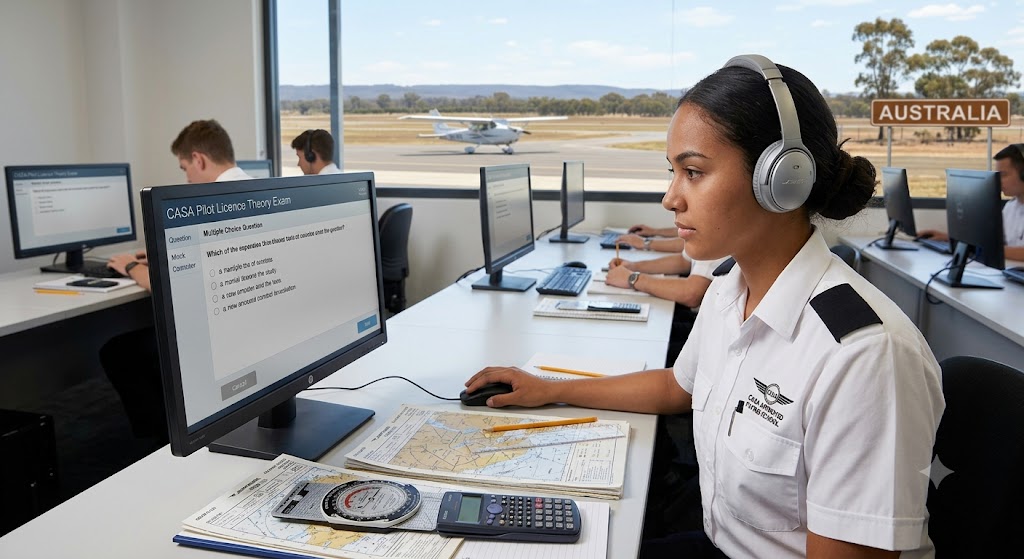
Additional Information
What the Course Entails and Exam Details
Outline the core topics, syllabus, or skills covered.
CASA pilot theory exams assess a wide range of essential subjects, increasing in complexity as a pilot progresses through different licence levels. The core knowledge required for lower licences is combined and expanded upon for professional qualifications. The primary areas covered include:
Air Law: Understanding visual flight rules (VFR) and instrument flight rules (IFR), airspace classifications, pilot responsibilities, and the comprehensive regulatory framework governing Australian aviation.
Aerodynamics: Comprehending the principles of flight, lift, weight, thrust, drag, aircraft stability, and the factors affecting an aircraft's handling characteristics.
Aircraft General Knowledge: Mastering the details of aircraft engines, electrical systems, flight instruments, airframes, and systems crucial for safe operation and maintenance.
Meteorology: Interpreting complex weather forecasts and charts (TAFs and METARs), recognizing hazardous weather phenomena, and understanding how meteorological conditions impact flight safety.
Navigation: Demonstrating proficiency in map reading, using radio navigation aids, and calculating headings, groundspeeds, and fuel requirements based on wind effects.
Flight Planning and Performance: Applying theoretical concepts to perform critical aircraft performance calculations, including takeoff and landing distances, and determining weight and balance to ensure a safe flight within aircraft limits.
Human Factors: Exploring the psychological and physiological aspects of being a pilot, including decision-making, situational awareness, stress management, fatigue, and the effects of hypoxia.
For professional-level licences like CPL and ATPL, separate, more in-depth exams are held for individual subjects. For instance, ATPL candidates must pass seven distinct theory examinations, including advanced topics like Advanced Systems and Performance and Loading.
What to Expect in the Final Exam
Detail the exam format (multiple choice, practical, etc.), passing score requirements, time limits, and any specific rules.
CASA theory exams are standardized, computer-based assessments designed to be fair, efficient, and secure. Candidates sit their exams at an authorized test center under strict invigilation conditions. While the format is primarily multiple-choice, it is designed to test in-depth understanding, not just rote memorization.
Format: Almost all questions are multiple-choice. For certain questions, particularly those involving calculations, candidates may be required to type a numerical answer into a fill-in-the-box field rather than selecting an option. In some calculation questions, a specific tolerance for error may be built-in.
Passing Score: The pass mark for all CASA theory exams is consistently 70%.
Time Limits: Time limits are substantial but vary by exam level and subject complexity. For example, a single integrated PPL exam might last around 3 hours and 30 minutes. Individual CPL subject exams can range from a little over 1 hour (Human Factors) to 3 hours (Flight Planning), making the complete suite of exams a significant multi-day time commitment.
Specific Rules: There are strict rules regarding permitted materials. Candidates must bring their own specific navigation equipment, including a scale ruler, non-programmable calculator, specific charts, and a navigation computer (e.g., Jeppesen or E6-B). All items, especially reference materials like the Visual Flight Rules Guide (VFRG), must be in their original, unmodified form. The exam center will verify all permitted items before the exam begins. All other personal electronic devices and study aids are strictly prohibited in the testing room.
How to Study and Exam Centers
Provide actionable study strategies and practice methods. Explain where and how to take the exam (e.g., online portals, Pearson VUE, specific physical testing centers or authorized schools).
Successfully conquering CASA theory exams requires dedicated preparation and a strategic approach to study. It's not just about memorizing facts; it's about learning to apply theoretical knowledge to solve practical aviation problems.
Actionable Study Strategies:
Use Up-to-Date Official Resources: Rely first on official CASA documents and publications, particularly the VFRG and other Advisory Circulars. For comprehensive theory, use approved and widely respected aviation textbooks, such as those from Bob Tait or the Aviation Theory Centre. Always ensure you are studying the latest version, as aviation regulations are subject to change.
Focus on Understanding the ‘Why’: CASA questions are known for testing deep understanding, often using scenarios to challenge memory. Learn the concepts, not just the answers. Try to explain a concept in your own words to verify your grasp of it.
Structured Study Plan: Give yourself ample time—often weeks or months, depending on the level. Create a study timeline that covers all subjects, allowing for regular review and dedicated deep dives into your weaker areas.
Practice Methods:
Reputable Online Practice Exams: Use a high-quality online practice exam service that closely replicates the look, feel, and question style of the actual CASA interface. Timed simulations are invaluable for mastering time management and building exam stamina.
Review Your Performance: After a practice attempt, thoroughly analyze not just the questions you got wrong, but also those you found difficult. Use the provided Knowledge Deficiency Reports (KDRs) to identify specific areas that need more focus. Re-study those topics before attempting another practice exam.
Where and How to Take the Exam:
You cannot take CASA theory exams directly from CASA's headquarters. Instead, they are administered by dedicated external assessment providers with a network of secure testing facilities across Australia.
Booking Your Exam: All exam bookings must be made online through the specific assessment provider.
The Assessment Providers: The two primary organizations authorized to deliver CASA pilot theory exams are Aspeq and Pearson VUE. You will need to create a candidate account with the chosen provider to view exam availability, select a time and location, and make payment.
Exam Centers: Both Aspeq and Pearson VUE operate a vast network of authorized test centers. These centers are located in all capital cities and many major regional centers across all states and territories in Australia. A full, up-to-date list of available centers can be found on their respective websites. Some flight schools might hold authorized status to deliver lower-level exams on-site, but higher-level professional exams are exclusively available through the major assessment provider networks.
Job Opportunities from the Course
Create a clear list or table showing the specific job titles and career paths this certification unlocks.
Passing CASA theory exams, in conjunction with the corresponding practical flight training and flight tests, is the key that unlocks a variety of rewarding career paths in aviation. Each successive licence level, supported by its requisite theory knowledge, opens new doors in the industry.
Private Pilot Licence (PPL):
Recreational Pilot: Flying for personal leisure, with friends and family, anywhere in Australia, provided no payment is received.
Commercial Pilot Licence (CPL) - the gateway to a paid aviation career:
Charter Pilot: Conducting unscheduled passenger or freight transport.
Agricultural Pilot: Performing crop dusting and aerial spraying operations.
Flight Instructor (requires additional rating): Teaching student pilots.
Scenic Flights Pilot: Operating scenic and tour flights.
Skydiving Pilot: Piloting aircraft for skydiving operations.
Search and Rescue Pilot: Participating in emergency response and recovery missions.
Regional Airline Pilot (as First Officer): Flying for smaller regional carriers as a co-pilot.
Airline Transport Pilot Licence (ATPL):
Major Airline Captain: Acting as pilot-in-command of large, multi-crew airline aircraft, such as those used by major domestic and international carriers. This is the ultimate goal and is necessary for captain positions at large airlines.
Frequently Asked Questions
Reviews
5.0
Based on 0 reviews
Leave a Review
No reviews yet. Be the first to review!