
Canadian Citizenship Practice Exam 2026
$69.00
- Buy to unlock unlimited access to all Quiz questions.
- After purchase you can print a PDF of the whole quiz at any point. The PDF will contain the questions and the correct answers.
About this Exam
The Canadian Citizenship Test is a fundamental step in the naturalization process for permanent residents wishing to become Canadian citizens. Administered by Immigration, Refugees and Citizenship Canada (IRCC), this exam is designed to evaluate an applicant's knowledge of Canada's history, values, institutions, and symbols, as well as the rights and responsibilities of citizenship. It is a mandatory requirement for most applicants aged 18 to 54. Passing this test demonstrates that an individual has a sufficient understanding of Canadian society to participate fully and responsibly.
Ready to test your knowledge?
Buy Now to Access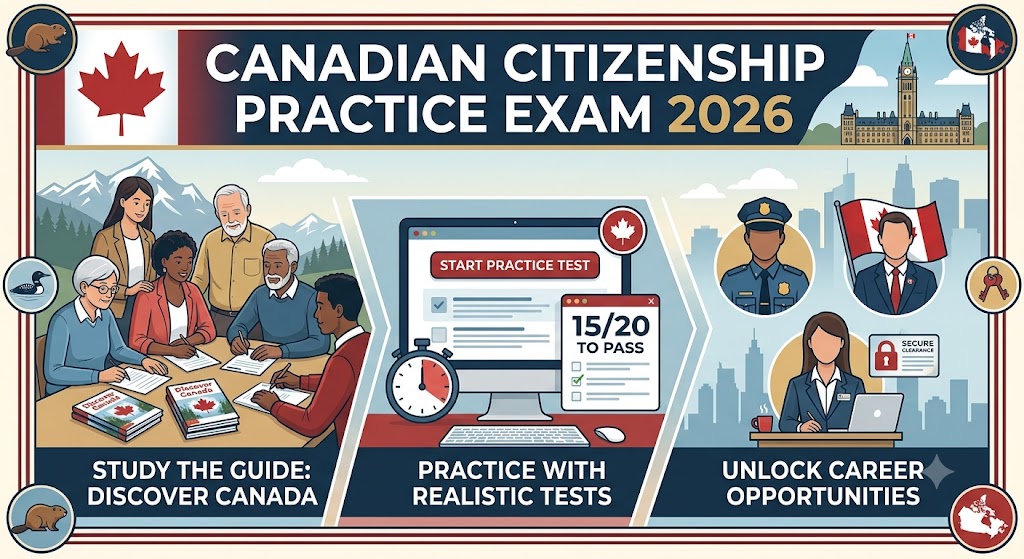
Additional Information
What the Course Entails and Exam Details
While not a formal "course" with lectures, preparation for the test entails comprehensive self-study of the only official resource: the guide "Discover Canada: The Rights and Responsibilities of Citizenship." The core topics covered in this guide, and subsequently on the exam, are:
The Rights and Responsibilities of Citizenship: Including the Canadian Charter of Rights and Freedoms, and the duties that come with being a citizen.
Canadian History: From pre-Confederation to modern times, including key figures and events.
How Canadians Govern Themselves: The structure of the federal government, Parliament, the monarchy, and the judiciary.
Federal Elections and the Voting Process: How to vote, the political parties, and the electoral system.
Canadian Symbols: Such as the flag, the coat of arms, the National Anthem, and the Maple Leaf.
Geography of Canada: An overview of Canada's regions, provinces, and territories.
The Economy of Canada: Understanding Canada's economic system and key industries.
Indigenous Peoples: The history, culture, and contributions of First Nations, Inuit, and Métis peoples.
What to Expect in the Final Exam
As of 2026, the standard format for the Canadian Citizenship Test is an online proctored exam. The test consists of 20 multiple-choice questions, which may include matching and true/false questions, all drawn directly from the "Discover Canada" guide. Applicants are typically given a time limit of 45 minutes to complete the test online. For in-person written tests, the time limit is 30 minutes.
To pass, you must correctly answer at least 15 out of the 20 questions, which is a 75% score. There are no essay or oral components, although an IRCC officer will verify your identity over a video call (for the online version) and may ask clarifying questions after the test is completed. Applicants have up to three attempts to pass. If you fail the first time, you can be rescheduled for a second test, often within a few weeks. A third failure would lead to an interview with a citizenship officer.
How to Study and Exam Centers
Effective preparation requires a combination of in-depth reading and focused practice. Your primary and most important strategy is to study the official guide, "Discover Canada," which is available for free as a PDF, eBook, or audio version on the official IRCC website. Read it multiple times, take notes, and focus on details like dates, names, and geographical facts.
Complement your reading by taking multiple Canadian Citizenship practice tests. These practice materials are widely available online and at local public libraries, often including questions specific to your region, as you may be asked about your local representatives.
Regarding where to take the test, the process begins after IRCC reviews your application. You do not schedule the test yourself; instead, IRCC will send you an official invitation via email or mail. This invitation will specify the date, time, and method. For the online test, which is the default in 2026, you will need a quiet room, a valid piece of ID, and a computer with a webcam and microphone. The test is administered using IRCC’s secure online platform. In special cases or if you require accommodations, you may be invited to take an in-person written test at a local IRCC office.
Job Opportunities from the Course
While Canadian citizenship is not a professional license that directly "unlocks" specific jobs, becoming a citizen facilitates access to various career paths and professional benefits. The following are specific benefits and opportunities that Canadian citizenship enables:
Public Service Jobs at All Levels: Access to federal, provincial, and municipal government jobs, which often require or give preference to Canadian citizens.
Jobs Requiring High-Level Security Clearance: Many roles in national defense, intelligence, and sensitive technology sectors are restricted to Canadian citizens.
Elected Political Office: Only Canadian citizens can run for office at the federal, provincial, or municipal levels.
Work and Travel Mobility: A Canadian passport simplifies international business travel, often without needing visas for many countries.
Professional Recognition: In certain regulated professions, citizenship may be a factor in licensing, though this varies by province.
Enhanced Employment Security: Certain job sectors, such as border services and specialized government contracting, have citizenship as a core requirement.
Frequently Asked Questions
Reviews
5.0
Based on 0 reviews
Leave a Review
No reviews yet. Be the first to review!