
Canada PPL Checkride Oral Practice Test
$69.00
- Buy to unlock unlimited access to all Quiz questions.
- After purchase you can print a PDF of the whole quiz at any point. The PDF will contain the questions and the correct answers.
About this Exam
The Canada Private Pilot License (PPL) Checkride Oral Exam is a significant and pivotal moment for aspiring aviators across the country. Designed for student pilots seeking to transition from recreational flying to becoming licensed pilots, this test assesses a candidate's practical aeronautical knowledge and operational understanding before they can carry passengers. It is a critical gateway to obtaining a Private Pilot License in Canada.
Ready to test your knowledge?
Buy Now to Access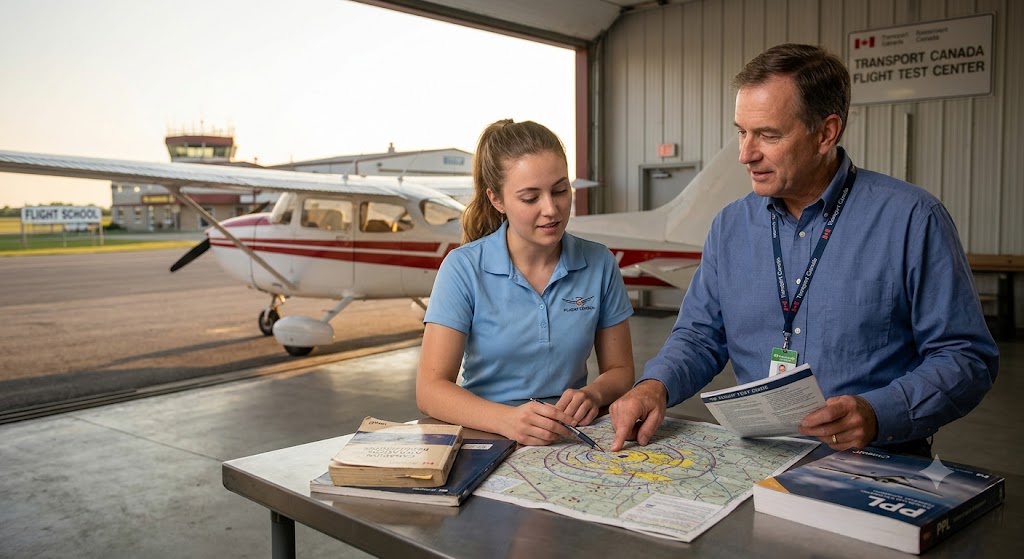
Additional Information
What the Course Entails and Exam Details
To successfully navigate the Canada PPL Checkride Oral Exam, candidates must demonstrate a thorough command of a wide range of aviation subjects. This section of the PPL journey is not just about memorization but about applying knowledge practically. The topics are extensive and critical for safe flight operations, including:
Canadian Aviation Regulations (CARs): A comprehensive understanding of the legal and regulatory framework governing flight operations in Canada. This includes pilot privileges, licensing requirements, and operational limitations.
Aeronautical Information Manual (AIM): Familiarity with standard operating procedures, airspace structures, communication protocols, and safety practices detailed in the Canadian AIM.
Meteorology: Interpreting and applying weather data, including forecasts (TAFs), actuals (METARs), upper-wind forecasts, and understanding meteorological phenomena like icing and turbulence.
Navigation: Demonstrating proficiency in using aeronautical charts (VNC/VTA), plotting courses, calculating visual navigation, and understanding radio navigation aids (VOR, NDB).
Flight Planning and Performance: Preparing and calculating weight and balance, determining aircraft performance figures (takeoff and landing distances, fuel requirements), and completing official flight plans.
Aircraft Systems and Operations: Specific knowledge regarding the candidate's testing aircraft, including engine systems, fuel systems, electrical systems, emergency procedures, and operational limitations.
Human Factors: Understanding the physiological and psychological factors affecting pilot performance, including fatigue, stress, and decision-making (ADM).
What to Expect in the Final Exam
The Canada PPL Checkride Oral Exam is conducted one-on-one by a Transport Canada approved Flight Test Examiner. This is a verbal examination that often takes place immediately preceding the flight test portion. It is typically held in a professional environment, such as a flight school classroom, briefing room, or examiner’s office.
Candidates should expect:
Format: A detailed, rigorous questioning session that can last from one to two hours, designed to evaluate practical knowledge through scenarios and operational problems.
Passing Score Requirements: There is no specific numerical score; rather, the examiner assesses whether the candidate’s knowledge is comprehensive enough for the safe conduct of a flight. A pass means the examiner believes you are ready to handle the practical flight test.
Time Limits: While there is no rigid time clock, the session is efficient and focused. Excessive hesitation or inability to answer standard operational questions can lead to failure.
Specific Rules: The examiner will pose scenarios (e.g., 'If we encounter this specific weather issue during the flight plan we have prepared, what would your decision-making process be?'). Candidates must demonstrate sound judgement and consistent adherence to regulations. All required personal flight documents, including logs and medical certification, must be present and valid.
How to Study and Exam Centers
Preparation for the oral checkride requires a structured, multi-faceted approach. You cannot "cram" for this exam; you must cultivate operational understanding.
Master the Manuals: Use a high-quality study guide and deeply read the official Transport Canada manuals (e.g., From the Ground Up, the CARs, and the Canadian AIM). These are the authoritative sources the examiner will be pulling from.
Scenario-Based Study: Practice analyzing specific flight scenarios. Grab a section chart, pick two airports, and determine all the requirements for that flight: airspace rules, fuel calculations, potential weather hazards, and emergency procedures relevant to that route.
Mock Oral Exams: This is the most effective technique. Ask your flight instructor or a seasoned pilot to conduct rigorous, verbal practice sessions, mirroring the examiner’s questioning style.
Prepare Your Documents: Ensure your pilot logbook, medical certificate, Student Pilot Permit, and ground school records are meticulously organized and accurate before the exam day.
Exam Centers:
The oral checkride is conducted at authorized flight training units (flight schools) or by approved independent Flight Test Examiners across Canada. Once you and your instructor feel you are ready, your flight school will assist in scheduling a checkride with an examiner. There is no central, online Pearson VUE registration for this specific practical verbal test; it is handled locally through the aviation training network.
Job Opportunities from the Course
A Private Pilot License is often the foundational step toward advanced ratings required for employment in aviation. While the PPL itself does not permit commercial flight for remuneration, it unlocks the essential path toward numerous rewarding careers.
Foundational Requirement for:
Commercial Pilot License (CPL)
Flight Instructor Rating
Instrument Rating (IFR)
Multi-Engine Rating
Frequently Asked Questions
Reviews
5.0
Based on 0 reviews
Leave a Review
No reviews yet. Be the first to review!